
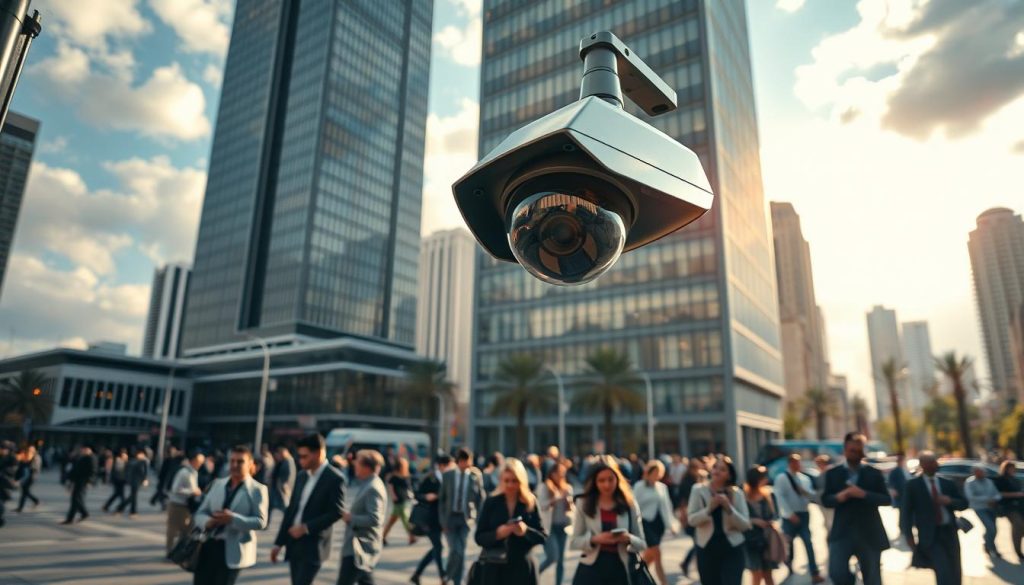
Modern cities face a critical balancing act. The drive for greater security often clashes with the right to personal privacy. This debate is central to the future of our public spaces.
Singapore provides a powerful case study. The nation is a global leader in adopting surveillance systems. A striking 93% of retailers use monitoring tools, showing a deep commitment to security infrastructure.
Globally, opinions are split. A recent study found 58% of people prioritize safety, while 42% favor privacy protections. This tension defines the discussion on monitoring in communal areas.
This article explores Singapore’s unique model. It examines how advanced technology integrates with strict laws. We will analyze the benefits for public safety and crime reduction. We will also address the legitimate concerns about freedom and ethics.
Key Takeaways
- Singapore is a world leader in the use of public surveillance technology.
- A global debate exists between prioritizing security (58%) and protecting privacy (42%).
- Surveillance systems can significantly enhance safety and deter crime in crowded areas.
- Implementing cameras raises important questions about personal privacy and ethical oversight.
- Singapore’s approach involves balancing advanced monitoring with a strong legal framework.
- The future of surveillance includes integration with AI and smart city initiatives.
- Public perception and cost are critical factors in the ongoing discussion.
Singapore: A Global Leader in Public Surveillance
With over half a million monitoring devices watching its streets, Singapore leads globally in urban surveillance density. This extensive network forms a comprehensive security blanket across the island nation.
The city-state’s approach to monitoring represents a strategic national priority. It combines advanced technology with systematic urban planning.
The Smart Nation Initiative and Camera Density
Singapore’s surveillance expansion gained momentum through the government’s Smart Nation initiative. This program integrates digital technology into every aspect of city management.
Since the early 2010s, installations have grown at an exponential rate. Major providers have deployed more than 500,000 surveillance cameras across the territory.
This creates one of the world’s most monitored urban landscapes. Camera density here surpasses that of other major global cities like London or New York.
The growth reflects a deliberate policy choice. Authorities view these systems as essential infrastructure for modern urban living.
Key Sectors with High Adoption Rates
Several industries drive Singapore’s high surveillance adoption. Each sector employs monitoring tools for specific security objectives.
Retail leads with remarkable penetration. Approximately 93% of local stores utilize surveillance systems.
These tools primarily prevent loss and protect assets. Major retail chains have adapted proven security models for high-traffic districts.
The education sector follows closely behind. Around 80% of public schools employ monitoring devices on campus.
These installations enhance student safety and campus security. They deter unauthorized access and monitor common areas.
Public housing estates feature extensive coverage too. HDB blocks and common spaces maintain visible security presence.
Transportation hubs represent critical monitoring zones. MRT stations and bus interchanges use cameras to manage crowd flow.
These systems also track traffic patterns and deter vandalism. They help authorities respond quickly to incidents.
Businesses across commercial districts rely on these technologies. They create safer environments for employees and customers alike.
Authorities strategically prioritize high-risk locations for camera placement. This approach balances maximum security visibility with privacy considerations.
The result is a layered security ecosystem. It spans residential, commercial, educational, and transportation spaces throughout Singapore.
Should CCTV Cameras Be Placed in Public Places? The Core Debate
At the heart of urban policy discussions lies a fundamental conflict between collective security and individual liberty. This tension defines the global conversation about monitoring in shared environments.
A 2023 international study quantified this divide precisely. It found that 58% of people worldwide prioritize safety benefits from observation systems. Meanwhile, 42% value privacy protections more highly.
Singapore mirrors this global split with local nuances. Research indicates 67% of citizens accept surveillance systems as necessary. However, a significant portion maintains reservations about their scope and potential overreach.
Security vs. Privacy: The 58% vs. 42% Divide
Proponents of extensive monitoring often employ a common argument. They suggest that only those with something to hide should fear being watched.
“If you’re not doing anything wrong, you have nothing to worry about.”
This perspective emphasizes the practical benefits for public safety. Visible monitoring can deter criminal activity in vulnerable locations.
Critics offer a powerful counter-argument. They assert that even law-abiding citizens deserve robust data protection.
Constant observation in communal areas can feel intrusive. It may create a chilling effect on normal social behavior and expression.
Singapore’s Unique Cultural and Security Posture
The nation’s security-conscious culture shapes its approach. Historical and geopolitical factors justify extensive monitoring for national stability.
This outlook sometimes clashes with growing privacy awareness. Controversies over HDB corridor installations highlight these tensions perfectly.
High-profile cases demonstrate the systems’ value. In 2018, school security monitoring helped prevent a potential tragedy.
Authorities identified suspicious behavior through footage. This allowed for timely intervention before incidents could occur.
A National University of Singapore study reveals complex public sentiment. It found 34% of citizens experience “surveillance fatigue.”
One in three residents worries about potential system misuse. These concerns highlight the need for transparent governance.
Ethical questions persist about the practical impact. Does the visible presence of monitoring create a genuine deterrent?
Some experts argue it may foster a false sense of safety. They question whether observation alone prevents determined criminal acts.
The debate continues as technology evolves. Singapore’s experience offers valuable insights for other urban centers.
Advantage: Enhanced Crime Deterrence and Prevention
The most compelling argument for urban monitoring technology lies in its proven ability to prevent crime before it happens. This proactive security benefit transforms how cities manage risk in crowded areas.
Visible observation systems create an environment where unlawful acts become less attractive. Potential offenders reconsider their actions when they know they are being watched.
Singapore’s experience offers concrete proof of this effect. Data from various sectors shows measurable improvements in public safety where monitoring is present.
Reducing Theft and Vandalism in Hotspots
Opportunistic offenses decrease significantly under the watchful eye of surveillance cameras. Retail districts and transportation hubs see the clearest benefits.
Orchard Road provides a powerful case study. This bustling shopping corridor recorded a 27% drop in theft incidents after 2019.
The installation of comprehensive monitoring across the district created a noticeable deterrent. Shoplifting and bag-snatching attempts fell as the systems became operational.
Public parks managed by NParks show similar trends. Reports of vandalism decreased by 34% over a five-year monitoring period.
Graffiti and property damage became less frequent in these green spaces. The continuous presence of observation technology changed visitor behavior.
High-risk zones like MRT stations benefit enormously. Fewer incidents occur during peak hours when platforms are most crowded.
Retailers express strong confidence in these solutions. A survey found 83% satisfaction rates among stores using monitoring as their primary anti-theft tool.
The continuous, non-confrontational nature of surveillance systems makes them effective. They work around the clock without direct human intervention.
The Psychological Impact of Visible Monitoring
The mere presence of a camera alters criminal psychology. It introduces what researchers call “perceived detection risk” into every decision.
Potential offenders conduct a mental cost-benefit analysis. The visible threat of being recorded tips the scales against unlawful action.
A University of Cambridge study confirmed this mechanism. Visible monitoring reduces theft attempts by changing risk perception.
The concept of a “deterrence gradient” explains the phenomenon. Criminal abandonment rates increase as individuals approach clearly visible camera units.
“The sight of a surveillance camera activates our social awareness. It reminds us that our actions have consequences and that we are accountable.”
Strategic placement maximizes this psychological effect. Positioning units in crime hotspots, combined with proper signage, creates optimal deterrence.
Shopping malls and public housing estates use this approach effectively. They place surveillance cameras at entry points and common areas.
The technology serves as both a practical tool and a symbolic reminder. It represents institutional oversight and community standards.
This dual function makes CCTV systems uniquely effective. They prevent crimes while reinforcing social norms about appropriate behavior.
The psychological barrier remains active even when monitoring isn’t continuous. The possibility of recording creates sufficient uncertainty for deterrence.
Advantage: A Critical Tool for Law Enforcement
When incidents occur, video evidence from public monitoring systems transforms from a passive observer into an active investigative partner. This footage provides law enforcement with an objective, timestamped record of events. It has become indispensable for modern police work.
Providing Crucial Evidence for Investigations
Surveillance footage serves as a powerful forensic tool. Investigators collect recordings from multiple cameras in the vicinity of an incident. They perform frame-by-frame analysis to extract details.
Technical teams enhance images to identify suspects or license plates. They track movements across different camera views. This creates a comprehensive timeline of events.
Global statistics highlight the utility of video evidence. Approximately 62.2% of robbery cases use surveillance evidence for convictions. Nearly 61% of violent crime convictions now involve video proof.
The chain-of-custody for footage is critically important. Proper documentation ensures admissibility in court. This maintains the integrity of the evidence throughout legal proceedings.
Video recordings help both convict the guilty and exonerate the innocent. They provide objective accounts that reduce reliance on witness memory. This increases accuracy within the justice system.
High-Profile Success Stories in Singapore
Singapore offers compelling case studies of surveillance effectiveness. The 2013 Little India riot demonstrates this powerfully. Recordings helped authorities identify 90% of offenders involved.
Investigators reconstructed events minute-by-minute using timestamped videos. This detailed evidence was crucial for subsequent legal actions. The case showed how multiple camera angles create a complete picture.
Singapore’s crime clearance rates improved significantly after network expansion. They increased by 18 percentage points following surveillance system enhancements. Police efficiency gained substantially from this technological support.
The Police Cameras on Vehicles (POLCAM) program represents advanced integration. These mobile units stream real-time data to command centers. They enable faster response to developing situations across various areas.
International cases further illustrate the value of surveillance evidence. The FBI pinpointed Boston Marathon bombing perpetrators in just three days. Department store recordings provided critical identification clues.
Local authorities leverage these tools to streamline investigations. They reduce court backlogs by providing clear, compelling evidence. This strengthens overall community safety and security.
Modern law enforcement relies on these digital eyes. They capture objective records that become indispensable in courtrooms. The evolution continues as technology advances investigative capabilities.
Advantage: Smarter Traffic and Urban Management
Singapore’s vision for a Smart Nation leverages its vast camera network not just for security, but as the eyes of an intelligent urban system. This data-driven approach transforms public spaces into responsive environments.
The benefits extend far beyond crime deterrence. They tackle daily frustrations like gridlock and slow emergency aid.
Integrating Cameras with ERP and Smart City Systems
The Land Transport Authority (LTA) creates a powerful synergy. It weaves surveillance feeds directly into the Electronic Road Pricing (ERP 2.0) system.
This integration allows for real-time congestion monitoring. Pricing adjusts dynamically based on live traffic conditions.
AI-powered analytics use this video data for smarter city planning. It optimizes traffic light cycles during peak hours to ease gridlock.
“The data from our sensor and camera network is the lifeblood of Smart Mobility 2030. It allows us to manage the city proactively, not reactively.”
This plan aims to cut average commute times by 15%. It uses surveillance-assisted routing to guide drivers efficiently.
Automated enforcement cameras at intersections have proven highly effective. They slashed red-light violations by 62% in targeted high-risk areas.
LTA’s predictive models are another key tool. They use historical and real-time footage to redirect vehicles during floods or major events.
Improving Emergency Response Times
Advanced sensors paired with surveillance cameras detect accidents instantly. This automation shaves critical minutes off emergency dispatch.
The result is a dramatic 40% reduction in response times for road incidents. Faster aid saves lives and reduces secondary collisions.
Authorities and police gain a comprehensive operational picture. They can deploy resources precisely where needed.
This technology also manages pedestrian flow and crowds at large events. It ensures public safety during national celebrations or sports gatherings.
The long-term benefits for urban development are significant. Footage informs infrastructure projects and public transport planning.
Environmental gains are a major plus. Smoother traffic flow means less idling and lower vehicle emissions.
This supports Singapore’s broader sustainability goals. It shows how integrated surveillance systems can create cleaner, more livable cities.
Disadvantage: Privacy Invasion and Ethical Concerns
A shadow side accompanies the growth of urban security infrastructure: the erosion of personal space and autonomy. Extensive monitoring networks collect unprecedented amounts of data about daily movements and behaviors. This creates significant ethical dilemmas that challenge traditional notions of freedom in public places.
The debate extends beyond simple security trade-offs. It questions how much observation a society should tolerate for collective safety. Citizens now navigate spaces where their actions are continuously recorded and potentially analyzed.
Public “Surveillance Fatigue” and Data Anxiety
Constant observation creates psychological weariness known as surveillance fatigue. A National University of Singapore study quantified this phenomenon precisely. It found that 34% of citizens experience this fatigue from feeling perpetually watched.
This mental strain affects how people behave in monitored areas. Some individuals report self-censoring normal activities. They modify behavior due to awareness of recording devices.
Data anxiety represents another growing concern. Citizens worry about how their footage gets stored and who can access it. Questions arise about potential uses beyond original security purposes.
Retailers faced six PDPA violation cases in 2022 alone. These incidents involved improper handling of customer video footage. They highlight systemic issues in data protection practices.
A Debate.org survey reveals the depth of public unease. Approximately 58% of Singaporeans express worry about excessive monitoring. This indicates significant reservations about current surveillance scope.
“Privacy isn’t about having something to hide. It’s about having control over your personal information and how it’s used in society.”
Transparency remains a critical issue in many installations. PDPC audits found only 41% of monitored locations display proper signage about recording. This lack of notification exacerbates public concerns.
Case Studies: HDB Disputes and Voyeurism Incidents
Real-world incidents crystallize abstract privacy debates into tangible cases. The 2021 Bishan HDB dispute highlighted tensions between security and domestic privacy. Residents objected strongly to corridor cameras facing directly into their living units.
This conflict illustrated how public surveillance can infringe on personal sanctuary. The home represents a fundamental zone of privacy. Monitoring that penetrates this boundary raises serious ethical questions.
The 2019 Toa Payoh incident demonstrated system vulnerability in dramatic fashion. A man manipulated public monitoring equipment for voyeuristic purposes. He hacked into surveillance cameras to violate women’s privacy intentionally.
This case showed how security systems can be perverted to achieve opposite goals. It revealed technical weaknesses in network protections. The incident intensified debates about oversight and access controls.
Commercial misuse of footage represents another ethical gray area. Retailers might track customer behavior without explicit consent. This data could potentially inform marketing strategies beyond loss prevention.
These examples underscore a fundamental tension. Even individuals with “nothing to hide” possess basic rights to privacy. They deserve protection from indiscriminate data collection in communal spaces.
The ethical landscape continues evolving alongside technological capabilities. Personal privacy requires robust safeguards as monitoring networks expand. Singapore’s experience offers valuable lessons for global discussions about digital rights.
Disadvantage: The Risk of Misuse and Function Creep
Technological systems implemented for public safety carry a dual nature. Their protective capabilities can be inverted into tools for harm through exploitation or error. This risk transforms security infrastructure into potential vulnerability points.
Tools designed for community protection sometimes enable opposite outcomes. The 2023 Jurong coffee shop lawsuit highlighted these concerns dramatically. A customer successfully sued over unauthorized video footage collection.
Potential for Unauthorized Access and Data Breaches
Research reveals alarming technical weaknesses in monitoring networks. Experts identified vulnerabilities in 28% of public cameras tested. These security gaps create openings for unauthorized access.
Hackers can exploit these flaws to view sensitive surveillance footage. The StarHub incident demonstrated this danger clearly. Criminals accessed live feeds from various monitored areas.
Unauthorized access risks exposing personal movements and activities. This breaches the privacy these systems should protect. It creates opportunities for blackmail or harassment.
Robust cybersecurity measures become essential safeguards. Encryption and strict access controls help mitigate these risks. Regular security audits identify vulnerabilities before exploitation occurs.
“When surveillance cameras become hackable, they don’t just stop providing security—they actively undermine it by giving criminals a window into our lives.”
From Security to Unintended Social Monitoring
Function creep represents a subtle but significant danger. Monitoring tools gradually expand beyond their original crime-fighting goals. They start tracking behaviors and associations unrelated to criminal activity.
The Jurong case established important legal boundaries. The court ruled the coffee shop owner violated PDPA guidelines. This judgment clarified rules for legitimate use of monitoring technology.
Information gathered by authorities could be misused hypothetically. It might enable targeting based on non-criminal criteria. Political affiliations or personal relationships could become factors.
Pervasive social monitoring chills free expression and assembly. People modify behavior when they feel constantly observed. This effect extends beyond formal legal restrictions.
Accountability remains challenging in complex surveillance networks. Multiple public and private entities operate various cctv systems. Coordinated oversight requires transparent governance frameworks.
Singapore continues refining its approach to these dilemmas. The balance between security utility and privacy protection evolves constantly. Each new case provides lessons for better system design.
Disadvantage: High Costs and Questions of Effectiveness
Beyond the ethical debates, the financial and practical realities of widespread surveillance present a formidable challenge for urban planners. A complete cost-benefit analysis must scrutinize both the substantial investment and the sometimes-mixed results in crime prevention.
The initial purchase of hardware is just the beginning. Long-term operational expenses often determine a program’s true sustainability.

Breaking Down the Financial Burden: CAPEX vs. OPEX
Capital Expenditure (CAPEX) covers the upfront costs. This includes the cameras, installation labor, and network setup.
Surprisingly, this initial outlay represents only about 40% of the total lifetime cost. The larger, ongoing financial drain is Operational Expenditure (OPEX).
OPEX includes continuous maintenance, data storage, and software upgrades. In Singapore, maintaining police cameras alone costs approximately S$2.8 million annually.
Integrating artificial intelligence features adds another 30% to technology budgets. This highlights how a system is never truly “finished.”
The American Civil Liberties Union (ACLU) estimates similar scales elsewhere. City-wide programs can require $3 million or more each year just for maintenance.
“Our analysis consistently shows diminishing returns on these massive security investments. Funds directed toward expansive surveillance networks might yield greater safety benefits if redirected to community policing and social programs.”
This concept of diminishing returns is critical. Expanding coverage beyond optimal levels yields smaller crime reduction for much higher cost.
Technological obsolescence and vendor lock-in further strain budgets. Businesses and municipalities face constant pressure to upgrade.
Limitations Against Premeditated and Violent Crimes
The effectiveness of these systems is not uniform across all offense types. Crime statistics reveal a telling pattern.
Monitored housing estates in Singapore report about 22% fewer thefts. This shows clear benefits against opportunistic property crimes.
However, rates of violent assaults in these same areas remain similar to unmonitored locations. This points to a significant limitation.
Determined, premeditated attackers operate outside normal criminal psychology. The 2015 Charlie Hebdo attack in Paris is a stark case study.
Extensive surveillance cameras covered the city. The attackers were still able to carry out their violent plan.
For suicidal operatives, the fear of being identified is irrelevant. Their willingness to die completely neutralizes the deterrent effect of any camera.
This shows that while CCTV systems are excellent tools for post-event investigations, their power to prevent certain cases is limited. They cannot stop every determined act of violence.
These financial and practical questions are crucial. They ensure public funds for security achieve the greatest possible impact.
Singapore’s Legal Framework: The PDPA and Beyond
Singapore’s extensive monitoring infrastructure operates within a carefully constructed legal framework designed to balance security needs with privacy rights. The Personal Data Protection Act (PDPA) serves as the cornerstone of this regulatory landscape.
This legislation establishes clear boundaries for how organizations handle surveillance footage. It applies to both public and private entities operating monitoring systems.
Amendments to the PDPA specifically address modern surveillance cameras. They provide detailed guidance for businesses and authorities deploying these technologies.
Rules for Data Collection, Storage, and Signage
The PDPA mandates strict rules for data collection practices. Organizations must identify a clear purpose before deploying monitoring devices.
Consent requirements vary by context. In many public spaces, implied consent applies when proper signage is displayed.
Data retention limits form a critical protection. Most recordings must be deleted within 30 days under normal circumstances.
Exceptions exist for ongoing investigations or legal cases. Law enforcement can request extended retention for specific evidence.
Storage security standards prevent unauthorized access. The 2019 PDPA guidelines specify encryption methods and access controls.
Organizations must implement audit trails for all surveillance footage viewing. This creates accountability within their system.
Mandatory signage plays a crucial transparency role. “Under Surveillance” notices must be visible in all monitored areas.
The Personal Data Protection Commission (PDPC) enforces these requirements. Their audits check for compliance with notification rules.
“The PDPA creates a balanced framework. It enables legitimate security use of monitoring technology while establishing clear privacy boundaries for citizens.”
Contrasting Regulations for Residential vs. Commercial Use
Regulatory approaches differ significantly between settings. Residential areas face stricter controls than commercial ones.
HDB flat owners must follow specific guidelines for camera installations. Placement cannot intrude on neighbors’ privacy.
Improper positioning risks substantial penalties. Homeowners face fines up to S$5,000 for violations affecting others’ rights.
Shared corridors require neighborly consensus for monitoring devices. This prevents conflicts in communal living spaces.
Commercial and public places operate under different standards. Businesses have more flexibility but must still comply with PDPA.
The Surveillance Cameras Act provides additional regulatory layers. It governs specific types of monitoring equipment and their use.
National security represents a special category. The Internal Security Act allows exceptions for critical security operations.
Non-compliance carries serious consequences. Organizations risk fines up to S$1 million for major PDPA violations.
The 2022 StarHub case demonstrated enforcement reality. The telecom provider faced penalties after a data breach exposed surveillance footage.
This incident highlighted the importance of robust cybersecurity. It showed how cctv systems require strong technical protections.
Singapore’s legal framework continues evolving with technology. It aims to maintain public safety while respecting individual privacy.
The balance enables effective crime prevention through cctv cameras. Simultaneously, it protects against potential misuse of recordings.
This structured approach informs how authorities and police conduct their investigations. It provides legal clarity for handling video evidence.
The framework addresses various crimes and cases systematically. It creates predictable processes for all parties involved.
Technological Evolution: AI and Facial Recognition
The next frontier in urban monitoring moves beyond simple recording to intelligent, predictive analysis. Artificial intelligence transforms passive observation networks into active security partners. This revolution changes how cities approach public surveillance and community protection.
Machine learning algorithms now scan live feeds from thousands of monitoring points. They identify patterns humans might miss. This enables real-time responses to developing situations.
Singapore leads this technological shift with ambitious integration projects. The nation’s surveillance systems are becoming smarter and more connected. Data from various sensors creates a comprehensive urban awareness picture.
POLCAM and the Future of Proactive Policing
The Police Cameras on Vehicles program represents a major advancement. POLCAM’s 2025 rollout will deploy facial recognition across major transport hubs. Early GovTech trials achieved 87% accuracy in identifying persons of interest.
This technology enables what experts call “proactive policing.” Instead of just reviewing recordings after incidents, authorities can respond immediately. Real-time alerts help prevent crime before it occurs.
Traffic Police now use Automatic Number Plate Recognition systems at 38 expressway points. These video analytics tools detect stolen vehicles instantly. Recovery rates improved by 19% in early 2023.
The National Environment Agency employs similar technology for different purposes. Littering detection algorithms analyze patterns across 12,000 monitoring devices. The system identifies enforcement hotspots with 92% precision.
“Proactive policing represents a paradigm shift. We’re moving from reactive investigation to preventive intervention using real-time intelligence from our sensor networks.”
During the COVID-19 pandemic, this integration demonstrated its utility. Contact tracing merged with transport CCTV networks. Authorities mapped infection chains 60% faster using this approach.
The concept extends beyond traditional law enforcement. Urban planners use these insights for smarter city design. Traffic flow optimization and crowd management benefit from AI analysis.
Balancing Advanced Capabilities with Public Trust
These powerful tools raise significant privacy questions. Facial recognition enables mass identification without individual consent. This creates ethical dilemmas about constant tracking in communal areas.
The COVID-19 integration showcased both utility and risk. While helpful for health safety, it demonstrated how surveillance networks can expand beyond original purposes. This “mission creep” concerns privacy advocates.
Cybersecurity becomes critically important with connected, AI-driven systems. Robust encryption and access controls prevent unauthorized use. The StarHub data breach highlighted these vulnerabilities clearly.
Public trust requires transparent governance frameworks. Citizens need clear policies about data usage. They deserve to know how their surveillance footage gets analyzed and stored.
Singapore’s approach involves careful calibration. The PDPA provides legal boundaries for these technologies. Ongoing public consultations help shape responsible deployment.
Recognition technology must balance security benefits with individual rights. Proper oversight ensures these tools serve community protection without overreach. Regular audits maintain accountability.
The evolution continues as capabilities advance. Future systems may predict incidents before they happen. This requires ongoing dialogue about ethical implementation.
Urban centers worldwide watch Singapore’s experience. The nation’s balanced approach offers valuable lessons. Technological innovation can enhance public safety while respecting personal privacy.
Public Perception and Building Community Trust
Public sentiment toward observation systems reveals complex patterns shaped by age, experience, and perceived transparency. The 2022 REACH survey provides crucial insight. It found 74% approval for monitoring when proper safeguards exist.
This majority support indicates a conditional acceptance. Citizens weigh security benefits against privacy concerns. Their trust depends on visible protections for personal data.
Building sustainable community confidence requires ongoing effort. It involves more than just installing technical equipment. Authorities must demonstrate respect for individual rights through consistent actions.
Generational Divides in Acceptance of Surveillance
A clear age gap shapes attitudes toward monitoring technology. Older citizens show stronger support for extensive systems. The REACH data reveals 68% of seniors approve.
Younger generations express more reservation about constant observation. Only 49% of those under 30 agree with widespread deployment. This 19-point difference highlights significant demographic variation.
Several factors explain this generational divide. Older residents often prioritize tangible safety outcomes from their life experience. They remember times with higher crime rates in certain areas.
Younger citizens grew up in the digital age. They are more aware of data collection practices and potential misuse. Many value personal privacy as a fundamental right in public spaces.
Education programs aim to bridge this understanding gap. Schools and community centers host interactive demonstrations. These sessions show how monitoring enhances public safety while addressing concerns.
GRC town hall meetings consistently reveal an important pattern. Community trust grows when residents participate in placement decisions. This collaborative approach transforms passive subjects into active partners.
The Role of Transparency and Public Engagement
Transparency serves as the foundation for lasting public confidence. Mandatory signage represents the most basic form of communication. Clear notices inform people when they enter monitored public places.
Ang Mo Kio’s pilot program demonstrated the power of engagement. The neighborhood reduced objections by 40% after incorporating resident feedback. This success shows the value of collaborative planning.
Major mall operators now publish quarterly transparency reports. These documents detail cctv cameras usage statistics and data handling practices. Businesses build trust through open disclosure of their monitoring activities.
“When communities help design their own security infrastructure, they become stakeholders in its success. This shared ownership transforms surveillance from an imposition into a collective asset.”
Corporate policies now emphasize clear usage guidelines. They specify exactly how footage gets collected, stored, and accessed. This clarity addresses common privacy worries among shoppers and visitors.
Ongoing dialogue between authorities and citizens remains essential. Regular forums allow for questions about specific cases or policies. This two-way communication prevents misunderstandings from festering.
Successful models share several key characteristics. They involve residents early in the planning process. They provide accessible information about system capabilities and limitations.
Education extends beyond demonstration sessions. Community workshops explain legal frameworks like the PDPA. They help citizens understand their protections under existing regulations.
Public perception is not static or fixed. It evolves with new experiences and information. Consistent engagement maintains alignment between community values and security practices.
The future of public surveillance depends on this delicate balance. Systems must deliver tangible security outcomes while respecting personal boundaries. Trust emerges from demonstrated commitment to both objectives.
Singapore’s approach offers valuable lessons for urban centers worldwide. Building community confidence requires patience and genuine partnership. The most effective monitoring networks enjoy broad public support through transparent governance.
Weighing the Future of Surveillance in Public Spaces
The debate over communal area monitoring finds no simple resolution. It represents an ongoing societal negotiation.
Singapore’s experience reveals clear security benefits alongside serious privacy costs. The nation’s 2025 roadmap forecasts a 40% rise in observation network density.
Focus areas include transport hubs and smart housing estates. Emerging hybrid AI-human systems aim to improve efficiency while maintaining oversight.
Privacy-by-design principles build data protection into new technology from the start. A proposed biometrics regulation bill seeks to standardize facial recognition use.
The core challenge remains finding sustainable balance. This requires continuous recalibration through transparent regulation.
Meaningful public consultation is essential. The future of monitoring in shared spaces depends on responsible innovation.
Genuine citizen engagement and fair law enforcement matter greatly. Observation systems are powerful tools that must be wielded with wisdom.
Constant regard for the society they protect is paramount. Singapore’s journey offers valuable lessons for urban centers worldwide.