
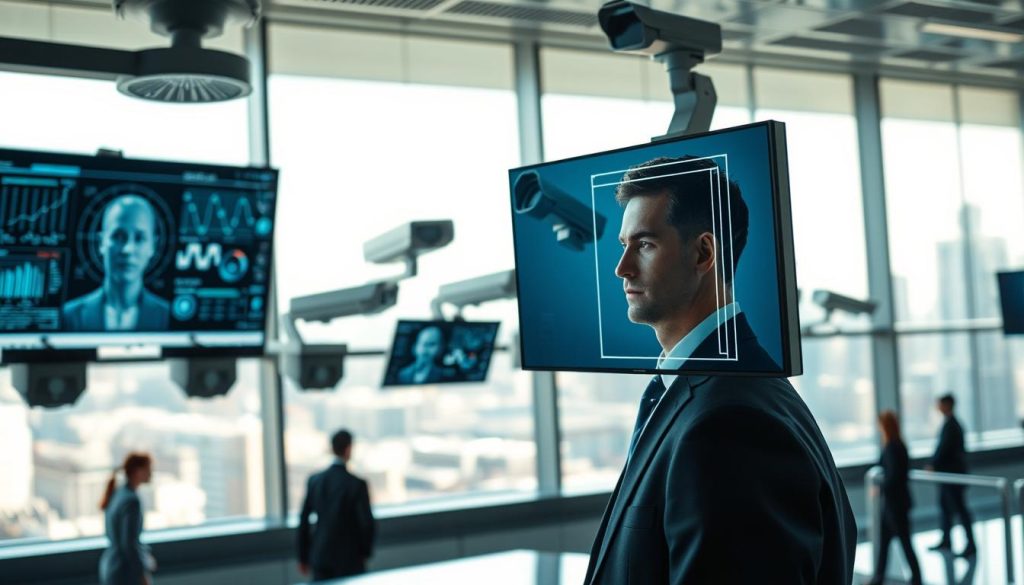
Modern security systems do much more than simply record events. Today’s surveillance technology can actively analyze footage to recognize individuals. This capability transforms passive monitoring into an intelligent safety tool.

The key to this advancement is facial recognition technology. When integrated with camera networks, it compares live video against databases of facial features. This enables real-time identification of people entering secured areas.
Surveillance has evolved from basic recording to sophisticated analysis. In places like Singapore, where safety is paramount, these solutions offer enhanced protection. Businesses and public spaces now rely on intelligent systems for accurate monitoring.
This article explores how facial recognition works with security cameras. We’ll examine its practical applications and important considerations. Understanding both the power and limits of this technology is crucial for effective implementation.
Key Takeaways
- Modern surveillance systems can analyze footage, not just record it.
- Facial recognition technology enables cameras to identify individuals.
- Security has evolved from passive recording to active analysis.
- These solutions provide enhanced safety for businesses and public areas.
- Understanding how the technology works is key to proper implementation.
- Both capabilities and limitations must be considered for effective use.
- Real-time identification transforms basic monitoring into intelligent security.
Understanding the Core Question: Can CCTV Identify a Person?
Traditional security footage captures events, but determining who is involved requires additional analysis. The answer lies in the specific technology integrated with the surveillance equipment.
Standard recording devices document activity for later review. True identification demands specialized tools that analyze visual data.
From Simple Recording to Intelligent Identification
Conventional surveillance acts as a passive witness to events. These setups record continuous video streams for forensic examination after incidents occur.
This approach has clear limitations for proactive security. Staff must manually review hours of footage to find relevant moments.
Intelligent identification represents a fundamental shift. Advanced systems actively analyze live feeds or archived video.
They can pinpoint specific individuals in real-time or during investigations. This transforms security from reactive documentation to active monitoring.
The Crucial Role of Facial Recognition Technology
Facial recognition serves as the cornerstone for modern identification. This biometric technology analyzes the unique characteristics of human faces.
It measures key facial features like the distance between eyes or nose shape. Sophisticated algorithms convert these measurements into mathematical data.
This technology upgrades standard video cameras into powerful security tools. Systems can now verify identities, track individuals, and trigger alerts.
The process creates a digital template often called a faceprint. This template allows for quick comparison against watchlists or authorized personnel databases.
Not all surveillance systems possess this capability. Implementing facial recognition requires specific hardware and specialized software integration.
Modern solutions combine high-resolution imaging with machine learning. This enables reliable performance across various lighting conditions and angles.
Facial Recognition vs. Face Detection: Knowing the Difference
Two related but fundamentally different capabilities exist within modern video surveillance: detection versus recognition. Understanding this distinction clarifies what surveillance technology can truly accomplish.
Many people use these terms interchangeably. This creates confusion about system capabilities and expectations.
What a Standard Security Camera Captures
Most modern imaging devices include basic face detection. Your smartphone likely has this function when you take photos.
This technology simply identifies the presence of a human face within the frame. It distinguishes facial patterns from other objects like cars or trees.
The system draws a box around the detected face. This represents the first step in visual analysis.
Face detection answers one basic question: “Is there a human face present?” It provides no information about whose face it might be. The function works without any database of known individuals.
The Added Intelligence of an AI Face Recognition Camera
Facial recognition adds a critical layer of intelligence. After detection, specialized software analyzes the specific geometry of that face.
It maps unique facial features like eye distance, nose shape, and jawline contours. Sophisticated algorithms convert these measurements into a mathematical template.
This digital faceprint enables comparison against databases. Systems can match the captured image with records of authorized personnel or watchlists.
Think of it like a bouncer at an exclusive venue. Face detection merely notices someone approaching the door. Facial recognition technology checks their identification against the guest list.
This recognition capability enables powerful security applications:
- Automated access control for secure areas
- Real-time alerts when specific individuals appear
- Forensic searching through archived video footage
- Enhanced safety monitoring in public spaces
Implementing this technology requires specific hardware and advanced software. Not all surveillance systems include true recognition capabilities.
The difference transforms passive recording into proactive security. Businesses gain actionable insights rather than just video evidence.
How Facial Recognition Technology Works: A Four-Phase Process
Behind the scenes of a modern security camera’s identification capability lies a sophisticated four-phase sequence. This process transforms raw video into verifiable data. It is the engine that powers intelligent surveillance solutions.
Understanding these steps demystifies the technology. It shows how geometry and mathematics enable reliable recognition.
Phase 1: Face Detection and Capture
The journey begins when a camera captures a live feed. Specialized software scans this video stream in real-time. Its first job is to find human faces within the frame.
Sophisticated algorithms search for patterns that match a face. They look for shapes like ovals, skin tone textures, and the basic arrangement of eyes, nose, and mouth. When a potential match is found, the system isolates it from the background clutter.
This step answers a simple question: “Is a face present?” No identity is known at this point. It is merely the initial location of a subject for further analysis.
Phase 2: Face Analysis and Feature Mapping
Once a face is detected, the system performs a detailed scan. It maps the unique geometry of the facial landscape. This is where facial recognition truly begins.
The technology measures key nodal points or features. It calculates the distance between the eyes and the depth of eye sockets. The shape of cheekbones and the contour of the lips, chin, and jawline are all quantified.
Advanced systems use machine learning to understand these spatial relationships. This creates a unique “facial signature” based on precise measurements. It is a geometric blueprint, not just a stored photograph.
Phase 3: Converting the Image into a Digital Faceprint
The detailed measurements from Phase 2 are not stored as a picture. Instead, they are converted into a numerical code. This code is a mathematical representation called a faceprint.
Think of it as a complex, digital fingerprint for a face. The original image is discarded after this conversion. Only the encrypted numerical data is retained.
This conversion from visual to data is crucial. It enhances privacy by not storing actual images. It also allows for efficient storage and rapid comparison.
The faceprint is compact and secure. This process ensures the system handles abstract information, not identifiable photos.
Phase 4: Matching and Identification Against a Database
The final phase is where identification occurs. The newly generated digital faceprint is compared against a stored database of known faceprints.
This database could contain authorized employees, persons of interest, or watchlists. The comparison happens in milliseconds. The system calculates a confidence score based on how closely the faceprints align.
This capability enables two main functions:
- Verification (1:1 Match): Confirming an individual is who they claim to be, like for secure access.
- Identification (1:N Search): Finding a specific person within a large group of people.
The match threshold is adjustable to balance security needs with accuracy. A high threshold minimizes false positives. This step transforms data into actionable intelligence for businesses and safety operations.
Mastering this four-phase process is key to deploying effective facial recognition technology. It highlights the advanced capabilities within modern surveillance solutions.
The Surveillance Landscape in Singapore: A Case Study
Singapore stands as a global benchmark for integrated surveillance infrastructure and public safety strategy. The city-state’s approach demonstrates how advanced monitoring networks operate at national scale. This real-world example shows the practical application of technologies discussed earlier.
Scale and Density: Cameras in Public and Private Spaces
Singapore’s monitoring network achieves remarkable penetration across urban environments. Statistics reveal approximately one camera for every thirteen residents. Current estimates exceed ninety thousand operational units throughout the island.
Public areas feature extensive coverage for community protection. Housing Development Board (HDB) estates, Mass Rapid Transit (MRT) stations, and major streets all host visible security installations. These placements create overlapping zones of observation.
Private commercial spaces contribute significantly to the overall network. Shopping malls, office buildings, and industrial parks deploy their own security systems. This creates a layered approach to urban monitoring.
The public safety rationale behind this density is clear and compelling. Visible cameras serve as powerful deterrents against criminal activity. They also enable rapid incident response by authorities.
National Projects: From PolCam 2.0 to the 2030 Vision
Government-led initiatives drive Singapore’s surveillance strategy forward. The PolCam 2.0 program represents a major coordinated effort. This initiative involves approximately ten thousand five hundred cameras in public locations.
PolCam 2.0 serves specific security objectives for the community. Its primary goals include deterring crime and assisting police investigations. The network has demonstrated tangible success in both areas.
Reported cases show how this technology aids law enforcement. Suspects have been apprehended more quickly using footage from these cameras. The system provides valuable video evidence for criminal proceedings.
Singapore’s vision extends well beyond current implementations. National plans call for expanding the camera network substantially. The target exceeds two hundred thousand units by the year 2030.
This expansion aligns with broader “Smart Nation” objectives. It represents part of a comprehensive digital transformation strategy. The approach balances technological advancement with practical safety outcomes.
Such widespread implementation naturally raises important questions. How does Singapore regulate these extensive monitoring systems? The next section examines the legal framework governing responsible use.
Government Regulations: The PDPA and Responsible Use
The power to recognize individuals through video carries significant responsibility, governed by strict data protection laws. In Singapore, this responsibility is formalized under the Personal Data Protection Act (PDPA).
This framework ensures that technological advancement in security does not come at the expense of individual privacy. For any organization, understanding and complying with these rules is essential for lawful operation.
An Overview of Singapore’s Personal Data Protection Act (PDPA)
The PDPA is the cornerstone of data privacy law. It regulates how organizations collect, use, and disclose personal information.
Critically, the Act defines biometric data very broadly. The digital templates created by facial recognition technology are considered personal data.
This classification triggers specific legal obligations. Organizations must handle this sensitive information with heightened care.
Key obligations under the PDPA include:
- Purpose Limitation: Data can only be collected for a clear, stated purpose. For surveillance, this is typically security and safety.
- Notification: Individuals must be informed that collection is occurring. This is usually done via clear signage in monitored areas.
- Protection: Organizations must implement reasonable security safeguards. This secures data against unauthorized access or disclosure.
The law seeks a careful balance. It enables legitimate business and security needs while protecting the rights of individuals.
Guidelines for Using Biometric Data from CCTV Footage
Beyond the PDPA’s general rules, specific best practices guide the use of biometric data. These guidelines help businesses deploy systems responsibly.
First, camera placement must respect privacy. Installation in private areas like toilets or changing rooms is strictly prohibited.
The purpose of collection must be legitimate and declared. Video footage and derived facial features cannot be used for unauthorized monitoring of people.
Effective deployment involves several practical steps:
- Post clear, visible notices at all entrances to surveilled zones.
- Define and document a specific security purpose for the system.
- Implement strict access controls for stored data.
- Establish a data retention policy. Delete footage and templates when no longer needed for the stated purpose.
- Choose software and solutions that prioritize accuracy and have configurable privacy settings.
Responsible use means the technology serves as a tool for public safety, not unchecked observation. Compliance builds public trust and ensures police can use evidence effectively.
Following these guidelines turns legal requirements into operational excellence. It ensures surveillance solutions are both powerful and principled.
Enhancing CCTV with AI and Security Camera Analytics
Video analytics software unlocks hidden patterns within surveillance footage, converting endless streams of video into structured security data. This represents the next frontier beyond basic facial recognition. Intelligent analysis transforms passive recording into an active security partner.
Modern solutions leverage machine learning to understand context and behavior. These systems don’t just capture images—they interpret scenes in real time. This creates a comprehensive security ecosystem that protects people and property more effectively.
Integrating AI for Real-Time Monitoring and Alerts
Artificial intelligence automates the tedious task of watching live feeds. Human operators cannot maintain constant focus across multiple cameras. AI capabilities solve this by continuously scanning every frame for predefined events.
The software can be configured to trigger instant notifications. When an event occurs, alerts go directly to security phones or control centers. This enables immediate response instead of delayed discovery during video review.
Common triggers include unauthorized entry into restricted areas or detected loitering. Sound detection can identify breaking glass or aggressive shouting. Each alert contains specific information about what triggered it and where.
This automation delivers dramatic operational efficiencies. Organizations report reducing manual monitoring costs by 80-90%. Security teams shift from passive observers to proactive responders.
How Analytics Turn Video into Actionable Security Intelligence
Advanced analytics convert raw video into categorized, searchable data. This transforms surveillance from evidence collection to intelligence gathering. The technology identifies patterns invisible to human observers.
Specific functions provide targeted security benefits:
- People Counting & Crowd Density: Tracks foot traffic in real-time. Retail stores optimize staffing based on customer flow. Venues prevent dangerous overcrowding for safety.
- Intrusion Detection: Creates virtual tripwires or zones. The system alerts when someone crosses a boundary or enters a forbidden area.
- Unattended Object Detection: Flags bags or packages left behind. This is crucial for transportation hubs and public spaces.
- License Plate Recognition (LPR): Automatically reads vehicle plates. It controls parking access and monitors vehicle movements.
- Behavioral Analysis: Identifies unusual actions like falling, fighting, or rapid movement.
These tools work alongside facial recognition technology to provide complete situational awareness. While recognition verifies individuals, analytics understand what those people are doing.
Consider a retail application. Analytics measure customer dwell times at displays and track popular store paths. This business intelligence informs layout changes and promotional strategies.
In a secured facility, the same system might trigger an alert if someone approaches a sensitive area after hours. It could also count employees during an evacuation drill.
The integration of analytics creates security networks that think for themselves. They filter out normal activity to highlight genuine threats, making security teams more effective with fewer resources.
Singapore’s public safety networks likely employ similar analytic capabilities. The city-state’s extensive camera infrastructure generates vast amounts of video data. Intelligent analysis helps authorities monitor crowd flows during festivals and detect anomalies in public spaces.
This approach maximizes the value of existing surveillance investments. Businesses gain operational insights alongside enhanced protection. The combination of recognition technology and behavioral analytics represents the future of intelligent security.
Key Features to Look for in a Facial Recognition Security System
Selecting the right facial recognition security system requires careful evaluation of several critical components. The hardware and software must work together seamlessly to deliver reliable performance. This guide highlights the essential features that separate effective solutions from basic installations.
Investing in this technology demands attention to both technical specifications and practical considerations. Businesses need systems that provide accurate identification while respecting privacy concerns. The right combination of features ensures long-term value and operational efficiency.
High-Resolution Imaging and Low-Light Performance
Image quality forms the foundation of any reliable facial recognition system. High-resolution sensors capture the fine details necessary for accurate analysis. Modern security cameras should offer at least 4-megapixel resolution for clear facial images.
Sensor technology plays a crucial role in capturing usable data. Larger sensors perform better in challenging lighting conditions. They gather more light information for processing by recognition algorithms.
Low-light capability is essential for 24/7 security operations. Many incidents occur during nighttime hours when visibility is limited. Systems must maintain performance regardless of lighting conditions.
Infrared illuminators provide invisible light for nighttime monitoring. Specialized low-light sensors can capture usable images in near-darkness. These features ensure continuous protection around the clock.
Consider environments where the system will operate. Outdoor installations face weather challenges and varying light levels. Indoor spaces may have backlighting from windows or uneven artificial lighting.
Night vision technology has advanced significantly in recent years. Modern systems can produce clear, detailed images even in complete darkness. This capability is non-negotiable for comprehensive security coverage.
Advanced Software, AI Capabilities, and System Integration
The software platform represents the intelligence behind facial recognition technology. Robust algorithms analyze captured images to extract unique facial features. These mathematical patterns enable reliable identification of individuals.
Machine learning enhances system performance over time. Algorithms improve their accuracy as they process more data. This adaptive capability is crucial for maintaining effectiveness in dynamic environments.
Integration capabilities determine how well the system fits existing infrastructure. Modern solutions should connect seamlessly with access control systems. They must also interface with video management software and alarm panels.
Look for software that offers regular updates and improvements. Security threats evolve constantly, requiring adaptive defenses. Vendor support ensures the system remains effective against emerging challenges.
Advanced analytics extend beyond basic facial recognition. Behavioral analysis can detect unusual patterns or potential threats. People counting and crowd monitoring provide valuable operational insights.
Real-time processing enables immediate response to security events. Systems should generate instant alerts when recognized individuals appear. This proactive approach transforms security from reactive to preventive.
The most effective facial recognition solutions combine cutting-edge hardware with intelligent software. This partnership creates systems that learn and adapt to their environment.
Scalability, Privacy Safeguards, and Remote Access
Scalability ensures your investment grows with your needs. The system should accommodate expanding databases of recognized faces. Camera networks must be easily expandable without major infrastructure changes.
Database management capabilities are crucial for larger deployments. Systems should handle thousands of facial templates efficiently. Look for solutions that offer cloud-based or distributed storage options.
Privacy protection features demonstrate responsible technology use. Data encryption should protect information both in transit and at rest. On-device processing reduces the need to transmit sensitive data over networks.
User permission controls limit access to sensitive information. Different staff members should have appropriate access levels. Audit trails track who accessed the system and when.
Remote access capabilities are essential for modern security management. Authorized personnel should view live feeds from smartphones or tablets. Mobile alerts keep security teams informed wherever they are located.
Comprehensive reporting tools provide insights into system performance. Analytics dashboards display recognition accuracy rates and event patterns. This information helps optimize security operations over time.
Consider future expansion when selecting a facial recognition solution. The system should support additional cameras and increased database sizes. Flexible licensing models accommodate growth without excessive costs.
Privacy-by-design principles should guide system selection. Look for features that minimize data collection while maximizing security value. Responsible deployment builds public trust and ensures regulatory compliance.
Benefits and Challenges of Deploying Facial Recognition Cameras
Organizations weighing facial recognition deployment must carefully balance operational gains against practical hurdles. A thorough evaluation considers both transformative capabilities and implementation realities. This analysis helps decision-makers understand the complete picture before investment.
The technology delivers powerful advantages for modern security operations. These benefits extend beyond basic monitoring to create intelligent protection networks. However, successful implementation requires addressing several important considerations.

Operational Benefits: Enhanced Security and Efficiency
Facial recognition systems transform passive monitoring into active protection. The presence of these cameras alone serves as a powerful crime deterrent. Potential offenders recognize that their identity could be captured and matched instantly.
Real-time identification enables faster incident response. Security teams receive immediate alerts when specific individuals appear in monitored areas. This allows for proactive intervention before situations escalate.
Automation represents another significant advantage. These solutions handle access control without manual verification. Employees gain entry through facial verification instead of cards or codes.
Timekeeping and attendance tracking become seamless processes. The technology eliminates buddy punching and manual record-keeping errors. Businesses report improved operational efficiency with these automated functions.
Investigative capabilities receive a major boost. Searching through archived video footage becomes dramatically faster. Investigators can locate a person of interest across multiple cameras and timeframes.
Forensic analysis benefits from precise identification capabilities. Law enforcement can establish presence and movement patterns with greater confidence. This strengthens evidence collection for legal proceedings.
Business intelligence emerges as a valuable secondary benefit. Retail operations analyze customer traffic patterns and dwell times. This information helps optimize store layouts and promotional strategies.
Insurance providers often offer premium discounts for advanced security installations. The reduced risk profile makes businesses more attractive to insurers. This creates tangible financial benefits alongside improved protection.
The most effective deployments leverage facial recognition as part of a comprehensive security ecosystem. Integration with other systems multiplies the operational benefits.
Addressing Challenges: Cost, Accuracy, and Public Perception
Implementation costs represent the first major consideration. High-quality facial recognition requires substantial investment in hardware and software. Organizations must budget for cameras, servers, and specialized processing units.
Ongoing expenses include software licensing and maintenance agreements. Network infrastructure may need upgrades to handle increased data loads. Staff training ensures proper system operation and management.
Accuracy concerns demand careful attention. Poor lighting conditions can degrade image quality and matching reliability. Camera angles and obstructions like masks or sunglasses present additional challenges.
Algorithmic bias remains an important technical issue. Some systems perform differently across demographic groups. Regular software updates and diverse training data help address these concerns.
Proper installation minimizes accuracy problems. Strategic camera placement considers lighting and approach angles. Regular testing verifies system performance under various conditions.
Privacy considerations are paramount for responsible deployment. Organizations must comply with data protection regulations like Singapore’s PDPA. Clear policies govern data collection, storage, and usage.
Transparency builds public trust in surveillance technology. Visible signage informs people about camera presence and purpose. Public education explains how the technology enhances community safety.
Public perception varies across different communities. Some individuals express “Big Brother” concerns about constant monitoring. Demonstrating tangible safety benefits helps address these apprehensions.
Legal compliance forms the foundation of responsible implementation. Organizations must understand and follow all applicable regulations. Regular audits ensure ongoing adherence to legal requirements.
Successful deployments balance technological capability with social responsibility. They deliver security benefits while respecting individual rights. This balanced approach ensures long-term acceptance and effectiveness.
Organizations should conduct thorough risk assessments before implementation. Pilot programs allow testing in controlled environments. Gradual rollout enables adjustment based on real-world experience.
The challenges are manageable with proper planning and execution. Each consideration represents an opportunity for thoughtful solution design. Addressing these factors creates robust, sustainable security installations.
Best Practices for Installation and Responsible Deployment
The transition from purchasing security equipment to achieving reliable protection hinges on proper deployment practices. Technical excellence requires disciplined implementation across physical, digital, and ethical dimensions. Following established guidelines transforms sophisticated hardware into trustworthy safety solutions.
Successful implementation addresses three critical domains: strategic hardware placement, robust infrastructure support, and ethical operational governance. Each element contributes to system reliability and public acceptance. This checklist provides actionable steps for organizations deploying monitoring technology.
Strategic Camera Placement and Lighting Considerations
Physical positioning directly impacts the quality of captured footage. Mount devices at an optimal height between seven and nine feet from the ground. This elevation provides clear facial views while minimizing vandalism risks.
Focus installation on natural pathways and controlled entry points. Choke points like doorways, hallways, and reception areas offer maximum coverage efficiency. Avoid extreme camera angles that distort facial features or create blind spots.
Lighting quality determines recognition accuracy more than camera resolution. Ensure consistent, adequate illumination across monitored zones. Test installations during different times to identify shadow patterns or glare issues.
Backlighting from windows or bright signs can completely wash out facial details. Position devices to avoid direct light sources behind subjects. Consider supplemental infrared illuminators for consistent night vision performance in outdoor areas.
Regularly clean lenses and check for obstructions like growing foliage. Environmental factors gradually degrade image quality without proper maintenance. A simple monthly inspection preserves long-term system effectiveness.
Ensuring Network Reliability and Ongoing System Maintenance
The infrastructure backbone supports all advanced security capabilities. Implement Power over Ethernet (PoE) for simplified installation and centralized power management. This approach reduces cabling complexity and improves reliability.
Network bandwidth must handle multiple high-resolution video streams simultaneously. Calculate requirements based on camera count, resolution settings, and frame rates. Over-provision capacity to accommodate future expansion without performance degradation.
Cybersecurity measures protect sensitive surveillance data from unauthorized access. Isolate security networks from general business internet connections. Implement strong encryption for all data transmission and storage.
Establish a routine maintenance schedule with specific checkpoints:
- Weekly verification of recording functionality and storage capacity
- Monthly lens cleaning and physical inspection of all devices
- Quarterly software updates and firmware patches
- Annual comprehensive system health audit and performance review
Document all maintenance activities for compliance verification. Keep spare components available for rapid replacement during failures. Proactive care prevents minor issues from escalating into security gaps.
Prioritizing Transparency and Legal Compliance
Ethical deployment builds public trust and ensures regulatory adherence. Post clear, visible signage at all entrances to monitored areas. Notifications should state the purpose of data collection in simple language.
Develop a publicly available privacy policy detailing specific practices. This document should explain what data gets collected, how long it’s retained, and who can access it. Include contact information for privacy inquiries or concerns.
Transparency transforms surveillance from a source of anxiety into a recognized safety feature. When people understand the purpose and limits of monitoring, they’re more likely to support its implementation.
Comprehensive staff training ensures proper system operation. Personnel should understand data handling protocols and legal boundaries. Regular refresher courses keep teams updated on evolving regulations and best practices.
Conduct periodic audits to verify ongoing compliance with Singapore’s PDPA. Review data retention periods match stated policies. Ensure security safeguards remain effective against evolving threats.
Document all data access requests and system modifications. Maintain records demonstrating responsible governance of surveillance technology. This documentation proves valuable during regulatory reviews or public inquiries.
Responsible deployment balances powerful protection with respect for individual rights. Following these practices creates sustainable security solutions that serve both businesses and communities effectively.
The Impact on Law Enforcement and Public Safety
The deployment of advanced monitoring tools fundamentally reshapes how authorities protect communities and solve crimes. These intelligent networks provide unprecedented capabilities for maintaining urban security. They transform traditional policing methods into data-driven protection strategies.
Success Stories: Aiding Investigations and Crime Prevention
Singapore’s experience demonstrates the practical value of modern surveillance. The PolCam network has delivered measurable results for public safety. Authorities report faster suspect apprehension using facial recognition technology.
Real-world cases show how these systems aid investigations. Police can track movements across different camera feeds efficiently. This creates comprehensive timelines of suspect activities before and after incidents.
The technology acts as a powerful force multiplier for law enforcement. It allows smaller teams to monitor larger areas effectively. Automated alerts notify officers about persons of interest in real-time.
Crime prevention benefits from visible surveillance infrastructure. Potential offenders recognize the increased risk of identification. This deterrent effect contributes to safer public spaces for everyone.
Searching through archived video becomes dramatically faster. Investigators locate relevant footage using facial features instead of manual review. This efficiency saves valuable time during critical investigations.
Surveys indicate strong public support for police use of this technology in Singapore. Most residents recognize its contribution to community safety when deployed responsibly.
Navigating the Ethical Implications and Building Public Trust
Powerful security capabilities require equally strong ethical frameworks. The potential for mass surveillance raises legitimate privacy concerns. Function creep represents another significant challenge for regulators.
Clear operational guidelines establish boundaries for system use. They define acceptable purposes for data collection and analysis. These rules prevent mission expansion beyond original security objectives.
Algorithmic bias demands continuous attention and mitigation. Some recognition systems show varying accuracy across demographic groups. Regular software updates and diverse training data address these performance gaps.
Independent oversight ensures accountability in surveillance operations. Audit trails document all system access and data queries. This transparency demonstrates responsible management of powerful tools.
The human-in-the-loop principle maintains crucial oversight. Critical decisions like arrests require officer judgment alongside technological input. This balance preserves individual rights while leveraging advanced capabilities.
Building public trust remains essential for long-term acceptance. Transparency about system capabilities and limitations fosters understanding. Communities need to see tangible safety benefits from surveillance investments.
Ongoing public dialogue addresses evolving concerns about privacy. Educational initiatives explain how data protection laws govern system operations. This communication bridges the gap between technological capability and public comfort.
Singapore’s approach demonstrates this balanced implementation. Strict legal frameworks under the PDPA provide clear rules. Public support reflects confidence in responsible technology deployment.
Ethical use requires continuous evaluation and adjustment. As technology evolves, so must governance frameworks. This adaptive approach ensures security gains align with civil liberties protection.
Current Limitations and Challenges of CCTV Identification
Despite significant advancements, surveillance technology for recognizing individuals still faces substantial technical hurdles. These constraints affect real-world reliability and demand careful consideration during system design. Understanding these limitations helps organizations set realistic expectations for security investments.
Two primary categories of challenges impact performance. The first involves fundamental issues with misidentification and bias in algorithmic processing. The second encompasses technical and environmental factors that degrade recognition accuracy.
Issues of Misidentification, Bias, and Dependence on Footage Quality
False positives represent a critical concern for any security deployment. This occurs when the system incorrectly matches an innocent individual to a watchlist entry. Such errors can lead to unnecessary confrontations or denied access.
False negatives present the opposite problem. The technology fails to recognize a person of interest who should trigger an alert. This creates dangerous security gaps in monitored areas.
Algorithmic bias has emerged as a significant ethical and technical challenge. Multiple studies reveal performance disparities across demographic groups. Some software demonstrates lower accuracy for women and people with darker skin tones.
This bias often stems from insufficiently diverse training data. Algorithms learn from the examples they’re given during development. Without comprehensive representation, performance becomes uneven across populations.
The absolute dependence on video input quality cannot be overstated. Recognition technology follows the “garbage in, garbage out” principle. Poor footage inevitably leads to unreliable identification results.
High-resolution images provide the detailed facial features necessary for accurate matching. Compression artifacts from low-bandwidth streaming degrade these critical details. Maintaining video quality is essential for system effectiveness.
Technical and Environmental Factors Affecting Accuracy
Lighting conditions dramatically influence recognition capabilities. Strong backlighting from windows can completely wash out facial details. Heavy shadows obscure critical features like eye sockets and cheekbone structure.
Camera stability affects image clarity during the capture phase. Shake or vibration introduces motion blur that confuses analysis algorithms. Secure mounting and stabilization are necessary for consistent performance.
Subject appearance presents multiple obstacles to reliable identification. Hats, masks, and sunglasses intentionally or accidentally obscure facial regions. These obstructions prevent the system from analyzing complete feature sets.
Capture angles and distance further complicate the identification process. Extreme angles distort facial proportions and spatial relationships. Great distances reduce the number of pixels available for feature analysis.
Appearance changes over time introduce another layer of complexity. Aging alters facial structure and skin texture gradually. Hairstyle changes, facial hair growth, or weight fluctuations affect recognition.
Database management must account for these natural variations. Regular updates with current images maintain matching accuracy. Without refreshing stored templates, systems struggle with evolving appearances.
Environmental factors like weather and obstructions also impact outdoor installations. Rain, fog, or snow reduce visibility and contrast. Growing foliage or new construction can create unexpected blind spots.
Computational requirements present practical deployment challenges. Real-time matching across large databases demands substantial processing power. Network bandwidth must support high-quality video streams without latency.
These technical constraints highlight the importance of proper system design. Strategic camera placement minimizes environmental interference. Regular maintenance ensures ongoing performance despite changing conditions.
The Future of CCTV and Person Identification
Tomorrow’s security landscape will be defined by cameras that not only see but understand and predict. A major shift toward edge AI processes data locally on devices. This approach enhances privacy by keeping raw video on-site and dramatically improves response times.
Multi-modal biometrics will merge facial analysis with gait or voice recognition. This fusion increases accuracy in poor lighting or when faces are obscured. These intelligent systems will integrate with broader IoT networks for smart environments.
Future solutions may analyze behavior patterns to enhance public safety. International standards for ethical technology use are evolving. Effective identification ultimately balances advanced capabilities with responsible practices and sustained public trust.