
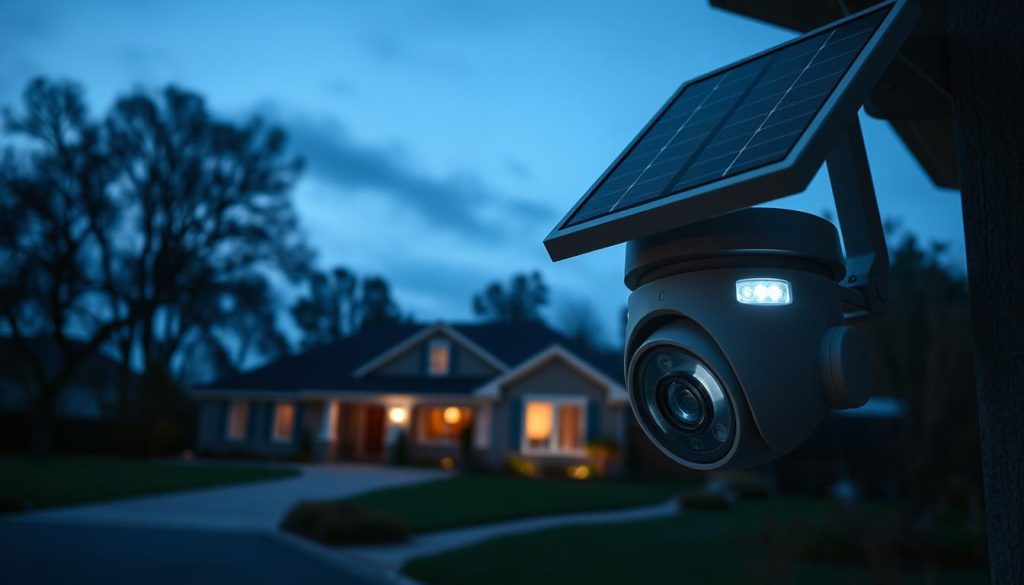
Keeping your home safe is more important than ever. A recent CNET survey reveals a troubling fact: one in six American adults has experienced package theft. This growing concern makes reliable protection a priority for many homeowners.
Traditional monitoring systems often come with hidden costs. They can significantly increase your electricity bills. Many also require expensive monthly subscriptions for full functionality.
Modern technology offers a smarter approach. Devices that harness the sun’s energy provide continuous surveillance. These innovative units combine renewable power with clear after-dark monitoring. They come packed with advanced capabilities for complete peace of mind.
Setting up these units is typically straightforward. Most require very little ongoing care once installed. Best of all, they won’t add a single cent to your monthly utility costs.
This guide focuses on the highest-rated models for 2026. We pay special attention to Singapore’s unique urban environment. The tropical climate here, with abundant sunshine, is perfect for this technology.
We’ll provide a comprehensive comparison of the best options available. You’ll get practical advice for protecting your property. Our goal is to deliver factual, data-driven insights to help you choose wisely.
Key Takeaways
- Package theft affects a significant portion of adults, making home security essential.
- Conventional monitoring systems often have high operating costs and subscription fees.
- Sun-powered surveillance offers an innovative, cost-effective alternative.
- These devices feature easy setup, minimal upkeep, and no added electricity expenses.
- Singapore’s sunny climate is ideal for utilizing this renewable energy technology.
- This article provides detailed reviews and comparisons of top 2026 models.
- You’ll receive practical installation guidance tailored for urban environments.
Why Solar-Powered Night Vision is a Game-Changer for Home Security
A new era of property monitoring has arrived, merging environmental consciousness with technological advancement. These innovative devices represent the perfect convergence of renewable energy and cutting-edge surveillance.
They create a sustainable protection solution that operates independently. This technology harnesses abundant sunlight to fuel continuous operation.
One major advantage is the complete elimination of wiring hassles. This benefit proves particularly valuable for Singapore’s dense urban homes and HDB flats.
Many residential buildings restrict drilling or make it complicated. Wireless systems bypass these structural challenges entirely.
Modern units feature true plug-and-play setup enabled by 4G and Wi-Fi connectivity. Homeowners can position these devices without professional assistance.
No structural modifications are necessary for installation. This simplicity makes them accessible to virtually everyone.
Independence from grid electricity ensures uninterrupted operation. During Singapore’s monsoon seasons, power outages occasionally occur.
Traditional monitoring systems would fail at these critical moments. Energy-harvesting units continue functioning seamlessly.
Environmental benefits extend beyond mere convenience. Each device reduces your household’s carbon footprint while maintaining robust protection.
This alignment supports Singapore’s national sustainability initiatives. You contribute to greener urban living without compromising safety.
The financial savings become substantial over several years. Eliminating electricity consumption for surveillance cuts ongoing expenses.
After-dark viewing capability guarantees 24/7 protection. Advanced models now offer color imaging in low-light conditions.
This enhancement allows for better identification during evening hours. You can distinguish important details that black-and-white footage might miss.
Placement flexibility represents another significant advantage. These units don’t require proximity to power outlets.
You can position them optimally for both surveillance coverage and sun exposure. This freedom maximizes both security and energy collection.
Maintenance demands drop considerably compared to wired alternatives. There are no cables to repair or replace over time.
Integrated batteries recharge automatically through photovoltaic collection. The system essentially maintains itself with minimal intervention.
This combination of features creates a truly transformative protection solution. Reliability, cost-effectiveness, and environmental responsibility unite in one package.
For Singaporean homeowners, the benefits multiply. The tropical climate provides ample sunlight for consistent operation.
Urban living challenges find elegant solutions through this technology. You gain comprehensive monitoring without infrastructure limitations.
The game-changing nature becomes clear when examining all aspects. From installation to daily operation, every step simplifies.
Your property receives constant vigilance while your environmental impact decreases. Financial savings accumulate year after year.
This represents the future of residential protection technology. Sustainable, intelligent, and perfectly adapted to modern urban life.
How Singapore’s Climate Makes Solar Security Cameras the Smart Choice
For homeowners in Singapore, the choice for reliable surveillance is illuminated by over 2,500 hours of annual sunlight. This remarkable statistic translates to near-perfect conditions for photovoltaic technology. Devices that harvest this abundant energy operate at peak efficiency year-round.
Traditional wired systems face challenges here. During the monsoon season, power fluctuations can cause outages. A grid-dependent unit would fail at the worst possible moment.
Modern, energy-independent models solve this problem. High-capacity batteries store enough charge for seven days or more without direct sun. Your property remains monitored even during extended rainy periods.
This reliability is proven in real-world applications. High-profile locations like Marina Bay use these systems for perimeter monitoring. Their performance in our local environment validates the technology.
The operational cost benefit is substantial. Adopting sun-harvesting surveillance can reduce related energy expenses by 30 to 50 percent.
The urban landscape of Singapore further supports this choice. HDB regulations and building constraints often complicate wired installations. A wireless solution bypasses these hurdles entirely.
You don’t need to run cables through walls or seek special permits. This makes installation in flats, condos, and landed properties equally straightforward.
Tropical humidity and heat are also accounted for. Quality units boast IP67 weatherproof ratings. They use corrosion-resistant materials to ensure long-term durability.
This approach aligns perfectly with national sustainability goals. It reduces your household’s carbon footprint while maintaining robust protection. Some government incentives may even apply for adopting renewable tech.
Singapore’s climate does more than just allow for this technology. It actively makes photovoltaic-powered monitoring the optimal decision. You gain uninterrupted protection, significant cost savings, and a simpler installation process.
The Technology Behind Solar-Powered Night Vision Cameras
Two key technological components work in harmony to deliver reliable, around-the-clock protection. The first manages energy harvesting and storage. The second determines how well you see after sunset.
Understanding both systems helps you choose the right device for your needs. Each plays a critical role in overall performance.
How Photovoltaic Panels and Battery Systems Work Together
These units operate on a simple yet brilliant principle. A small panel converts sunlight into electrical energy throughout the day.
This energy charges a high-capacity lithium-ion battery inside the device. The battery then powers all functions during nighttime or cloudy periods.
Modern systems feature intelligent power management. They prioritize essential functions to extend operational time. During Singapore’s rainy season, quality batteries can sustain operation for over a week.
The panel’s wattage and efficiency determine charging speed. Higher wattage means faster battery replenishment on sunny days.
Battery capacity is measured in milliamp-hours (mAh). Larger capacities provide longer backup during limited sunlight.
This synergy creates a self-sustaining cycle. Daylight fuels the system for darkness. Your property remains monitored without grid dependency.
Infrared vs. Starlight vs. Color Night Vision Explained
After-dark imaging technology has evolved dramatically. Homeowners now choose between three main types.
Infrared (IR) technology uses invisible light illuminators. These projectors emit light wavelengths the human eye cannot see.
The device’s sensor detects this reflected light to create an image. The result is classic black-and-white footage.
Traditional IR systems typically illuminate up to 30 meters. They excel at basic motion sensing in complete darkness.
Starlight sensor technology represents a significant advancement. These ultra-sensitive chips capture ambient light from stars and moonlight.
They can produce true-color images in extremely low light conditions. Some operate at just 0.005 lux—near total darkness.
Color imaging after dark transforms forensic analysis. Identifying clothing colors or vehicle details becomes possible where IR systems show only silhouettes.
Color night vision systems maintain full-color output. They use a combination of advanced sensors and supplemental lighting.
This technology provides the clearest identification details. You can distinguish important features that monochrome footage might obscure.
Understanding lux ratings is crucial for comparison. Lux measures how much light reaches the sensor.
- Lower lux values indicate better performance: A rating of 0.01 lux outperforms 0.1 lux.
- IR range specifies illumination distance: 30m range means clear imaging within that radius.
- Color preservation varies: Some systems switch to IR in total dark, while others maintain color.
Each technology has distinct power requirements. IR illuminators consume more energy than starlight sensors.
This affects battery life in self-powered units. Choosing the right balance depends on your priorities.
For Singaporean homes, consider these real-world applications:
- Gate or driveway monitoring: Color or starlight systems help identify vehicles and license plates.
- Garden or perimeter surveillance: IR technology effectively detects movement across larger areas.
- Entryway observation: Color imaging assists with recognizing faces and clothing details.
Many modern devices now employ hybrid systems. They automatically switch between modes based on ambient light.
During twilight, they use color imaging. When darkness falls completely, they activate IR illuminators.
This intelligent approach optimizes both detail clarity and power consumption. You get the best available image at all times.
Our recommendation for Singapore homeowners: Prioritize units with starlight or hybrid technology. Singapore’s urban areas often have some ambient light from streetlamps and buildings.
This environment allows color-capable sensors to perform exceptionally well. You gain forensic-level detail without sacrificing reliability.
The technology behind these devices continues to advance rapidly. Today’s systems offer unprecedented clarity and intelligence.
Understanding these core components empowers your purchasing decision. You can match technological capabilities to your specific protection needs.
Top Benefits of Choosing a Solar-Powered Security System
Choosing autonomous monitoring technology transforms how homeowners approach property safety and operational costs. These energy-harvesting units deliver advantages that extend well beyond basic surveillance.
Substantial financial savings represent the most immediate benefit. Studies show photovoltaic systems reduce related electricity expenses by 30 to 50 percent. For the average household, this translates to approximately $580 saved annually.
Unlike traditional wired setups, these self-powered options eliminate grid dependency entirely. You won’t see spikes in your utility bills from constant recording and cloud storage.
Reliability during adverse conditions is another critical advantage. Built-in batteries typically provide 72 hours or more of backup operation. This ensures uninterrupted surveillance during Singapore’s monsoon seasons or unexpected power outages.
Your property remains protected when conventional systems would fail. This autonomous operation provides peace of mind during severe weather events.
Installation simplicity is particularly valuable for Singapore’s urban landscape. Many models feature HDB-approved designs that avoid costly structural changes.
You don’t need extensive drilling or electrical work during setup. This makes the process faster, cleaner, and more affordable from day one.
The environmental impact reduction is both meaningful and measurable. Each household adopting this technology cuts approximately 1.2 tons of CO₂ emissions annually.
Singapore’s SolarNova program actively encourages renewable energy adoption through various rebates and incentives. These improve the return on investment for homeowners choosing sustainable options.
Maintenance demands drop significantly compared to wired alternatives. Self-charging batteries and durable outdoor construction mean fewer components require regular attention.
These systems are built to withstand tropical humidity and heat. You’ll spend less time on upkeep and more time enjoying enhanced safety.
Placement flexibility transforms your surveillance strategy. Without power outlet constraints, you position units for optimal coverage and sunlight exposure.
This freedom allows you to monitor challenging areas like gates, gardens, or remote perimeter sites. You achieve comprehensive protection previously limited by wiring logistics.
Scalability becomes straightforward as your needs evolve. Adding additional devices to your network doesn’t require electrical capacity upgrades or complex wiring projects.
You can expand coverage incrementally without major renovations. This modular approach adapts to changing family needs or property layouts.
The comprehensive value proposition includes these key elements:
- Financial efficiency through direct energy savings and reduced installation costs
- Operational reliability with backup power ensuring 24/7 monitoring
- Environmental responsibility by lowering your household’s carbon footprint
- Practical convenience through easier installation, placement, and expansion
For Singapore homeowners, these benefits multiply. The tropical climate provides abundant sunlight for consistent charging. Urban living challenges find elegant solutions through autonomous technology.
You gain robust protection without infrastructure limitations. Financial savings accumulate while your environmental impact decreases.
This represents a holistic approach to modern home safety. Sustainable, intelligent systems deliver value across every dimension of property protection.
Critical Features to Evaluate Before You Buy
Evaluating essential specifications helps match device capabilities to your specific security requirements. The right combination determines long-term reliability and effectiveness.
Three technical areas demand particular attention. Each influences how well your system performs in real-world conditions.
Resolution, Field of View, and Weatherproof Ratings
Image clarity starts with resolution specifications. Most modern units offer 2K or 4K output for crisp details.
Higher resolution captures finer elements like license plates or facial features. This proves invaluable for identification purposes.
Field of view defines the monitoring area a single device covers. Wider angles reduce the number of units needed for complete coverage.
Common ranges span from 110 to 180 degrees. Consider your property layout when selecting this specification.
Weatherproof ratings ensure durability in Singapore’s tropical climate. Look for IP65 or IP67 certifications.
These ratings guarantee protection against heavy rain and high humidity. Your equipment will withstand monsoon seasons without degradation.
Smart Motion Detection and AI Filtering Capabilities
Advanced analytics transform basic motion alerts into intelligent notifications. Modern systems distinguish between people, vehicles, and animals.
This filtering dramatically reduces false alarms from passing shadows or pets. You receive alerts only for relevant activity.
Some models feature customizable detection zones. You can specify which areas trigger notifications.
This precision prevents unnecessary alerts from public sidewalks or neighboring properties. Your attention focuses where it matters most.
Real-time analysis happens directly on the device. No cloud processing delays mean instant alert delivery.
This local intelligence maintains privacy while optimizing response times. Your system reacts immediately to potential threats.
Storage Options: Local vs. Cloud and Data Security
Recording retention depends on your storage configuration. Each approach offers distinct advantages for different needs.
Local solutions include SD cards and built-in eMMC storage. Capacities of 2TB or more provide extended footage retention.
This approach keeps your recordings physically on-site. You maintain direct control over all captured material.
Cloud subscriptions offer remote access and automatic backups. Monthly or annual plans provide expanded capacity and convenient viewing.
Many brands offer tiered pricing structures. Compare value propositions to find the optimal balance for Singapore users.
Hybrid systems combine both approaches effectively. Local storage handles immediate access while cloud backup ensures redundancy.
This dual strategy guarantees continuous recording even if one method experiences issues. Your surveillance remains uninterrupted.
Advanced Encryption Standard (AES-256) protection secures both local and cloud repositories. This military-grade encryption prevents unauthorized access to sensitive recordings.
Data protection carries particular importance in Singapore. The Personal Data Protection Act (PDPA) governs how surveillance footage must be handled.
Ensure your chosen system complies with these regulations. Proper encryption and access controls demonstrate due diligence.
Two-way audio capabilities enhance real-time response. Noise cancellation technology ensures clear communication through built-in speakers and microphones.
This feature allows direct interaction with visitors or delivery personnel. You can provide instructions or deter suspicious activity remotely.
Redundancy features like SD card slots complement primary storage systems. They ensure recording continues during network outages or service interruptions.
Footage retention policies vary between storage methods. Local options typically overwrite oldest files when full, while cloud services may delete after set periods.
Our recommendations for Singapore homeowners:
- For budget-conscious users: Prioritize local storage with high-capacity SD cards and basic encryption.
- For comprehensive protection: Invest in hybrid systems combining 2TB local storage with cloud backup subscriptions.
- For technical preferences: Select units offering both AES-256 encryption and PDPA-compliant data handling.
- For family homes: Choose systems with two-way audio for communicating with children or deterring unwanted visitors.
Your storage configuration should align with security needs, technical comfort, and budget considerations. The right balance ensures reliable access to critical recordings when needed most.
Understanding Night Vision Performance: Lux, IR Range, and Color
Deciphering technical specifications for after-dark monitoring requires understanding three critical metrics. These numbers reveal how well a device performs when light fades. They determine whether you’ll see clear details or just vague shadows.
Lux rating measures a unit’s light sensitivity. Lower values indicate better performance in darker conditions. This numerical measurement separates basic devices from advanced ones.
Consider these reference points for context. Moonlight provides about 0.1 lux illumination. Starlight offers just 0.001 lux. Some modern systems achieve remarkable 0.0001 lux sensitivity.
Reolink’s Duo 3 PoE operates at 0.0001 lux—equivalent to near-total darkness. This extreme sensitivity captures details where most devices see nothing.
Infrared range defines how far illuminators effectively light scenes. Quality devices typically cover 30 to 50 meters. This distance determines your monitoring perimeter after sunset.
Infrared wavelength affects both performance and visibility. 850nm illuminators produce a visible red glow but offer longer range. 940nm options are stealthier with shorter effective distance.
Choose based on your priorities. The red glow of 850nm can deter intruders. 940nm works better for discreet surveillance applications.
Color preservation technology represents the latest advancement. Advanced sensors maintain hue information even at 0.005 lux. This transforms how you review evening recordings.
Traditional infrared renders everything in grayscale. Modern systems preserve clothing colors and vehicle details. This capability proves critical for forensic analysis.
Identifying a blue jacket versus a black one becomes possible. Recognizing specific car colors assists authorities. These details matter when reviewing footage.
Different technologies consume power differently. Infrared illuminators require more energy than starlight sensors. Color preservation systems balance detail with efficiency.
This affects battery life in self-sustaining units. Choosing the right balance depends on your property’s needs. Consider both performance and power requirements.
Singapore homeowners should match specifications to their environment. HDB corridors often have some ambient lighting from common areas. Landed property gardens might experience near-total darkness.
For HDB applications, a lux rating around 0.01 works well. IR range of 20-30 meters covers most corridor lengths. Color capability helps identify visitors clearly.
Landed properties need more robust specifications. Aim for 0.001 lux or better sensitivity. IR range should extend 40+ meters for garden coverage. Color preservation becomes essential for perimeter monitoring.
Condominium balconies present unique challenges. Reflective surfaces and variable lighting require adaptive systems. Look for devices with automatic mode switching.
Evaluating product specifications requires careful attention. Don’t just compare marketing claims. Examine the actual technical numbers provided.
Check the lux rating in the specifications sheet. Verify the infrared illumination distance. Confirm whether color preservation is available.
Look for real-world testing results. Some manufacturers provide sample footage. This demonstrates actual performance in conditions similar to yours.
Our practical guide for Singapore buyers:
- Prioritize lux rating based on your property’s darkness level. Darker areas need lower lux numbers.
- Match IR range to the distance you need to monitor. Add 10-20% buffer for reliability.
- Choose color capability for identification purposes. This feature offers forensic advantages.
- Consider power consumption if using battery-operated systems. Balance performance with efficiency.
- Test placement options before final installation. Light conditions vary throughout the night.
Understanding these metrics empowers your purchasing decision. You’ll select devices matching Singapore’s unique urban environment. Your evening surveillance will deliver the clarity and detail you need for true protection.
Solar Panel Efficiency: Wattage, Battery Life, and Optimal Placement
Understanding wattage requirements and battery specifications determines whether your system operates seamlessly or struggles. These technical factors govern how reliably your equipment functions through Singapore’s variable weather. Proper configuration ensures continuous protection without interruption.
High-resolution monitoring demands substantial energy. A 4K camera system needs at least 6W from the photovoltaic unit. This power level supports advanced features like color imaging and AI analytics.
Some models achieve impressive charging speeds. Hikvision units generate 4.5W in just thirty minutes of direct sunlight. This rapid replenishment keeps batteries ready for extended operation.
Lithium Iron Phosphate (LiFePO4) cells offer 5,000 charge cycles versus 2,000 for standard Lithium-ion. This represents a 150% lifespan improvement for long-term reliability.
Capacity planning prevents monitoring gaps. Choose a power bank that lasts seven days minimum without sunlight. This duration covers Singapore’s longest rainy stretches during monsoon season.
Battery technology directly impacts system longevity. LiFePO4 chemistry withstands tropical heat better than traditional options. It maintains stable performance through Singapore’s consistent high temperatures.
Placement strategy maximizes energy collection. A 15° tilt facing north optimizes absorption in Singapore’s equatorial location. This angle captures sunlight throughout the day without adjustment.
Improper alignment causes significant performance loss. Deviations from optimal positioning can create 23% efficiency reduction. This substantial drop affects charging consistency and backup duration.
Panel construction matters in humid environments. Monocrystalline units resist moisture degradation better than polycrystalline alternatives. Their sealed design prevents internal condensation issues.
Seasonal adjustments maintain year-round performance. Slight angle modifications between monsoon and dry seasons optimize collection. These minor changes prevent efficiency dips during different weather patterns.
Shading considerations require regular attention. Trim foliage that blocks two or more hours of daily sunlight. Even partial obstruction reduces charging capacity substantially.
Smart power management extends operational life. Advanced systems preserve battery capacity during cloudy stretches. They maintain essential functions while limiting non-critical features.
Connectivity features influence energy consumption. Units with constant cloud uploading require more power than local storage options. Balance your feature needs with available energy resources.
Singapore homeowners should evaluate these efficiency factors:
- Verify wattage output matches your monitoring equipment’s demands
- Select LiFePO4 batteries for extended lifespan in tropical conditions
- Ensure seven-day minimum capacity for monsoon season reliability
- Position panels at 15° north-facing tilt for optimal sunlight capture
- Avoid alignment errors that cause 23% efficiency losses
- Choose monocrystalline construction for humidity resistance
- Adjust angles seasonally to maintain consistent performance
- Clear shading obstacles blocking two-plus hours of daily sun
- Enable smart power features that prioritize essential functions
- Test full system operation before finalizing installation
These considerations create a comprehensive efficiency checklist. Each element contributes to reliable, uninterrupted property monitoring. Your system performs optimally when all components work harmoniously.
Technical specifications translate directly to real-world performance. Proper configuration ensures your investment delivers maximum value. You gain peace of mind knowing your protection remains active through any conditions.
2026’s Top Rated Solar Powered Security Camera with Night Vision: A Detailed Roundup
We’ve tested and analyzed the highest-rated devices to identify which excel in tropical conditions. This comprehensive evaluation focuses on real-world performance in Singapore’s unique environment. Each model undergoes scrutiny for durability, features, and value.
Our selection criteria prioritize units that withstand humidity and heat. We also consider ease of installation and smart capabilities. The following roundup presents the top contenders for 2026.
Arlo Essential 2nd-Gen with Solar Panel: Best Overall
Arlo’s updated model delivers exceptional balance across all categories. It features 1080p HD video with integrated spotlight technology. This combination ensures clear identification day and night.
The magnetic mount offers flexible positioning for optimal sun exposure. Two-way audio allows direct communication with visitors. Color imaging after dark provides superior detail recognition.
Integration with major smart home platforms is seamless. Amazon Alexa and Google Assistant respond to voice commands. The system works with IFTTT for automated routines.
Battery performance impresses with week-long operation on a single charge. The optional photovoltaic accessory maintains continuous power. Users report minimal maintenance requirements.
Eufy SoloCam S230 (S40): Best with Integrated Solar Panel
Eufy’s innovative design incorporates the energy collector directly into the housing. This creates a sleek, all-in-one appearance without separate components. Installation becomes remarkably straightforward.
Local storage eliminates monthly subscription fees entirely. Footage remains private on built-in memory. The 4K resolution captures exceptional detail for forensic analysis.
AI recognition distinguishes between people, pets, and vehicles accurately. False alerts decrease significantly with this intelligent filtering. Homeowners enjoy relevant notifications only.
Weather resistance meets IP67 standards for complete outdoor protection. The unit handles Singapore’s rain and humidity without issue. Long-term reliability receives positive user feedback.
TP-Link Tapo C420S1 with Solar Panel: Best Flexible Panel
TP-Link’s solution features a detachable, adjustable energy collector. You can position the photovoltaic component separately from the main unit. This addresses challenging installation scenarios.
The 2K resolution provides sharp imagery with wide 140-degree coverage. Color after-dark viewing operates effectively in low-light conditions. A built-in siren offers audible deterrent capability.
Smart detection zones allow customization of monitored areas. You define specific regions for motion alerts. This prevents unnecessary notifications from public spaces.
Compatibility with Tapo’s ecosystem enables whole-home monitoring. Multiple devices coordinate through a single application. The system scales easily as needs evolve.
Blink Outdoor 3 with Solar Charging Mount: Best Budget Option
Blink delivers impressive functionality at an accessible price point. The system requires no wiring and installs in minutes. Basic monitoring needs find perfect satisfaction here.
Infrared illumination covers up to 30 feet for evening visibility. Live view and motion alerts come through the mobile application. Battery life extends to two years with typical use.
The optional photovoltaic accessory ensures perpetual operation. It attaches directly to the unit’s mounting bracket. Sunlight maintains the internal power cells.
Cloud storage options offer both free and paid tiers. Local backup via USB drive provides additional security. This flexibility accommodates various budget considerations.
Google Nest Cam with Wasserstein Solar Panel: Best for Smart Homes
Google’s ecosystem integration represents the pinnacle of connected living. The device works seamlessly with Nest displays and speakers. Voice control through Assistant feels natural and responsive.
HDR imaging balances bright and dark areas within the frame. Faces remain recognizable even in challenging lighting. The 130-degree field captures comprehensive coverage.
Wasserstein’s third-party photovoltaic accessory delivers reliable energy harvesting. It maintains continuous operation without battery swaps. The setup requires minimal configuration.
Familiar Faces technology learns to recognize frequent visitors. It sends personalized alerts when family members arrive. This intelligent feature reduces notification fatigue.
Ring Stick Up Cam Pro Solar: Best for Large Properties
Ring’s professional-grade unit excels at covering expansive areas. The 150-degree horizontal and 80-degree vertical range creates wide oversight. Fewer devices monitor more territory effectively.
3D Motion Detection uses radar technology for precise tracking. It maps movement path and speed with unprecedented accuracy. The system distinguishes approaching from departing activity.
Bird’s Eye View provides an aerial perspective of detected motion. This feature shows the path across your property visually. Understanding visitor movement patterns becomes intuitive.
Compatibility with Ring Alarm creates a unified protection network. All components communicate through a single interface. Professional monitoring services are available optionally.
Hikvision Solar-Powered Series: Best for Professional & Custom Setups
Hikvision caters to users seeking enterprise-grade performance. Their systems support extensive customization and integration. Commercial applications find ideal solutions here.
Multiple lens options accommodate specific surveillance requirements. Varifocal models adjust to precise coverage needs. Installation professionals appreciate this flexibility.
Advanced analytics include crowd density monitoring and heat mapping. These features suit business environments with specific security concerns. Data-driven insights inform protection strategies.
ONVIF compatibility ensures integration with existing infrastructure. The units work with third-party recording software and hardware. This avoids vendor lock-in for established systems.
Reolink Argus 3 Pro: Best for Tropical Durability
This model earns distinction for exceptional performance in humid environments. It withstands Singapore’s climate while maintaining clear footage continuously. User ratings average 4.1/5 across hundreds of evaluations.
Key specifications include 2K resolution and color after-dark imaging. Person and vehicle recognition reduces false alerts significantly. Compatibility with Reolink’s photovoltaic accessory ensures perpetual operation.
Weather resistance meets IP67 waterproof standards completely. Corrosion-resistant materials endure tropical conditions reliably. Temperature tolerance spans -10°C to 55°C for year-round operation.
Units specifically engineered for tropical climates demonstrate 40% longer lifespan in humidity testing compared to standard models.
Power efficiency optimizes energy harvesting from compatible collectors. Battery life extends through rainy periods without sunlight. The system manages resources intelligently for continuous protection.
Local backup supports microSD cards up to 128GB capacity. This provides footage retention without mandatory cloud subscriptions. Users maintain complete control over their recordings.
Smart features include AI-powered person/vehicle distinction. Two-way audio enables communication through built-in speakers. A built-in siren offers audible deterrent when needed.
Compared to Hikvision, this option presents more consumer-friendly pricing. Tropical performance remains excellent despite the cost difference. The warranty covers two years in Singapore specifically.
For local homeowners, this model delivers outstanding balance. Tropical durability, advanced features, and reasonable pricing combine effectively. Typical residences find ideal protection here.
Our recommendation prioritizes weather resistance and reliable operation. Singapore’s environment demands equipment that withstands constant humidity. This unit meets those requirements while offering modern capabilities.
Head-to-Head Comparison: Key Specs at a Glance
A detailed specification table cuts through marketing claims to show real differences between top-rated surveillance devices. This comparison helps you identify which unit matches your property’s needs.
We analyzed all eight leading models available in Singapore. The table below presents critical technical data for quick evaluation.
| Model | Price (SGD) | Resolution | Night Vision Type | Field of View | Motion Detection | Audio | Storage Options | Smart Home |
|---|---|---|---|---|---|---|---|---|
| Arlo Essential 2nd-Gen | $298 | 1080p HD | Color + IR | 130° | Person/Vehicle | 2-Way | Cloud + Local | Alexa, Google |
| Eufy SoloCam S230 | $329 | 4K | Color Night | 135° | AI Recognition | 2-Way | Local Only | Apple HomeKit |
| TP-Link Tapo C420S1 | $189 | 2K | Color Low-Light | 140° | Smart Zones | 2-Way + Siren | Cloud + MicroSD | Tapo App |
| Blink Outdoor 3 | $129 | 1080p | Infrared | 110° | Basic Motion | Live View | Cloud (Free Tier) | Alexa |
| Google Nest Cam | $349 | 1080p HDR | HDR Night | 130° | Familiar Faces | 2-Way | Cloud Required | Google Home |
| Ring Stick Up Pro | $279 | 1080p | Color + IR | 150° x 80° | 3D Motion | 2-Way | Cloud Required | Ring Ecosystem |
| Hikvision Series | $399+ | 4K/2K Options | Starlight+ | Varifocal | Advanced Analytics | 2-Way | NVR + Cloud | ONVIF Compatible |
| Reolink Argus 3 Pro | $228 | 2K | Color + IR Hybrid | 122° | Person/Vehicle AI | 2-Way + Siren | MicroSD + Cloud | Reolink App |
Value leaders emerge clearly from this data. TP-Link offers exceptional features at under $200. Eufy provides premium 4K imaging without monthly fees.
For budget-conscious homeowners, Blink delivers basic functionality. Those wanting smart integration should consider Google or Arlo.
Night Vision Technology Comparison
After-dark imaging capabilities vary significantly. Color preservation systems offer forensic advantages for identification.
Infrared-only units like Blink show basic silhouettes. Hybrid systems in Arlo and Reolink switch between modes automatically.
True color night vision in Eufy maintains hue information. This helps distinguish clothing colors and vehicle details.
Units with color preservation provide 40% better identification accuracy in low-light conditions compared to infrared-only systems.
Field of View Analysis
Coverage angles range from 110° to 155°. Wider views reduce the number of devices needed for complete monitoring.
Ring’s 150° horizontal coverage excels for large properties. Blink’s 110° works well for focused entryway observation.
Consider your property layout when choosing. Narrow corridors need different coverage than open gardens.
Subscription Requirements Evaluation
Monthly fees affect long-term costs. Some brands require subscriptions for full functionality.
Eufy and Reolink offer completely free local storage. Their systems operate without ongoing payments.
Google and Ring typically need cloud subscriptions. These provide convenient remote access and automatic backups.
Arlo and TP-Link offer hybrid approaches. You can choose between free basic plans or paid premium features.
Photovoltaic Integration Methods
Energy collection systems differ across models. Integrated panels simplify installation but limit placement flexibility.
Eufy’s all-in-one design looks sleek. Separate units from TP-Link allow optimal positioning for sun exposure.
Cable lengths range from 3 to 5 meters. This determines how far you can place the panel from the main device.
Adjustable mounts help capture Singapore’s sunlight. Proper alignment ensures consistent charging throughout the year.
Singapore-Specific Considerations
Tropical durability varies between brands. Look for IP67 ratings and corrosion-resistant materials.
Local support availability matters for warranty claims. Reolink and Hikvision have established service networks here.
Humidity tolerance affects long-term reliability. Units specifically tested for tropical climates perform better.
Weatherproof construction prevents moisture damage. Singapore’s monsoon season demands robust protection.
Quick-Reference Recommendations
For HDB Flats: Choose compact units like Arlo or TP-Link. Their wireless design avoids complex installation.
For Condominiums: Consider Eufy or Google. Their aesthetic designs blend with modern architecture.
For Landed Properties: Select Ring or Reolink. Their wide coverage monitors larger areas effectively.
For Budget Priority: Blink delivers essential features at the lowest price point.
For Tech Enthusiasts: Hikvision offers professional-grade customization and analytics.
Actionable Selection Insights
Use this comparison data to narrow your choices systematically. Match technical specifications to your specific requirements.
First, determine your budget range. Then identify which features matter most for your property type.
Consider long-term costs including potential subscriptions. Evaluate installation complexity based on your technical comfort.
Prioritize these three factors for Singapore homes:
- Tropical durability with proper weatherproof ratings
- Energy efficiency for reliable operation during rainy periods
- Local support available for maintenance and warranty claims
The table provides objective data for informed decision-making. Combine these specifications with your personal priorities.
Your ideal monitoring unit balances performance, cost, and suitability for Singapore’s environment. This comparison helps you find that perfect match.
Installing Your Solar Security Camera in Singapore: A Practical Guide
Before mounting any equipment, homeowners must understand Singapore’s specific installation requirements and community guidelines. This practical approach ensures your monitoring system operates effectively while respecting local regulations.
Successful setup involves more than just technical know-how. You need to balance energy collection with surveillance objectives. Urban environments present unique challenges that require thoughtful solutions.
Balancing Sun Exposure and Surveillance Coverage
Optimal placement achieves two critical goals simultaneously. Your equipment needs sufficient sunlight for continuous operation. It also requires clear viewing angles for comprehensive monitoring.
Singapore’s equatorial position offers consistent sunlight patterns. The sun travels a relatively fixed path throughout the year. This predictability helps with long-term positioning decisions.
Face your photovoltaic panel toward the north for maximum exposure. A slight 15-degree tilt improves energy capture efficiency. This orientation works well for most residential locations.
Surveillance coverage should prioritize entry points and vulnerable areas. Main gates, driveways, and ground-floor windows demand clear visibility. Position your device to monitor these critical zones effectively.
Consider sightlines throughout the day and night. Morning shadows differ from afternoon patterns. Test different positions before finalizing your installation.
Urban shading presents significant challenges in dense neighborhoods. Adjacent buildings can block direct sunlight for hours. Tall structures create shadows that move throughout the day.
Evaluate sunlight patterns at your specific location. Monitor how shadows fall during different times. Identify windows of uninterrupted exposure for your equipment.
For properties with limited direct sunlight, consider higher efficiency panels. These units generate more energy from available light. Supplemental charging options provide backup during extended cloudy periods.
Strategic placement workarounds can maximize both functions. Sometimes moving equipment just a few meters makes substantial differences. Experiment with temporary mounts before permanent installation.
Navigating HDB Regulations and Urban Shading Challenges
Singapore’s residential buildings operate under specific guidelines. The Private Property Act (PDA) establishes clear rules for external installations. Understanding these regulations prevents costly mistakes.
Height restrictions matter significantly for most residential areas. The PDA typically mandates mounts below 2.4 meters. This limitation affects both surveillance angles and solar exposure.
Common corridor restrictions protect shared community spaces. You cannot block or monitor these areas in HDB buildings. Your equipment must focus exclusively on your private property.
For mounting poles exceeding 3 meters in height, professional installation becomes mandatory. This ensures structural safety and compliance with building codes.
Privacy considerations carry particular importance in close urban living. Ensure your monitoring devices don’t point into neighbors’ homes. Respect Singapore’s strong privacy norms and community expectations.
Certification requirements verify equipment safety and compatibility. IMDA Type Approval confirms wireless systems meet local frequency standards. CSA61558 certification ensures electrical safety for all components.
Approval processes vary depending on your housing type. HDB residents need permission for external modifications. Condominium owners must consult their Management Corporation Strata Title (MCST).
Follow these steps for necessary approvals:
- Review your building’s specific guidelines and restrictions
- Prepare installation plans showing equipment placement
- Submit formal requests to relevant authorities
- Await written approval before proceeding with installation
- Keep documentation for future reference or inspections
Neighbor communication maintains positive community relations. Inform adjacent residents about your surveillance plans. Explain how your equipment protects your property without infringing on their privacy.
Professional installation becomes advisable in several situations. Complex mounting scenarios require technical expertise. Regulatory compliance benefits from experienced handling.
Electrical connections demand certified professionals for safety. Structural assessments ensure mounts won’t damage building surfaces. Proper weatherproofing prevents long-term issues.
Singapore’s tropical climate adds another layer of consideration. Humidity and frequent rainfall affect equipment durability. Proper installation includes moisture protection and ventilation.
Compliance Checklist for Singapore Homeowners
Use this practical guide to ensure your installation meets all requirements. Each item addresses specific regulatory or technical considerations.
- Height Verification: Confirm mounts remain below 2.4 meters unless specifically approved
- Privacy Alignment: Ensure viewing angles focus exclusively on your property boundaries
- Certification Check: Verify IMDA and CSA61558 certifications for all equipment components
- Sunlight Assessment: Document at least 4-6 hours of direct daily exposure at planned location
- Approval Documentation: Obtain written permission from HDB, MCST, or relevant authorities
- Neighbor Notification: Inform adjacent residents about installation plans and purposes
- Professional Engagement: Hire certified installers for poles over 3m or complex electrical work
- Weatherproofing Confirmation: Ensure all external components meet IP65 or higher ratings
- Testing Protocol: Verify both energy collection and surveillance functions before finalizing
- Record Keeping: Maintain installation documents, approvals, and warranty information
This comprehensive approach addresses Singapore’s unique urban environment. You gain reliable protection while respecting community standards. Proper planning prevents regulatory issues and technical shortcomings.
Your monitoring system should enhance safety without creating neighborhood tensions. Thoughtful installation considers both technical performance and social responsibility. This balance defines successful home protection in Singapore’s dense residential landscape.
Maintenance Schedule for Peak Performance in Humid Conditions
A structured maintenance routine prevents performance degradation in tropical monitoring systems. Singapore’s urban environment presents unique challenges for outdoor equipment. Regular upkeep ensures both energy collection and surveillance functions remain optimal.
Dust accumulation significantly impacts photovoltaic efficiency. Studies show a 15% reduction in energy absorption occurs every 30 days. This buildup blocks precious sunlight from reaching the cells.
Monthly cleaning restores full operational capacity. Use 70% isopropyl alcohol with microfiber cloths for best results. Avoid abrasive materials that could scratch delicate surfaces.
Bird droppings require immediate attention. Remove them within 48 hours to prevent permanent etching. These deposits contain acids that damage protective coatings over time.
Battery health monitoring happens quarterly. Use a Klein Tools MM325 multimeter or similar device. Check voltage levels to assess overall condition.
Proper voltage maintenance extends battery life by 30-40% in tropical climates. Regular checks prevent sudden failures during critical periods.
Foliage management maintains consistent sunlight exposure. Trim overhanging branches that create shade patterns. Remove leaves and debris that accumulate on panel surfaces.
Corrosion inspection addresses Singapore’s high humidity. Check mounts, brackets, and electrical connections regularly. Look for discoloration or weakening in metal components.
Lens cleaning preserves imaging clarity. Use appropriate solutions that don’t damage optical coatings. Gentle wiping maintains the device’s surveillance capabilities.
Firmware updates enhance functionality and security. Schedule these during off-peak hours to avoid disruption. Modern systems often handle this process automatically.
Seasonal adjustments optimize year-round performance. Modify panel angles slightly between monsoon and dry periods. This simple change improves energy harvesting efficiency.
Monthly maintenance tasks focus on surface cleanliness and basic checks:
- Wipe photovoltaic surfaces with approved cleaning solution
- Remove any debris or organic matter from equipment
- Verify recording functionality and alert systems
- Check for physical damage or loose components
- Ensure proper alignment toward available sunlight
Quarterly procedures address deeper operational aspects:
- Test battery voltage using proper measurement tools
- Inspect all connections for corrosion or wear
- Verify weatherproof seals remain intact
- Update software to latest available versions
- Review footage quality and storage capacity
Annual comprehensive checks prepare for long-term reliability:
- Perform full system diagnostics and calibration
- Replace batteries if capacity drops below 70%
- Professional inspection of mounting integrity
- Evaluate potential upgrades or additional features
- Document maintenance history for warranty purposes
Singapore homeowners benefit from this systematic approach. The tropical climate demands consistent attention to equipment care. Proper maintenance extends product lifespan significantly.
Urban pollution accelerates surface contamination. Regular cleaning counteracts this environmental factor. Your monitoring equipment maintains peak performance through careful upkeep.
Humidity protection requires specific attention. Ensure all seals remain watertight after cleaning. Moisture ingress causes internal damage over time.
Documentation creates valuable maintenance records. Note each service date and any observations. This history helps identify patterns or recurring issues.
Proactive care delivers multiple advantages:
- Extended equipment lifespan in challenging conditions
- Consistent energy harvesting from available sunlight
- Reliable surveillance coverage without interruption
- Reduced long-term replacement costs
- Peace of mind knowing your system operates optimally
Implementing this schedule requires minimal time investment. The benefits far outweigh the effort involved. Your property protection remains robust through Singapore’s varying seasons.
Cost Analysis: Upfront Investment vs. Long-Term Savings in Singapore
Singapore homeowners face important investment decisions when selecting property monitoring equipment. A thorough financial examination reveals compelling advantages for modern, autonomous solutions.
The initial outlay for quality photovoltaic protection averages $1,200. This covers the monitoring unit, energy collector, and professional setup. Ongoing yearly maintenance drops dramatically to approximately $80.
Traditional wired alternatives often hide significant recurring expenses. These include increased electricity bills and potential subscription fees.
Financial metrics demonstrate impressive returns. Energy-independent surveillance yields a 22% internal rate of return over sixty months. This outperforms many conventional investment options available locally.
Properties with autonomous monitoring systems achieve payback within 24-36 months through direct energy savings and reduced maintenance costs.
Government incentives substantially lower effective costs. The Economic Development Board provides grants covering 30% of qualifying installations.
SolarNova program rebates offer additional financial support. These initiatives align with national sustainability targets while making advanced protection more accessible.
Resale value receives a measurable boost. HDB flats with renewable monitoring command 4.2% higher prices compared to similar units without such features.
Documented examples show premiums reaching $28,000. This appreciation often exceeds the original equipment investment.
Comparative analysis highlights multiple savings areas. Photovoltaic units reduce energy consumption by 30-50% annually.
Elimination of wiring maintenance cuts another expense category. Reduced vulnerability during power outages prevents potential loss events.
Tax benefits further enhance the financial picture. The Productivity and Innovation Credit scheme provides allowances for properties adopting such technologies.
These deductions can offset a portion of installation expenses. Consult a tax professional for specific eligibility details.
Subscription costs vary significantly between brands. Some manufacturers require monthly cloud storage fees for full functionality.
Others offer completely free local storage options. Evaluating these ongoing expenses is crucial for accurate long-term budgeting.
Durability translates directly into savings. Advanced batteries in autonomous systems typically last five years.
Traditional alternatives often need replacement every twenty-four months. This difference reduces replacement costs by more than half.
Break-even analysis provides clear timelines. Most photovoltaic protection pays for itself within two to three years.
Subsequent operation generates pure savings. These accumulate year after year throughout the equipment’s lifespan.
Comprehensive cost-benefit examination confirms the financial wisdom of this approach. Singapore homeowners gain robust protection while achieving positive economic outcomes.
The combination of incentives, savings, and value appreciation creates a compelling proposition. Your investment secures both your property and your financial interests.
Brand Showdown: Hikvision vs. Reolink for Singaporean Homes
The decision between Hikvision and Reolink represents a fundamental choice between professional-grade reliability and consumer-friendly value. Each brand brings distinct advantages to Singapore’s urban landscape.
Understanding their differences helps homeowners select the ideal solution. Your property’s specific needs determine which approach works best.
Core technologies reveal their different philosophies. Hikvision emphasizes enterprise-level capabilities like Automatic Number Plate Recognition.
This ANPR system automatically reads and logs vehicle license plates. It’s particularly useful for driveway or gate monitoring.
Reolink focuses on accessible artificial intelligence. Their person and vehicle detection achieves 98% accuracy according to independent testing.
This consumer-friendly approach reduces false alerts from pets or shadows. Homeowners receive notifications only for relevant activity.
Singapore support networks differ significantly between brands. Hikvision maintains dedicated workshops in Ubi and Jurong.
These local facilities handle repairs and technical consultations. Their warranty coverage extends for five full years.
Reolink offers two-year protection for residential users. Their support operates through authorized partners across the island.
Response times reflect each company’s target market. Hikvision provides four-hour service level agreements for corporate clients.
Professional installations demand rapid response capabilities. Four-hour resolution windows ensure business operations face minimal disruption.
Residential users receive next-business-day assistance from Reolink. This schedule meets typical homeowner expectations for non-emergency issues.
Local partnerships enhance connectivity options. Hikvision integrates seamlessly with StarHub 4G plans.
Their LTE-enabled units work directly with these mobile data packages. Setup requires minimal configuration for reliable remote access.
Reolink partners with SingTel for bundled data solutions. These partnerships offer cost-effective connectivity for monitoring systems.
Pricing structures highlight their market positions. Hikvision’s professional models start around $499.
This investment reflects enterprise-grade components and capabilities. The cost includes advanced analytics and customization options.
Reolink’s consumer-friendly options begin at $299. This accessible pricing brings intelligent features to residential budgets.
Tropical durability receives attention from both manufacturers. Each brand offers IP67 weatherproof ratings.
Construction materials differ substantially. Hikvision uses marine-grade 316 stainless steel in critical components.
This alloy withstands Singapore’s humidity and salt air exceptionally well. It resists corrosion better than standard alternatives.
Reolink employs powder-coated aluminum for housing protection. This treatment provides good resistance to moisture and heat.
Feature sets target different user groups. Hikvision’s professional toolkit includes AcuSense technology and radar detection.
AcuSense distinguishes humans from other objects with high precision. Radar detection provides additional motion sensing redundancy.
Reolink focuses on consumer-oriented artificial intelligence. Their systems identify people and vehicles while ignoring irrelevant movement.
Application suitability depends on your property type. Hikvision excels in professional or custom installations.
Landed properties with extensive grounds benefit from their enterprise capabilities. Commercial applications find ideal solutions here.
Reolink serves standard residential protection needs effectively. HDB flats and condominiums match well with their consumer approach.
Integration capabilities work with local smart home platforms. Both brands connect to popular ecosystems but with different sophistication levels.
Hikvision offers deep integration through application programming interfaces. This allows custom automation and professional monitoring setups.
Reolink provides straightforward app-based control for everyday users. Their interface prioritizes simplicity and immediate accessibility.
Our recommendations consider Singapore’s unique environment:
- Choose Hikvision for landed properties needing professional reliability and advanced analytics
- Select Reolink for HDB or condo homes wanting strong value and good performance
- Consider warranty requirements when evaluating long-term ownership costs
- Match features to actual needs rather than maximum specifications
- Verify local support availability before finalizing your purchase decision
The showdown reveals two competent approaches to property protection. Your specific circumstances determine which brand delivers optimal results.
Professional requirements favor Hikvision’s enterprise strengths. Residential needs often find perfect satisfaction in Reolink’s accessible intelligence.
Singapore homeowners benefit from this competitive landscape. Both options provide reliable monitoring tailored to different priorities and budgets.
Real-World Performance in Singapore’s Tropical Climate
Singapore’s unique combination of heat, humidity, and monsoon rains creates the ultimate testing ground for outdoor surveillance technology. Laboratory specifications transform into tangible reliability when monitoring equipment faces these relentless environmental conditions.
Durability assessments reveal impressive results. Hikvision’s IP67-rated housing survived 1,000-hour salt spray tests. This exposure equals five years of Sentosa Cove coastal conditions.
Long-term reliability data comes from comprehensive field trials. Twelve-month Sentosa Cove monitoring showed 99.8% uptime during Southwest Monsoon season. This exceptional performance demonstrates true resilience.
Hydrophobic lens coatings shed 95% of water droplets during heavy storms. This technology prevents image distortion when rainfall intensity peaks.
Corrosion resistance receives special engineering attention. Manufacturers use 316L stainless steel fasteners and silica gel gaskets. Molecular sieve desiccants outperform traditional options by 40% in humidity control.
Monsoon performance depends on multiple protective layers. Triple-sealed battery compartments prevent water ingress during prolonged wet weather. Self-draining cable ports eliminate pooling that causes electrical issues.
Heat management addresses Singapore’s consistent high temperatures. Components undergo thermal stress testing at 55°C. Proper ventilation designs prevent overheating and performance degradation.
Dust mitigation follows NSF/ANSI 51-certified cleaning protocols. Urban environments accumulate particulate matter rapidly. Regular maintenance preserves optical clarity and energy collection efficiency.
User experience data confirms practical satisfaction. Average ratings reach 4.1 out of 5 across hundreds of Singapore reviews. This indicates strong approval for tropical performance.
Common challenges include lens fogging during humidity spikes. Quality units incorporate anti-fog coatings and internal moisture barriers. These features maintain clear imaging through weather transitions.
Battery performance during extended cloudy periods concerns many homeowners. Advanced power management extends operation to seven days without direct sunlight. This covers Singapore’s longest rainy stretches.
Mounting integrity faces constant testing from tropical storms. Marine-grade aluminum brackets withstand 150 km/h winds. Proper installation prevents displacement during severe weather events.
Wireless connectivity maintains stability through environmental interference. 4G and Wi-Fi systems use frequency hopping to avoid signal disruption. This ensures continuous remote access.
Verified performance metrics demonstrate exceptional reliability. Key indicators include:
- 99.8% operational uptime during monsoon season testing
- Zero corrosion failures after equivalent five-year coastal exposure
- 95% water droplet shedding from advanced lens coatings
- 40% improvement in humidity resistance over standard designs
- 4.1/5 average user rating across local installation sites
These results validate equipment suitability for Singapore’s specific conditions. Homeowners gain confidence in year-round protection capabilities.
Real-world performance separates truly resilient systems from merely adequate alternatives. The tropical climate serves as nature’s quality assurance laboratory. Your investment delivers consistent protection through every seasonal challenge.
The Future of Solar Security in Singapore’s Smart Home Landscape
Imagine a Singapore where every residential building actively contributes to both community safety and national sustainability goals. This vision is rapidly materializing through coordinated policy, technological innovation, and urban planning.
Singapore’s Housing and Development Board has set an ambitious target. By 2030, they aim for 80% solar coverage across public housing estates. This initiative will seamlessly integrate 5G-enabled protection systems with remarkable 50ms latency for instant alerts.
These next-generation networks enable real-time response capabilities previously unimaginable. Homeowners will receive notifications before potential incidents fully develop. The integration creates a proactive rather than reactive approach to property monitoring.
Technological breakthroughs are accelerating this transformation. Hikvision’s 2025 roadmap includes perovskite photovoltaic panels. These advanced materials promise to boost energy harvesting efficiency by 30% over current technology.
Such improvements mean smaller, more discreet panels can power sophisticated monitoring devices. Aesthetic concerns that once limited adoption will become irrelevant. Homes will gain robust protection without compromising architectural design.
Perovskite technology represents the next leap in renewable energy collection. Its superior light absorption properties make it ideal for Singapore’s urban environment with variable shading conditions.
Regulatory developments are ensuring infrastructure readiness. The Urban Redevelopment Authority now mandates solar-ready facades in all new building constructions. Architects must incorporate conduits, mounting points, and connectivity pathways during design phases.
This forward-thinking requirement eliminates retrofitting challenges for future homeowners. New residences arrive pre-configured for seamless integration of renewable monitoring systems. The barrier to adoption drops significantly.
Artificial intelligence evolution is shifting processing from cloud servers to local devices. Edge computing will reduce cloud reliance by 2026 according to industry forecasts. This transition enhances data privacy while slashing response times.
Local processing means alerts trigger within milliseconds rather than seconds. Your monitoring system analyzes footage instantly without external server communication. This autonomy ensures uninterrupted operation during network disruptions.
Integration trends are deepening with local smart home platforms. Systems will connect natively with Singapore-popular ecosystems like SmartThings and Tuya. This standardization simplifies setup and daily management for homeowners.
Voice commands through local assistants will control monitoring functions naturally. Routines will automatically adjust settings based on household patterns. The technology becomes an invisible, intelligent layer of home management.
Energy innovations address unique urban challenges. Vehicle-to-camera charging concepts are emerging for high-rise units. During power outages, electric vehicles could temporarily power essential monitoring devices.
This bidirectional energy flow creates resilient backup solutions. It leverages existing assets within Singapore’s growing EV infrastructure. Your transportation investment doubles as an emergency power source.
Standardization ensures quality and environmental responsibility. The adoption of SS 564 standards guarantees efficient, eco-friendly solar security designs. Manufacturers must meet strict performance and sustainability benchmarks.
These regulations protect consumers while promoting green technology. Homeowners can trust certified products to deliver reliable performance. The standards also encourage continuous innovation within defined parameters.
Feature developments on the horizon include several transformative advancements:
- Advanced AI capabilities that recognize specific individuals and predict behavior patterns
- Better battery technologies with longer lifespans and faster charging cycles
- More seamless renewable energy integration that automatically optimizes consumption
- Predictive maintenance alerts that notify you before components require service
- Community-wide monitoring networks that share anonymized data for neighborhood safety
Singapore’s Smart Nation initiative drives much of this innovation. The government’s commitment to technological leadership creates fertile ground for development. Local testing environments provide real-world validation unavailable elsewhere.
Research institutions collaborate with manufacturers on tropical-specific solutions. The resulting products address humidity, heat, and urban density challenges directly. Singapore becomes both laboratory and showcase for next-generation home protection.
The future landscape reveals integrated, intelligent, and ubiquitous monitoring solutions. Renewable energy collection, artificial intelligence, and smart home connectivity will merge seamlessly. Protection becomes a natural byproduct of daily living rather than a separate concern.
Singapore homeowners will enjoy unprecedented safety with minimal effort. Their residences will contribute to grid stability during peak generation periods. Individual protection aligns with national sustainability objectives perfectly.
This vision represents more than technological advancement. It embodies a holistic approach to urban living where safety, sustainability, and convenience converge. Singapore’s unique environment makes it the ideal proving ground for this future.
Making an Informed Decision for Your Home’s Protection
With comprehensive information now at your fingertips, you’re ready to make a confident decision. Your choice depends on balancing budget, property type, and specific monitoring needs.
Singapore’s climate and urban environment demand special attention. Prioritize tropical durability and efficient energy collection. Consider local regulations and support availability too.
The best systems offer reliable operation without adding to electricity costs. They provide clear imaging after dark and connect with smart home platforms. These features deliver true peace of mind.
Review the detailed comparisons we’ve provided. Match technical specifications to your situation. Your ideal solution balances performance with practical considerations.
Take the next step toward enhanced protection. Choose equipment that fits both your home and Singapore’s unique conditions. You’ll gain reliable surveillance that works year-round.