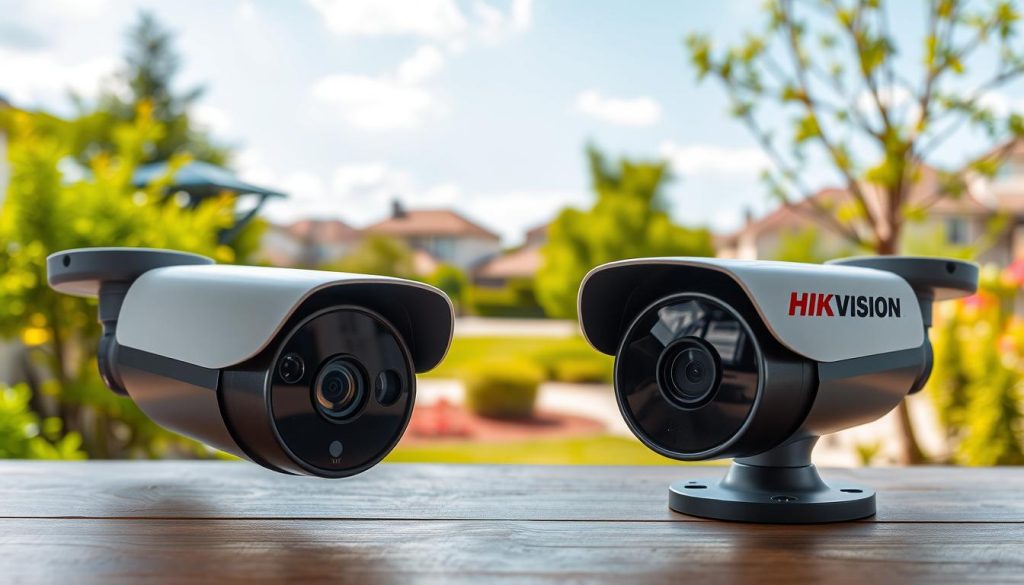
Choosing the right surveillance system is a critical decision for any property owner in Singapore. With so many options, two names dominate the conversation. This leaves many people wondering which brand truly meets their security needs.
Both Hikvision and Dahua are global leaders in the CCTV market. They are celebrated for innovation, high quality, and a vast product range. Your final choice often comes down to your specific requirements and budget.
This article provides a clear, head-to-head analysis. We cut through the common debate to give you the facts. Our goal is to help you make an informed investment in your property’s safety.
We will examine crucial factors like video resolution, smart AI features, system pricing, and durability in Singapore’s humid climate. Each brand has its strengths. One may excel for premium, feature-rich setups, while the other offers reliable, cost-effective coverage.
By the end of this detailed comparison, you’ll understand the key differences. You will be equipped to select the brand that aligns with your technical preferences and financial plan.
Key Takeaways
- Selecting a security camera brand is a major decision for homes and businesses in Singapore.
- Dahua and Hikvision are both internationally recognized for quality and a wide range of products.
- The best choice depends entirely on your specific security needs, technical desires, and budget.
- Important factors to compare include video quality, AI capabilities, price, and climate suitability.
- One brand may be better for advanced, feature-packed systems; the other often provides great value.
- An objective review helps cut through installer debates and strong user opinions.
- This analysis aims to give you a clear understanding to guide your final purchase decision.
Understanding the Security Camera Landscape in Singapore
Singapore’s security requirements are shaped by its unique urban density and challenging tropical climate. The island’s environment tests every outdoor camera with constant high humidity and frequent heavy rainfall. Dense housing estates and commercial complexes create complex sightlines that demand careful system planning.
Demand for reliable protection continues to grow across both residential and commercial sectors. Homeowners seek peace of mind with robust home security solutions. Businesses require comprehensive surveillance networks to protect assets and ensure public safety.
Modern users expect more than basic recording from their CCTV system. Advancements in artificial intelligence have raised the standard. People now want intelligent detection that distinguishes between people, vehicles, and false alarms.
Common concerns among Singaporean property owners include:
- System reliability in demanding conditions
- Simple operation through intuitive mobile apps
- Seamless integration with smart home networks
- Robust data privacy and cybersecurity measures
The local security market offers diverse options to meet these needs. Both leading brands maintain strong presence here. They provide everything from basic models to advanced AI-powered solutions.
Clear video evidence has become non-negotiable for any serious security investment. Quality footage can make the difference during investigations.
Installation trends show a clear divide between DIY and professional approaches. Many homeowners prefer self-install kits for their simplicity. Complex commercial setups almost always require expert installation for optimal performance.
Understanding this local context is crucial when evaluating products. Performance in controlled tests differs from real-world Singaporean conditions. The right choice must excel in humidity management, network stability, and practical intelligence.
Hikvision vs. Dahua: Company Background and Market Position
Two giants emerged in the early 2000s, each taking a distinct route to dominate the global surveillance industry. Their founding stories and corporate strategies reveal why their product lines and market perceptions differ today.
Understanding this background is key. It helps explain the feature sets, pricing, and technological focus you will encounter when shopping for a system.
Hikvision: Pioneering AI and Global Market Leadership
Founded in 2001, Hikvision rapidly grew to become the world’s largest supplier of video surveillance equipment. By 2017, it commanded a forecasted 17% share of the global market.
This leadership stems from heavy investment in research and development. The company is widely recognized for pioneering advanced artificial intelligence and IoT integration.
Its products cater to a vast range of environments. Solutions span from simple home kits to complex enterprise-grade networks for critical infrastructure.
Over the years, Hikvision has built a reputation as the premium choice. It often sets the industry benchmark for cutting-edge technology and comprehensive system integration.
Dahua: Innovation and Value in Surveillance Technology
Also established in 2001, Dahua Technology carved out its own significant space. It held a 5.5% global market share forecast, positioning it as a major innovator and strong competitor.
Dahua’s core strength lies in delivering high value. It is known for inventions like HDCVI technology, which allowed high-definition video over traditional coaxial cables.
The brand focuses intensely on practical applications for smart cities, retail analytics, and transportation management. This focus on scalable, real-world solutions defines its approach.
For many years, Dahua has been the agile challenger in the market. It offers robust technology and a wide portfolio of products at often very competitive price points.
Both brands have continuously evolved their offerings. Their lines now include full suites of IP cameras, NVRs, DVRs, and complete security ecosystems.
This parallel history means both have decades of deep experience. Yet, their strategic choices have created distinct identities: one as the established, feature-rich leader, the other as the value-driven innovator.
“A company’s heritage in R&D directly influences the reliability and intelligence of the security solutions it brings to market today.”
This foundational understanding sets the stage. It clarifies why their cameras and systems differ in performance, features, and cost, despite some underlying similarities.
Which is Better Dahua or Hikvision? Head-to-Head Feature Comparison
A detailed examination of video quality, intelligence, storage, and setup cuts through the noise. This side-by-side look at core technologies helps you decide based on your specific needs.
Homeowners and businesses have different priorities. One may prioritize advanced analytics, while another needs straightforward reliability.
Video Resolution and Low-Light Capabilities: ColorVu vs. TiOC
Daytime video quality is excellent from both brands. High-resolution cameras deliver clear, detailed footage. The real differences become apparent after dark.
Hikvision’s ColorVu technology uses a constant white LED light. This provides full-color video at night. It ensures you always see crucial details like clothing color.
Dahua’s TiOC takes a hybrid approach. It uses infrared (IR) for standard night vision. A color LED activates only when a person is detected.
This offers color footage when it matters most. It is also more discreet and energy-efficient. Both models perform well in extremely low light.
AI-Powered Analytics: AcuSense vs. Smart Motion Detection
Artificial intelligence separates modern systems from basic recorders. It filters out irrelevant motion. This focuses alerts on genuine threats.
Hikvision’s AcuSense suite is comprehensive. It includes advanced features like facial recognition. License plate detection is another powerful tool.
Dahua’s Smart Motion Detection (SMD) excels in practical reliability. Its algorithms are praised for minimizing false alarms. It effectively filters out bugs, rain, and car headlights.
You can also filter alerts by object size. This technology is highly effective for home security. It ensures you are notified for the right reasons.
Storage Flexibility and Recording Options
Both manufacturers support various storage options. Cloud, NVR, and DVR solutions are available. Hikvision provides highly customizable setups for large video surveillance networks.
A key practical comparison lies in recording schedules. Dahua allows for simultaneous 24/7 recording and event-based playback. This is managed through multiple schedules in the software.
On the other hand, Hikvision scheduling often requires a choice. You typically select either continuous recording or event-based recording. The former approach offers a significant advantage for review.
Ease of Installation and Mobile App Experience
User-friendliness from box to daily use is a major factor. Dahua camera systems are generally geared towards DIY users. The initial setup and interface are noted for their intuitive design.
Hikvision offers deep customization and powerful features. This often benefits from professional installation for optimal configuration. It targets users who need granular control.
“In the field, we see Dahua’s DMSS app and cloud service reconnect more seamlessly after a network drop. Hikvision’s Hik-Connect can sometimes require a manual reboot of the device,” notes a local installer.
This reliability in reconnection is crucial for consistent remote viewing. Furthermore, firmware updates and local technical support are often more readily accessible for one brand.
In summary, Hikvision frequently leads in raw, high-end AI features. Dahua provides intelligent technology in a more user-accessible package. Your choice depends on whether you value peak analytical performance or integrated, reliable ease of use.
Performance and Reliability in Real-World Conditions
Beyond initial setup, the true quality of security technology reveals itself through long-term stability and support. A system’s performance during a midnight monsoon or after several years of continuous operation defines its real value.
For Singaporean property owners, this means evaluating how camera systems withstand unique local challenges. Consistent reliability under stress separates exceptional gear from products that merely look good on paper.
Durability for Singapore’s Tropical Climate
Singapore’s environment presents a relentless test with constant heat, high humidity, and heavy rainfall. Both brands design their products to meet these demands with robust IP ratings.
Outdoor camera housings are typically rated IP67 or higher. This ensures protection against dust ingress and temporary immersion in water. Such build quality is essential for surveillance equipment exposed to the elements.
Professional installers note that both lines hold up well over time. Hikvision units are praised for maintaining exceptional night vision clarity even after prolonged exposure. Dahua camera models demonstrate particular resilience in extreme weather conditions.
The internal electronics are equally important. Proper sealing prevents moisture from damaging sensitive components during Singapore’s humid seasons. This attention to environmental protection contributes significantly to overall system reliability.
System Stability and Firmware Support
Continuous surveillance demands unwavering system stability. Any glitch or crash represents a critical security gap. Both manufacturers have strong track records in maintaining consistent uptime for their systems.
Where differences emerge is in firmware management and technical support. Firmware updates provide crucial security patches and feature enhancements. Easy access to stable software versions is vital for long-term performance.
Dahua makes firmware readily available through official channels. This approach, combined with responsive local support in Singapore, simplifies maintenance. Users can quickly address issues and keep their systems current.
Hikvision firmware can sometimes be less accessible for end-users. Certain updates may require specific authorization channels. While the technology itself is robust, this aspect of support infrastructure varies.
“In our experience, consistent firmware access directly impacts how smoothly a security system ages. Regular updates prevent obsolescence and address vulnerabilities that appear over time,” notes a local security integrator.
The longevity of these security products is well-documented. Many installations continue operating effectively after five or more years of service. Key features like motion detection and low-light imaging maintain their accuracy with proper maintenance.
Local technical support availability significantly impacts the ownership experience. Having accessible experts who understand both the products and Singapore’s specific conditions provides valuable peace of mind. This support network ensures any technical issues are resolved promptly.
Both brands deliver reliable performance in demanding conditions. The overall experience, however, can be influenced by differences in firmware management policies and support accessibility. These factors deserve consideration alongside pure hardware specifications.
Cost Analysis: Pricing, Value, and Budget Considerations
Evaluating cost goes beyond just the sticker price on a camera box. For Singaporean property owners, understanding the full financial picture is crucial. This includes initial purchase price, installation, and long-term maintenance.
Both leading brands offer complete systems from individual units to full kits. A basic 4-channel NVR package typically starts in a similar range. The real differences emerge when examining what features are included at each price point.
Hikvision’s Premium Pricing and Advanced Feature Set
This brand positions its products at the premium end of the market. The higher cost reflects its leadership position and cutting-edge technology. You pay for top-tier artificial intelligence and superior low-light performance.
Advanced features like facial recognition and sophisticated analytics justify the investment. For projects where the latest technology is non-negotiable, this premium makes sense. The brand reputation for reliability also factors into the value equation.
Dahua’s Competitive Pricing for Scalable Solutions
Dahua takes a different approach to value. It delivers robust performance and smart analytics at more accessible price points. This strategy is particularly effective for large-scale installations.
Budget-conscious projects benefit from this cost-effective proposition. The price-performance ratio is highly competitive. You get reliable features without the premium brand surcharge.
Total cost of ownership encompasses several components beyond the hardware. Consider these elements when planning your budget:
- Professional installation fees for complex setups
- Potential maintenance and replacement costs
- Subscription fees for cloud storage services
- Future expansion capabilities
Guidance on budget allocation depends entirely on your specific needs. Investing in premium features makes sense for high-security commercial applications. Cost-effective options often suffice for residential monitoring.
“For a single-family home, Dahua provides excellent functionality per dollar. A small business might split the difference. Large commercial properties requiring dozens of cameras should evaluate the total lifecycle cost,” advises a security consultant.
The comparison reveals that list prices are often very close. One brand packs more features into each dollar spent. The other charges for technological leadership and brand reputation.
Different scenarios call for different financial approaches. A basic home CCTV system has different needs than a retail chain. The scale of your project directly impacts which value proposition makes sense.
On one hand, premium technology justifies higher investment for critical applications. On the other, accessible products deliver essential protection without straining finances. Smart users match their requirements to the appropriate cost tier.
Ultimately, the better brand from a financial perspective depends on what you need. It hinges on which specific features you require and what you’re willing to pay for them. Both cameras and CCTV systems offer solid options across the price spectrum.
Choosing the Right Brand for Your Security Needs
Navigating the surveillance market requires matching robust technology to your specific environment and budget.
For premium, high-tech solutions, choose Hikvision. This brand excels with superior low-light performance and advanced AI analytics. It suits commercial properties or landed homes where top-tier features justify professional installation.
For excellent value and reliable operation, select Dahua. Its user-friendly systems offer great AI detection with minimal false alerts. This makes it ideal for HDB flats, retail shops, and DIY security projects.
Both brands lead the CCTV market. Your perfect choice depends on your unique priorities. Consider long-term costs, desired features, and local support.
Whether you pick Dahua or Hikvision, you invest in a high-quality security camera system. It will capably protect your Singaporean property for years to come.