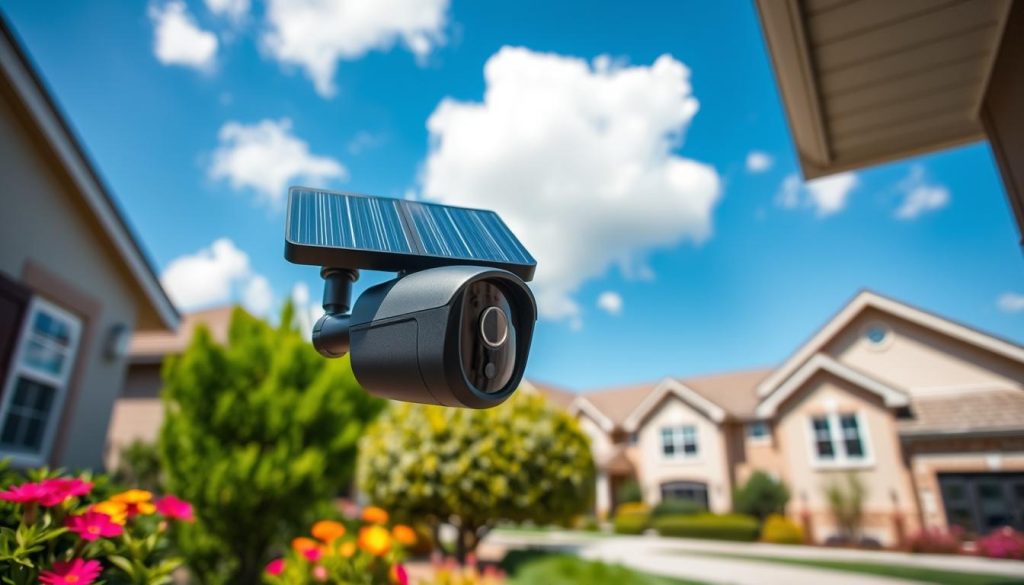
Home protection in Singapore is evolving. A new wave of sustainable technology offers a powerful solution for constant surveillance. These modern systems provide robust monitoring without the hassle of traditional wiring.
By harnessing energy from the sun, a solar-powered CCTV device ensures continuous operation. It eliminates dependence on the electrical grid. This creates a truly wire-free setup that is both flexible and reliable.
The design is specifically engineered for Singapore’s tropical climate. It withstands heavy rain, high humidity, and intense sun. This weatherproof build guarantees your system works year-round, providing unwavering security.
A major benefit is peace of mind during power outages. Your monitoring remains active when you need it most. Advanced features like high-resolution video, smart alerts, and remote access are integrated into these eco-friendly units.
This technology represents more than just a security tool. It is a smart home upgrade that combines environmental responsibility with top-tier performance for your property.
Key Takeaways
- Modern home security in Singapore can be sustainable and wire-free.
- Solar-powered systems provide continuous surveillance without grid power.
- Devices are built to withstand tropical weather like heavy rain and sun.
- They offer crucial protection and peace of mind, even during power outages.
- Advanced features like HD video and remote access come standard.
- This upgrade combines eco-friendly operation with robust performance.
Why a Solar-Powered CCTV Camera is a Smart Security Upgrade
This advancement represents a dual victory for homeowners. It delivers constant monitoring while embracing sustainable technology. The benefits extend far beyond basic functionality.
Uninterrupted Protection, Regardless of the Grid
Traditional monitoring units fail when the electricity stops. A storm can knock out lines. An intruder may cut power deliberately.
A solar-powered system avoids this flaw. It harnesses daylight to charge an integrated battery. This stored energy ensures the unit operates independently.
Your surveillance continues during a blackout. This is when robust monitoring is most crucial. As noted by Reolink, this provides continued operation when you need it most.
You gain true energy independence for your property’s defense. It is a resilient and future-proof approach to safety.
Eco-Friendly Operation and Reduced Energy Costs
This technology taps into a clean, renewable resource. It significantly reduces your home’s carbon footprint. Every hour of operation uses sustainable energy.
Compare this to the emissions from grid electricity in Singapore. The environmental benefit becomes clear. It aligns perfectly with global and local green initiatives.
The direct advantages for you include:
- Lower utility bills: The device draws power from the sun. Your monthly electricity statement remains unchanged by its operation.
- Sustainable monitoring: You contribute to a cleaner environment without sacrificing performance.
- Long-term value: The system pays for itself through savings and added resilience.
This is more than just a security device. It’s an investment in a smarter, greener home.
The Core Benefits of a Solar Powered CCTV Camera
Optimal property monitoring requires placing devices where they are most effective, not just where wires reach. This modern approach delivers three fundamental advantages: complete installation freedom, unwavering reliability, and minimal upkeep.
True Wireless Freedom and Flexible Placement
Forget the high cost and disruption of running cables. A solar-powered security camera needs no connection to a wall outlet. This allows installation in virtually any location with decent sun exposure.
You can position the unit for maximum coverage of driveways, side gates, or remote backyards. Difficult-to-wire structures like garden sheds or pergolas become easy to monitor. This flexibility is a game-changer for homes with large properties.
As Reolink notes, this design offers “true wireless freedom.” The built-in panel uses sunlight to fill the integrated battery. This keeps the device awake and recording without external power.
Continuous Operation During Power Outages
Traditional wired cameras fail when the electricity stops. A storm or a deliberate cut can disable your entire security system. This vulnerability is eliminated with a solar setup.
The battery acts as a dedicated backup power source. It is constantly recharged by the sun during the day. This ensures the unit continues its operation even during extended grid outages.
Your surveillance remains active when you need it most. This provides crucial peace of mind that conventional systems cannot match.
Low Maintenance and Long-Term Reliability
These systems are built for endurance with minimal owner intervention. The solar panel has no moving parts, making it quiet and reliable. It typically needs only occasional cleaning to maintain peak performance.
Overall build quality is designed for the long haul. Manufacturers like Hikvision engineer their products with anti-corrosion materials and high IP67 ratings. This means protection against heavy rain, dust, and humidity.
You get a durable system built to endure outdoor elements year after year. Compare this to the ongoing vulnerability of wired cameras to cuts, faults, and weather damage. The long-term reliability and reduced upkeep are clear advantages.
Designed for Singapore’s Unique Weather Conditions
Heavy downpours, relentless humidity, and blazing sun are not just weather notes. They are design specifications for a robust home defense system. A unit must be engineered to conquer these exact elements to provide dependable monitoring.
Modern surveillance technology meets this challenge head-on. It is built with specific materials and ratings for our tropical environment. This ensures unwavering security and performance no matter the conditions.
IP67 Rated Protection Against Heavy Rain and Humidity
The Ingress Protection (IP) code is your guarantee of durability. An IP67 rating is the gold standard for outdoor electronics here.
The “6” means complete protection against dust ingress. The “7” certifies the housing can withstand immersion in one meter of water for 30 minutes. This makes it ideal for monsoon rains and our high humidity levels.
As noted in industry guidelines, weatherproofing should be IP66 or higher. This handles driving rain and wind-driven dust. With this rating, your security camera remains fully operational during the fiercest storms.
Heat-Resistant Components for Tropical Sun
Constant exposure to strong light creates a major challenge: overheating. Internal components can fail if they cannot manage thermal load.
High-quality units use specially selected parts and passive cooling designs. These heat-resistant components prevent shutdowns and ensure stable operation.
Your system will function correctly from sunrise to sunset, every day. This thermal resilience is non-negotiable for consistent performance under the direct tropical sun.
Durable Construction for Year-Round Performance
Long-term reliability comes from the materials used. Manufacturers employ anti-corrosion metals and UV-stabilized plastics for the housing.
This durable construction prevents cracking, fading, and material degradation over time. It stands in stark contrast to standard devices that would quickly fail here.
Such failure leads to security gaps and the need for frequent replacements. A well-built solar security camera avoids this entirely.
You get a set-and-forget solution designed for Singapore’s climate. It delivers trustworthy, year-round monitoring for your home without weather-related downtime.
Key Features of Modern Solar Security Cameras
Beyond sustainable energy, contemporary security devices offer a suite of intelligent functions. These features transform a simple recording tool into an active, aware guardian for your property.
Modern units provide clarity, immediate alerts, and direct interaction. This creates a comprehensive monitoring system that keeps you connected and in control.
High-Resolution Video and Color Night Vision
Today’s top-tier security cameras capture stunning detail. They record in 2K, 4K, or 8MP Ultra HD resolution.
This means you get crisp, clear footage where faces and license plates are easily identifiable. Every piece of video evidence is highly detailed.
When the sun sets, the capability shines. Traditional infrared systems only show black-and-white images.
Advanced night vision technology is different. Models like those from Reolink use true full-color vision after dark.
Integrated spotlights or advanced sensors illuminate the scene. This delivers full-color video in low-light conditions. You can see what’s happening in your garden with clarity, even at night.
Advanced Motion Detection with Smart Alerts
Not all movement is a threat. Basic sensors trigger for swaying branches or passing pets. This leads to frustrating false alarms.
Intelligent motion detection solves this. It uses PIR sensors or AI analytics to classify objects.
The system can distinguish between people, vehicles, and animals. This smart filtering drastically reduces unnecessary notifications.
When genuine activity is detected, you receive instant alerts on your smartphone. This allows for an immediate response, whether you’re at home or away.
You stay informed about important events without being overwhelmed by minor ones.
Two-Way Audio and Remote Live View Access
Modern surveillance is interactive. Built-in microphones and speakers enable two-way audio communication.
You can listen to what’s happening and speak directly through the camera. Use this to greet a delivery person or warn a potential intruder.
Your control extends globally with remote live view access. A dedicated mobile app connects you to your security system from anywhere.
You can check on your property in real-time, day or night. This provides constant peace of mind and situational awareness.
Together, these features create an intelligent, interactive security system. They offer comprehensive awareness and direct control, making a modern solar-powered security camera a powerful partner in home defense.
Understanding Solar Panel and Battery Performance
The true reliability of any off-grid security system hinges on two core components: the solar panel and the battery. Their combined performance dictates whether your surveillance works seamlessly day and night. This energy duo is what enables the promise of uninterrupted, sustainable monitoring for your home.
How Solar Panels Charge in Variable Sunlight
Photovoltaic cells in the solar panel convert Singapore’s abundant sunlight directly into electrical energy. This process happens even on partly cloudy days, though at a reduced rate. The efficiency of these cells is a key factor.
Higher efficiency means more power is generated from the same amount of light. Placement also affects the charge rate. Angling the panel towards the sun’s path maximizes exposure.
Seasonal variations in daylight hours matter too. As noted by Reolink, panel efficiency is crucial for charging during brief winter days. A well-positioned unit will still gather enough energy for consistent operation year-round.
Battery Capacity and Days of Backup Power
The battery is your system’s energy reservoir. Its capacity, measured in watt-hours (Wh) or milliamp-hours (mAh), determines how long it can run without fresh sunlight.
This capacity translates directly into days of backup power. A larger battery bank provides a longer safety net during prolonged cloudy weather. Industry leaders provide clear benchmarks for this.
Hikvision, for example, highlights extended battery life with up to 7 days of continuous operation without sunlight.
This gives you a tangible time frame for expected performance. It means your solar security cameras can maintain vigilance through a week of rain.
Smart Power Management for Optimal Efficiency
Modern systems use intelligent software to optimize every watt of energy. This smart power management adjusts settings based on the battery level.
It can automatically lower video quality during low-energy periods. Recording schedules and motion sensor sensitivity can also be tuned. This ensures critical functions remain active for as long as possible.
These systems also protect the battery’s long-term health. They prevent overcharging when full and avoid deep discharge that can damage cells.
This dual approach maximizes both immediate uptime and the overall lifespan of the energy storage unit. For the user, it translates to a set-and-forget experience.
For reliable, year-round charging in Singapore’s urban environment, a simple rule applies. Ensure your solar panel has a clear view of the sky for most of the day. Avoid shadows from buildings or trees, especially during peak sun hours.
This straightforward placement guarantees your solar-powered security cameras have the energy needed for unwavering protection.
Storage Options: Local SD Card vs. Cloud Services
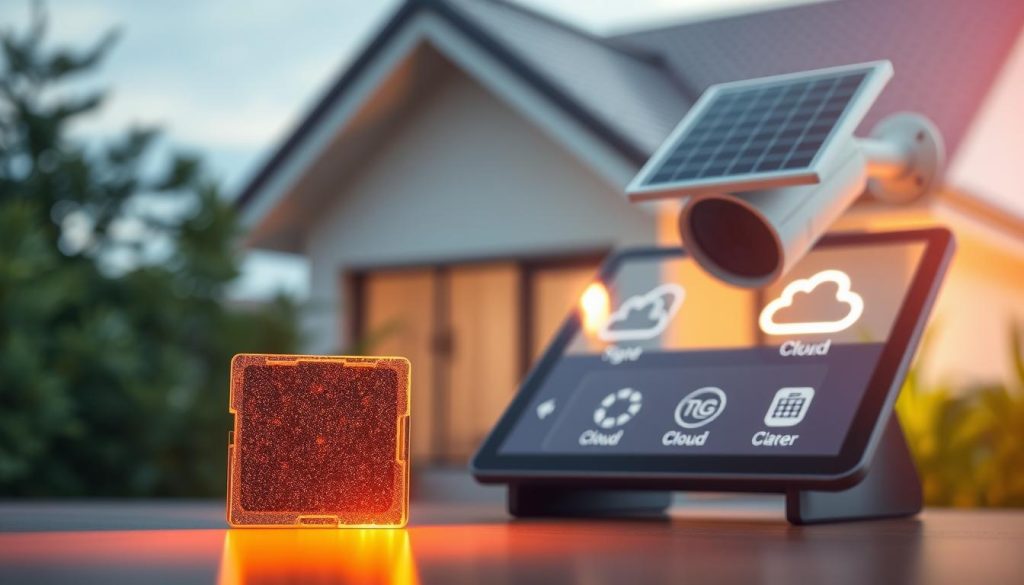
Your recorded video is the ultimate evidence, and how you store it defines your system’s effectiveness. You have two primary paths: keeping files on a device or sending them to a remote server.
Each method impacts cost, control, and long-term accessibility. The right choice balances your budget with your need for reliable evidence.
Pros and Cons of On-Device Storage
This method uses physical media inside your unit. A microSD card or a built-in SSD, as Hikvision offers, holds the data.
The advantages are clear. You pay a single, upfront cost with no monthly fees. You maintain direct control over your information.
There are significant limitations, however. Capacity is finite; cards fill up and loop-record, erasing old footage. The physical device is also at risk.
If a camera is stolen or damaged, the evidence is gone. You must also manage files manually, which takes time.
Evaluating Cloud Storage Plans and Security
Cloud services keep your video on secure, off-site servers. This offers different benefits for modern security.
You get virtually unlimited capacity and protection from local disasters like fire or theft. Remote access from any device is simple.
Many plans include advanced features like AI-powered search. The trade-off is an ongoing subscription cost and dependence on your internet connection.
When evaluating a plan, check the video retention period. Look for 7, 14, or 30-day options. See how many cameras are covered.
Data encryption standards are crucial for security. Reputable providers use strong encryption both in transit and at rest.
Reolink notes that local cards are cheap but fill up. Cloud plans cost more, yet keep files off-site.
Always use strong, unique passwords and enable two-factor authentication for your cloud account. This adds a critical layer of protection.
For the most robust setup, consider a hybrid approach. Use local storage for immediate review and frequent events. Back up critical alerts or continuous streams to the cloud.
This strategy ensures you have instant access and a fail-safe backup. Your choice in storage directly affects the reliability and usability of your entire monitoring system.
A well-planned solar-powered security camera setup is only as good as its ability to preserve what it sees.
Technical Specifications You Should Consider
To ensure your investment delivers, you must understand the key technical metrics that govern video quality, connectivity, and durability. These specs are the foundation of real-world performance for your home monitoring.
Video Resolution and Field of View
Image clarity is paramount. Resolution, measured in megapixels (MP), defines the detail in your footage. Common options are 8MP, 5MP, and 3MP.
Higher resolution means you can identify faces or license plates from a greater distance. This turns vague blobs into usable evidence.
Field of view (FOV), measured in degrees, determines how much area a single device covers. A wide-angle lens, like 120°, monitors a large backyard.
A narrower FOV, such as 60°, provides more detailed vision on a specific choke point like a front gate. Choose based on your coverage needs.
Connectivity: Wi-Fi vs. 4G LTE for Remote Areas
How your unit sends data is critical. Most homes use Wi-Fi. Dual-band options (2.4GHz and 5GHz) offer a stable, high-speed link for features like live streaming.
For remote areas like a garden shed or a street-side gate, Wi-Fi signals can be weak. Here, a 4G LTE model is the superior choice.
These devices use a cellular data SIM card, just like a smartphone. They create their own network connection independent of your home router.
This ensures reliable remote access and alert transmission from any location. It’s the definitive solution for complete property coverage.
Ingress Protection (IP) Rating and Operating Temperature
A device’s physical resilience is non-negotiable in our climate. The IP rating certifies its defense against solids and liquids.
For Singapore, look for IP66 or IP67. The first number ‘6’ means total dust protection. The second number indicates resistance to powerful water jets or temporary immersion.
This rating guarantees your system survives monsoon rains and high humidity. Operating temperature range is equally vital.
Ensure the unit is rated to function in our sustained heat. A broad range (e.g., -20°C to 50°C) confirms internal components are built for tropical conditions.
Match these specifications to your specific needs. Use a wide FOV for open spaces, 4G for distant points, and high resolution for critical identification zones.
Remember, these technical settings are often fixed at purchase. Careful selection now prevents limitations later.
Installation and Setup: A Straightforward Process
A successful installation balances two critical factors: energy collection and surveillance coverage. Modern kits are engineered for do-it-yourself success, saving you significant professional fitting costs.
You can complete the entire process in just a few hours. The following steps will guide you from unboxing to a fully operational system.
Choosing the Optimal Location for Sun and Coverage
Begin with a thorough site survey. Your goal is to find a spot with a clear view of the monitored areas and strong, direct light.
Conduct this survey around noon. Note the sun’s path and any potential shading from trees or structures throughout the day.
For Singapore’s latitude, orient the solar panel to face roughly true south. Angle it between 30 to 45 degrees for maximum daily energy harvest.
Also, verify your Wi-Fi signal strength at the chosen mounting point. A weak signal will hinder remote access and smart alerts.
Mounting the Camera and Solar Panel Correctly
Use the provided brackets to secure both units. Mount them on a wall, eave, or a sturdy pole.
Ensure all fittings are tight to withstand wind and weather. Manufacturers design these systems for durability.
Hikvision notes an easy installation with a net weight of 14 kg, indicating a solid, stable build.
A single, weatherproof cable typically connects the panel to the camera for charging. Route this cable neatly to maintain a clean look.
Connecting to Your Network and Mobile App
Power on your device and connect it to your home Wi-Fi network. For remote areas without a strong signal, insert a 4G LTE SIM card instead.
Next, download the manufacturer’s mobile app to your smartphone. Create a user account to manage your system.
Initial configuration is done through this app. Key settings to adjust include:
- Naming the camera for easy identification.
- Setting up motion detection zones to focus on important activity.
- Linking to your chosen storage method, whether local SD card or cloud service.
Once configured, you have full remote access to live views and recordings. This solar-powered security setup is now active, providing sustainable, reliable monitoring for your property.
Comparing Solar CCTV to Traditional Wired Systems
Evaluating two distinct paths for home surveillance reveals significant differences in setup, reliability, and long-term cost. This comparison helps you make an informed choice for your property’s protection.
Installation Flexibility and Cost
Wire-free units offer unmatched placement freedom. You can install them anywhere with good sunlight, without electrical work.
Traditional setups require proximity to a power outlet. They often need conduit and extensive cabling.
This increases complexity and professional labor costs. A solar-powered security system avoids these hurdles entirely.
Ongoing Operational Reliability
Grid-dependent cameras fail during blackouts. Storms or deliberate cuts can disable your entire network.
An energy-independent system is immune to these outages. Its battery ensures continuous performance.
There are also fewer physical points of failure. No wires exist for intruders to cut or for weather to degrade.
Total Cost of Ownership Over Time
The initial purchase price for a modern unit is often higher. The math changes when you consider the full picture.
Wired devices have lower hardware costs. They incur ongoing electricity usage and potential wiring repair bills.
The upfront cost is higher than a plug-in camera, but the math shifts when wiring is tough or utility bills rise. Value of coverage during a power cut favors solar.
A solar camera eliminates electricity costs for the device. It also reduces maintenance over time.
Scalability is another advantage. Adding more units is simpler without new wiring runs.
Aesthetic and practical benefits are clear. No visible cables help maintain your property’s clean look.
For locations with constant, easy access to power and no outage concerns, a wired security camera might still suit.
For most Singaporean homes seeking resilient, flexible, and modern security, a solar-powered setup presents a superior long-term value proposition.
Evaluating the Cost and Long-Term Value
A smart investment in home defense requires looking beyond the initial price tag to the total value over time. This analysis reveals why modern, sustainable systems often provide superior financial and practical benefits.
Understanding the Initial Investment
The purchase price for a complete unit includes several integrated components. You pay for the high-resolution imaging device, the photovoltaic panel, a rechargeable battery pack, and all mounting hardware.
This initial outlay is typically higher than for a basic plug-in monitoring device. The premium covers the advanced solar technology and the wireless, self-sufficient design.
The upfront cost is higher than a plug-in camera. No monthly fee exists for the unit itself; costs appear only for optional cloud storage or cellular data. Some brands bundle limited free cloud service.
This one-time investment establishes a fully independent surveillance point.
Savings on Electricity and Wiring Costs
Operational savings begin immediately. A traditional wired device draws a continuous trickle of grid electricity. Over several years, this adds a small but recurring amount to your utility bills.
A sun-powered system uses free, renewable energy. This eliminates the device’s electricity cost for its entire lifespan.
The savings on installation are often more significant. Running conduit and cables to remote locations like a side gate or garden shed requires labor and materials.
Trenching or complex cabling can be expensive. A wire-free unit avoids these costs entirely, as it needs no physical connection to your home’s electrical system.
The Value of Uninterrupted, Sustainable Security
The most compelling value may be intangible. During a blackout, a grid-dependent system goes dark. Your property is left unprotected precisely when risks can be higher.
An energy-independent unit ensures continuous monitoring. This provides peace of mind that is difficult to price but incredibly valuable.
Choosing an eco-friendly option aligns with sustainable living values. It reduces your household’s carbon footprint.
This feature can also increase your property’s appeal to environmentally conscious buyers. It represents a modern, forward-thinking upgrade.
While the sticker price may be higher initially, the long-term value is clear. You gain operational savings, installation flexibility, and unwavering resilience.
This makes a solar-powered security system a financially and ethically sound choice for lasting home protection.
Making the Informed Choice for Your Home Security
With various advanced options available, making an informed choice requires careful consideration of durability, features, and value. Focus on units built for Singapore’s tropical climate, with high IP ratings and heat-resistant components.
The independence offered by solar-powered systems provides crucial reliability during grid outages. Assess your property’s layout and sun exposure to ensure optimal placement.
Prioritize your security needs, whether it’s clear night video or smart motion alerts. Reputable brands like Reolink and Hikvision offer proven performance with the necessary ratings and battery life.
This decision represents a forward-thinking investment in a secure and sustainable home. It delivers long-term peace of mind through resilient operation.
Take the next step by researching specific models that match your criteria. Check the solar potential for your installation spots. Consulting with a security specialist can provide tailored advice.
By choosing a modern, energy-independent system, you opt for robust protection that stands the test of time and weather.