
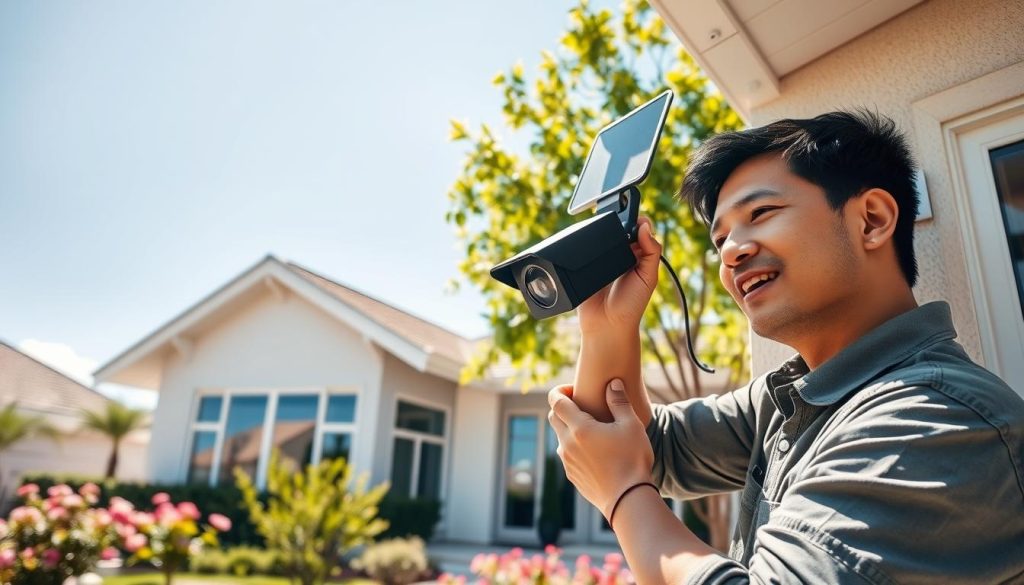
Protecting your property has evolved with modern technology. Sun-powered protection devices offer a smart, sustainable approach to monitoring. They work independently from your electrical grid.
In Singapore, these systems are gaining significant traction. Rising utility expenses and growing environmental awareness drive this trend. Homeowners seek efficient solutions that align with green values.
The benefit is twofold. You get reliable surveillance for your residence while reducing your carbon footprint. It’s a practical step toward more sustainable living.
Singapore’s climate is perfectly suited for photovoltaic technology. Consistent sunshine throughout the year provides ample renewable energy. This makes such units exceptionally effective here.
This guide compares top-rated models from leading brands. We examine Reolink, Eufy, Ring, and Arlo products in detail. Our goal is to help you choose the right system based on your specific needs and budget.
Key Takeaways
- Sun-powered monitoring systems provide reliable protection without wiring.
- These devices help lower electricity bills and environmental impact.
- Singapore’s sunny climate is ideal for renewable energy solutions.
- Leading brands offer various models with different features and price points.
- Key factors include battery life, video quality, and smart connectivity.
- A proper installation maximizes solar charging efficiency.
- Choosing the right unit depends on your property’s layout and security needs.
The Rise of Sustainable Home Security in Singapore
A quiet revolution is underway in residential protection, merging environmental responsibility with personal safety. More households are choosing technologies that align with both green values and practical needs. This shift reflects broader societal changes toward eco-conscious living.
Why Solar Power is a Perfect Fit for the Local Climate
Singapore’s tropical environment offers an ideal setting for photovoltaic technology. The nation enjoys over 2,500 hours of bright sun every year. This consistent daylight provides ample renewable energy for various applications.
Such abundant resources make sun-powered devices exceptionally reliable here. They can operate independently from the main electrical grid. This independence is crucial for locations where wiring is difficult or expensive.
The local government actively promotes green initiatives, aiming to increase renewable capacity significantly by 2030. Adopting these monitoring systems supports national sustainability targets. Homeowners contribute to environmental goals while securing their property.
Photovoltaic panels work efficiently even on partly cloudy days in this region. Their performance remains strong throughout different seasons. This reliability ensures continuous operation for protection equipment.
Addressing Growing Home Security Concerns
Recent surveys show that over 70% of residents worry about theft and safety. This concern drives demand for dependable surveillance solutions. People want systems that work consistently without interruption.
Sun-powered units address this need effectively. They maintain operation during power outages, which can occur during storms. This provides continuous monitoring when it’s needed most.
These devices offer peace of mind through their autonomous nature. You can place them in remote areas of your garden or perimeter. Their wire-free design eliminates complex installation challenges.
This approach represents more than just a technological gadget. It’s a practical response to dual priorities: environmental stewardship and personal protection. Modern households can achieve both objectives with a single, smart investment.
Key Benefits of Choosing a Solar-Powered Security Camera
The decision to adopt sun-powered monitoring brings multiple practical rewards beyond basic protection. These photovoltaic units deliver advantages in three key areas: financial savings, reliability, and installation flexibility. Each benefit contributes to a smarter approach for your property.
Significant Reduction in Energy Costs and Carbon Footprint
Photovoltaic surveillance technology slashes electricity consumption dramatically. Studies show these devices can cut energy costs by up to 75% compared to traditional wired models. This creates immediate savings on your monthly bills.
The environmental impact is equally impressive. A single unit reduces carbon emissions by hundreds of kilograms annually. This aligns perfectly with Singapore’s sustainability goals.
Over several years, the operational savings become substantial. Wired systems incur ongoing electricity expenses that add up. Sun-charged alternatives eliminate this recurring cost entirely.
Uninterrupted Security During Power Outages
Blackouts pose no threat to these autonomous monitoring systems. Their integrated battery reserves ensure continuous operation when the grid fails. This provides peace of mind during storms or electrical maintenance.
Advanced models can function for up to seven days without direct sunlight. The photovoltaic panel efficiently harvests energy even on cloudy days. Your surveillance remains active through various weather conditions.
This reliability is crucial for comprehensive property protection. You never face gaps in monitoring due to power issues. The system maintains vigilance exactly when it’s needed most.
Flexible, Wire-Free Installation Anywhere on Your Property
Installation becomes a simple DIY project, often completed in under an hour. You avoid professional fees that typically accompany wired setups. The process requires basic tools and minimal technical knowledge.
This approach prevents structural damage from extensive drilling. There are no unsightly cables running across walls or through gardens. Your property’s aesthetics remain intact while gaining advanced monitoring.
Placement flexibility is perhaps the greatest advantage. You position units in optimal surveillance spots without outlet constraints. Remote corners, garden sheds, and perimeter fences all become viable locations.
This adaptability extends to future changes. You can easily relocate devices as your needs evolve. The system grows with your property without complicated rewiring projects.
How Solar-Powered Wireless Security Cameras Work
At its core, a wireless photovoltaic monitoring system operates through a clever energy conversion process. This technology transforms abundant natural light into reliable electrical power for continuous surveillance. The entire setup functions autonomously, requiring minimal intervention from homeowners.
These devices represent a smart fusion of renewable energy harvesting and digital protection. They eliminate dependency on traditional electrical grids while maintaining vigilant watch over your property. Understanding this process helps appreciate their reliability in Singapore’s climate.
The Role of the Solar Panel and Battery System
The technological workflow begins with sunlight striking the photovoltaic panel. Specialized cells within this panel convert photons into direct current electricity. This energy then travels through a charge controller, which regulates the flow.
The controller protects the battery from overcharging during peak daylight hours. It ensures optimal charging rates regardless of intensity variations. Managed energy then gets stored in high-capacity rechargeable batteries.
These batteries serve as the system’s power reservoir. They supply electricity to the monitoring unit during nighttime and cloudy periods. Advanced lithium-ion batteries can retain charge for extended durations.
Energy efficiency features significantly extend operational life. Motion-activated recording conserves precious battery reserves. The device remains in low-power standby until detecting movement.
Only then does it activate full recording and transmission functions. This intelligent management allows some models to function for months between charges. Proper battery capacity planning ensures uninterrupted operation.
Ensuring Continuous Operation in All Weather Conditions
Singapore’s tropical climate presents unique challenges with frequent rain showers. Modern systems address this through robust battery backup capabilities. Even during prolonged cloudy days, well-designed units maintain functionality.
Hybrid systems offer additional reassurance for concerned homeowners. These configurations can connect to a standard power outlet for trickle charging. This backup activates only when photovoltaic harvesting proves insufficient.
“The integration of smart battery management with efficient photovoltaic harvesting creates a truly resilient monitoring solution that stands up to tropical weather patterns.”
Wireless connectivity forms the communication backbone of these setups. Wi-Fi transmits footage directly to your smartphone or cloud storage. For areas with weak Wi-Fi signals, 4G LTE options provide reliable alternatives.
This dual-connectivity approach ensures you receive alerts and can view live feeds consistently. Data transmission occurs only when necessary to conserve energy. The entire system prioritizes efficiency without compromising protection.
Manufacturers engineer these units for 24/7 reliability with minimal maintenance. Self-diagnostic features alert you to any performance issues. Routine checks involve simply wiping the photovoltaic panel surface.
Homeowners can trust that their investment delivers consistent performance year-round. The technology has matured to handle Singapore’s specific environmental conditions. You gain peace of mind knowing your monitoring remains active regardless of weather.
Essential Features to Look for in a Solar Security Camera
Beyond the basic promise of wireless operation, the true value of a sun-powered surveillance unit lies in its detailed features. These technical specifications determine how well it will perform in real-world conditions. A careful evaluation ensures you get a system that meets your specific needs.
Video Resolution and Night Vision Capability
Clarity is non-negotiable for effective monitoring. Look for a minimum of 1080p high-definition video. Premium models offer 2K or 4K resolution, providing crystal-clear details like faces or license plates.
This sharpness is crucial for identifying important details after an event. It transforms footage from a simple recording into usable evidence.
After sunset, night vision takes over. Standard infrared provides black-and-white images. Advanced color night vision is a superior feature.
It uses ambient light or built-in spotlights to deliver full-color footage in low-light conditions. This can be invaluable for distinguishing clothing colors or vehicle details in the dark.
Battery Life and Solar Charging Efficiency
Autonomy is a key advantage. Battery life refers to how long the device can run on a single charge without sunlight. Top-tier units can operate for several months under optimal conditions.
The integrated solar panel works to replenish this power daily. Its efficiency determines how quickly it can recharge the battery, even on partly cloudy days.
Together, these systems create a sustainable power cycle. You want a balance between a large battery capacity and high-efficiency photovoltaic panels. This combination guarantees uninterrupted operation.
Motion Detection Sensitivity and Smart Alerts
Basic motion detection can trigger frequent false alarms from leaves or shadows. Modern systems use AI to analyze what the camera sees.
This smart technology can distinguish between a person, a vehicle, and a pet. You receive targeted alerts on your phone, so you know what’s happening without constant notifications.
This feature saves hours of review time and conserves battery. It focuses your attention on events that truly matter for your property’s safety.
Durability and Weather Resistance Rating (IP Rating)
Outdoor devices must withstand the elements. The Ingress Protection (IP) rating is your guide to durability. For Singapore’s tropical climate, look for a rating of IP66 or higher.
An IP66 rating means the unit is completely dust-tight. It is also protected against powerful water jets from any direction. This is essential for handling heavy monsoon rains.
This robustness ensures long-term reliability. Your investment remains protected year-round, requiring minimal maintenance beyond occasional cleaning.
Additional features add significant value. A wide viewing angle covers more area with fewer devices. Two-way audio lets you communicate with visitors or deter intruders.
Integrated sirens or spotlights act as powerful deterrents. Remember, the right combination of these features determines overall value, not just the initial price.
Top Picks: Comparing the Best Solar Security Cameras for Home
A detailed examination of leading brands reveals important differences in performance, pricing, and functionality. Each manufacturer brings unique strengths to the table. Understanding these distinctions helps you make an informed investment.
We evaluated units based on real-world testing and user feedback. Key metrics include video clarity, battery longevity, and smart features. Our analysis focuses on what truly matters for daily use in Singapore’s environment.
Side-by-Side Analysis of Leading Models
The market offers several excellent photovoltaic protection units. Each has distinct advantages for different homeowner priorities. A comparison table (included in the final article) summarizes price, rating, and key specifications.
This table highlights which models excel in specific categories. You can quickly identify units suited for budget-conscious buyers or those prioritizing premium features. The data comes from extensive testing and verified customer reviews.
Beyond basic specs, we consider integration ease and long-term reliability. Some systems offer better value through included storage or reduced subscription fees. These factors significantly impact total cost of ownership.
Reolink Argus Series: Balancing Performance and Value
Reolink’s Argus lineup delivers impressive capability at accessible price points. The Argus 3 Pro earns a 4.4/5 rating with a cost around $150. Its 5MP resolution provides sharp details for identification.
This unit stands out for reliable photovoltaic charging. The integrated panels efficiently power the device throughout Singapore’s seasons. Users report consistent operation with minimal maintenance required.
Batteries can last up to six months on a single charge under optimal conditions. This makes it ideal for locations with consistent sunlight exposure. The balance of affordability and performance appeals to value-focused shoppers.
EufyCam Systems: Integrated Local Storage and AI Detection
Eufy prioritizes privacy through local data storage. The EufyCam 3 package ($549.99 for two units) includes 16GB built-in memory. Its base station offers massive 16TB capacity for extended recording.
Advanced AI enhances motion detection accuracy significantly. The system distinguishes between people, pets, and vehicles with precision. This reduces false alerts and focuses attention on relevant events.
This approach eliminates monthly cloud subscription fees. Your footage remains on-premises, giving you complete control. For homeowners concerned about data privacy, Eufy presents a compelling solution.
Ring and Arlo: Seamless Ecosystem and Smart Home Integration
Ring and Arlo excel at connecting with broader smart home environments. Their devices work harmoniously with Amazon Alexa and Google Assistant. This creates a unified control system for your entire property.
The Ring Stick Up Camera Solar ($139.98) emphasizes straightforward installation. Its 1080p video quality meets basic monitoring needs effectively. The user-friendly app simplifies daily management.
Arlo’s Pro 3 Floodlight ($249.99) offers superior 2K resolution and wireless convenience. Both brands provide optional professional monitoring plans. These services add an extra layer of protection through 24/7 alert response.
“The true advantage of ecosystem-focused brands lies in their seamless interoperability. You manage lighting, monitoring, and alerts through a single interface.”
Other notable contenders deserve mention. Google Nest devices pair with Wasserstein photovoltaic panels for reliable charging. Lorex offers robust units designed for challenging environmental conditions.
Budget-conscious shoppers might consider the Wyze Battery Cam Pro at $99.98. It delivers core functionality at an entry-level price point. Each brand caters to specific user preferences and technical requirements.
Choosing the right model depends on your primary priorities. Value seekers often prefer Reolink’s cost-effective performance. Privacy-focused users gravitate toward Eufy’s local storage approach.
Smart home enthusiasts benefit from Ring and Arlo’s extensive integrations. Those prioritizing video clarity might select Arlo’s 2K resolution. Consider both immediate needs and future expansion plans.
All these options provide reliable photovoltaic-powered monitoring. Your decision should align with your property’s layout and personal preferences. Each system brings distinct advantages to residential protection.
Understanding Pricing and Value for Singaporean Homeowners
The price tag on a sun-powered surveillance unit tells only part of the economic narrative. A complete evaluation requires examining both immediate costs and future financial benefits. This perspective reveals why these devices represent a smart investment rather than just an expense.
Singaporean property owners face unique considerations. The local climate enhances photovoltaic efficiency dramatically. This accelerates the return on your initial outlay compared to regions with less consistent sunlight.
Initial Investment vs. Long-Term Operational Savings
Quality photovoltaic monitoring systems often carry a higher upfront cost than basic wired alternatives. Expect to invest between SGD 100 for entry-level units and SGD 600+ for premium setups. This initial amount includes the camera, photovoltaic panel, and mounting hardware.
The long-term savings story is compelling. These autonomous systems can reduce electricity consumption by up to 75%. You eliminate monthly power costs associated with traditional wired devices.
Additional savings come from installation. Professional electrician fees for complex wiring are completely avoided. Most homeowners can install these units themselves in under an hour.
Consider this breakdown over three years:
- Wired System: SGD 200 (device) + SGD 300 (installation) + SGD 180 (electricity)
- Photovoltaic System: SGD 350 (device) + SGD 0 (DIY installation) + SGD 0 (electricity)
The photovoltaic option becomes more economical after approximately 18 months. In Singapore’s sunny climate, this payback period can be even shorter. The consistent daylight ensures optimal charging efficiency year-round.
What You Get at Different Price Points
The market offers distinct tiers with corresponding feature sets. Understanding these differences helps you allocate your budget effectively. Each price bracket delivers specific capabilities for residential monitoring.
In the SGD 200-300 range, expect solid core functionality. Standard features include:
- 1080p high-definition video quality
- Basic motion detection without AI filtering
- Standard infrared night vision (black & white)
- Weather resistance suitable for local conditions
- Rechargeable battery lasting several months
Premium systems costing SGD 500+ deliver advanced performance. These models typically offer:
- 4K ultra-high-definition resolution for crystal-clear details
- Advanced AI that distinguishes people, vehicles, and animals
- Color night vision using ambient light or built-in spotlights
- Larger local storage capacity (16GB or more)
- Facial recognition capabilities in some units
- Integrated sirens or deterrent lights
“The most cost-effective approach often involves purchasing bundled multi-camera packs. These packages provide better value per device compared to buying individual units and panels separately.”
Storage options significantly impact total cost of ownership. Some brands offer free local storage through built-in memory or base stations. Others require monthly subscriptions for cloud recording services.
Popular subscription plans like Ring Protect or Arlo Smart typically cost SGD 40-80 annually per device. These services provide extended video history and additional features. Local storage alternatives eliminate this recurring expense entirely.
Consider your property’s specific needs when choosing between these options. A single high-end unit might suffice for monitoring a main entrance. Larger properties often benefit from multiple mid-range devices covering different angles.
View this purchase as a dual investment. You’re securing your residence while managing long-term utility expenses. The technology pays for itself through operational savings and enhanced peace of mind.
For Singaporean conditions, the financial logic is particularly strong. Abundant sunshine maximizes photovoltaic panel output every day. This ensures your system operates at peak efficiency with minimal downtime.
The Core Advantages of a Wireless Solar Security System
Wireless design transforms property surveillance from a static installation to a dynamic, adaptable solution. This approach liberates homeowners from the limitations of traditional wired setups. You gain unprecedented freedom in placement and expansion.
The complete absence of cables represents more than just convenience. It fundamentally changes how you think about protecting your residence. Your monitoring strategy becomes fluid rather than fixed.
Eliminating Complex Wiring and Professional Installation Fees
Traditional protection systems often require extensive electrical work. This means drilling through walls and running unsightly cables. Professional electrician fees can add hundreds to your initial cost.
A photovoltaic-powered unit eliminates all these complications. Most homeowners complete the setup in under an hour with basic tools. You simply mount the bracket and align the photovoltaic panel toward the sun.
This DIY approach saves significant money immediately. There’s no need to hire specialists or modify your property’s structure. The process is straightforward enough for anyone to manage.
The mounting process typically involves just a few screws. You position the bracket where you want coverage. Then attach the device and connect it to the independent power source.
Aligning the solar panel correctly ensures optimal energy harvesting. In Singapore’s climate, south-facing placement captures maximum sunlight. This guarantees your battery remains charged throughout the year.
“The financial savings begin the moment you choose a wire-free system. You avoid professional installation costs entirely while gaining flexible monitoring that grows with your needs.”
Easy Relocation and System Expansion
Scalability is a cornerstone benefit of these autonomous systems. You can start with one or two units covering key entry points. Later, expand coverage area by area as your budget allows.
Adding new devices requires no complex rewiring projects. Each additional unit operates independently with its own power source. This modular approach makes gradual investment practical.
Easy relocation proves invaluable for several situations. Renters can take their entire monitoring setup when moving. Seasonal changes might shift focus to pool areas in summer or holiday decorations in winter.
Contrast this with traditional wired CCTV options. Those systems become permanent fixtures once installed. Modifying them involves costly electrical work and potential property damage.
Modern photovoltaic panels and their connected devices offer true adaptability. You respond to changing security needs without major reinvestment. This flexibility aligns perfectly with evolving family requirements.
The core theme connects sustainable technology with practical living. You maintain vigilant protection while embracing an adaptable approach. Your investment supports both immediate safety and long-term convenience.
Installation Process for Your Solar Outdoor Camera
A successful DIY installation requires attention to three critical factors: sunlight exposure, mounting stability, and network connectivity. Getting these elements right from the start ensures your photovoltaic monitoring device operates reliably. The process is designed to be straightforward for homeowners.
Most modern systems come with clear instructions and intuitive apps. You can typically complete the entire setup in under two hours. Proper placement maximizes both surveillance coverage and energy harvesting efficiency.
Following this guide will help you avoid common pitfalls. You’ll achieve optimal performance from your new protection system. Let’s walk through each step methodically.
Step 1: Selecting the Optimal Location for Sunlight and Coverage
Begin by surveying your property with two objectives in mind. First, identify spots with clear sightlines to monitor entry points or valuable areas. Second, ensure those locations receive sufficient direct sunlight throughout the day.
Your photovoltaic panel needs at least four to six hours of strong sunlight daily. This keeps the internal batteries fully charged. In Singapore, south-facing positions typically capture the most intense rays.
Consider seasonal changes in the sun’s path. What works in December might differ from June. Choose a location with minimal shading from trees, walls, or other structures.
Simultaneously, think like a protector. Position the camera to cover walkways, gates, or garage doors. Avoid pointing it directly at reflective surfaces or bright lights that could trigger false alerts.
Test the spot for a full day if possible. Observe how shadows move across the area. This reconnaissance ensures your chosen location meets both energy and surveillance needs.
Step 2: Mounting the Camera and Solar Panel Correctly
Once you’ve identified the perfect spot, it’s time for physical installation. You’ll need basic tools: a drill, screws, and possibly a ladder. Most kits include mounting brackets and hardware.
Position the monitoring unit approximately eight to ten feet high. This height provides a broad field of view. It also places the device out of easy reach, preventing tampering.
Secure the bracket firmly to a wall, eaves, or post. Ensure it’s level and stable. Then attach the security camera according to the manufacturer’s directions.
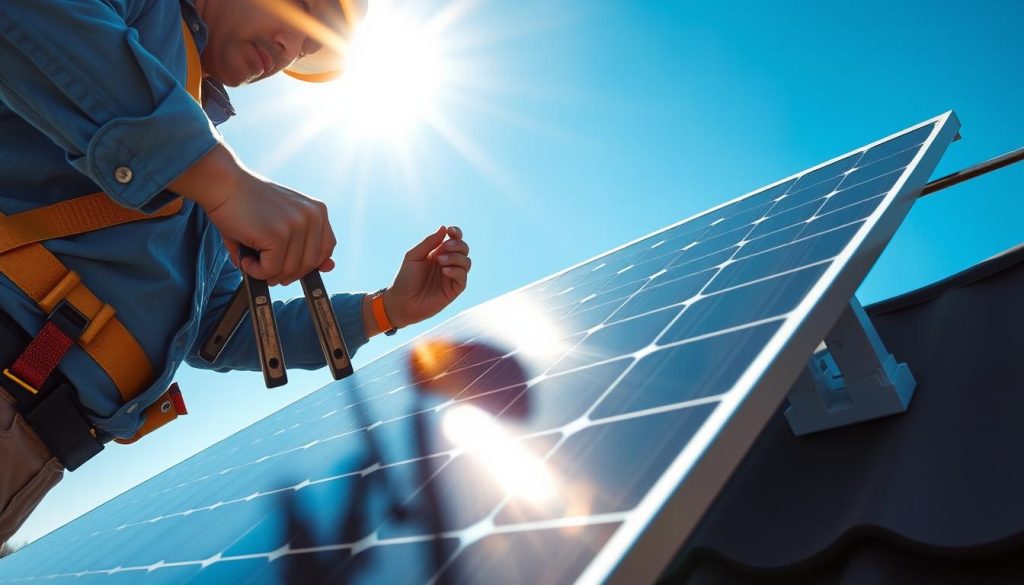
Now focus on the energy source. Orient the photovoltaic panel to face roughly south. Tilt it at a thirty to forty-five degree angle for maximum exposure.
Many panels have adjustable brackets. This lets you fine-tune the angle as seasons change. A proper setup captures more energy, extending operational time between charges.
Connect the panel’s cable to your monitoring device. Route the wire neatly to avoid tripping hazards or damage. Use included clips or conduit for a clean appearance.
“Taking time to mount both components securely pays dividends in long-term reliability. A wobbly bracket or poorly angled panel compromises the entire system’s effectiveness.”
Step 3: Connecting to Wi-Fi and Configuring the App
The final phase involves software setup. Download the manufacturer’s application to your smartphone or tablet. Create an account if you don’t already have one.
Power on your monitoring device. Typically, you’ll scan a QR code found on the unit or its packaging. This pairs the hardware with your mobile app.
Follow prompts to connect the device to your home Wi-Fi network. Choose the 2.4GHz band for better range through walls. Ensure you have strong signal strength at the installation site.
Weak connectivity causes laggy video feeds and missed alerts. If signal is poor, consider a Wi-Fi extender. Alternatively, some models offer 4G LTE cellular options for remote locations.
Once connected, configure your preferences. Set motion detection zones to focus on important areas. Adjust sensitivity to avoid false alarms from passing animals or swaying plants.
Create notification rules so you’re alerted for human detection but not every car that passes. Test the live view and two-way audio if available. Your home security system is now active.
Troubleshooting Common Installation Issues
Even with careful planning, you might encounter minor challenges. Most have simple solutions that don’t require professional help.
If the photovoltaic panel isn’t charging adequately, check for obstructions. Clean the surface of dust or bird droppings. Adjust the angle to capture more morning or afternoon light.
For connectivity problems, move your router closer or install a mesh network node. Ensure your Wi-Fi password is entered correctly during setup. Restart both the router and monitoring device.
Poor video quality often stems from incorrect placement. Reposition the unit to avoid backlight from windows or glare. At night, ensure infrared LEDs aren’t blocked by cobwebs or foliage.
Remember that initial battery charging might take a full sunny day. Don’t worry if the unit indicates low power immediately after installation. The system needs time to build up reserves.
For comprehensive guidance on outdoor setups, explore our detailed resource on solar wireless security cameras for outdoor. It covers advanced placement strategies for larger properties.
Following these steps correctly is key to achieving the promised battery life and reliability. Modern photovoltaic monitoring systems are designed for user-friendly setup. With proper installation, your new guardian will provide peace of mind for years to come.
Maintaining Your Solar Camera for Peak Performance
While these systems require minimal attention, a few simple routines maximize their effectiveness. Consistent upkeep ensures your photovoltaic monitoring device operates reliably throughout the year. This protects your investment and guarantees continuous protection for your property.
Neglecting basic maintenance can significantly impact performance. Dusty panels or aging batteries reduce efficiency when you need it most. Fortunately, these tasks are quick and infrequent.
Routine Cleaning of Solar Panels
Photovoltaic panels need clear surfaces to capture energy effectively. In Singapore’s environment, dust and rain residue accumulate over time. This buildup can reduce charging efficiency by 10-15%.
Clean your panels every two to three months for optimal results. More frequent cleaning helps in particularly dusty areas or after heavy monsoon seasons. A simple approach keeps them working at full capacity.
Use a soft cloth with mild soap and water for safe cleaning. Avoid abrasive materials that could scratch the sensitive surface. Gently wipe away debris to restore maximum light absorption.
Check panel alignment during cleaning sessions. Ensure they still face the optimal direction for capturing sunlight. A slight adjustment can significantly improve daily energy harvest.
Monitoring Battery Health and System Alerts
Your device’s companion mobile app provides valuable insights into power status. Regularly check battery levels and charging patterns through this interface. Most apps display clear indicators for charge percentage and estimated runtime.
Rechargeable batteries typically last two to three years before needing replacement. Signs of aging include shorter operation times between charges. The app may also show declining maximum capacity over months of use.
Heed system alerts for low battery or poor connectivity promptly. These warnings help you address issues before they affect surveillance. A timely response maintains uninterrupted monitoring.
Consider seasonal checks, especially before and after monsoon periods. Verify weather seals remain intact around the unit housing. This prevents moisture damage during heavy tropical rains.
“Regular maintenance transforms a reliable device into a durable guardian. Those few minutes every quarter pay dividends in year-round performance and peace of mind.”
Test all functions quarterly to ensure everything works as intended. Verify motion detection zones still cover important areas accurately. Check that alert notifications reach your smartphone without delay.
This simple, infrequent task guarantees your system’s longevity. You protect both your property and your financial investment. Proper care ensures your photovoltaic monitoring solution serves you well for years to come.
Smart Home Integration and Remote Monitoring
The true power of contemporary surveillance technology emerges when it seamlessly integrates with your daily digital life. These devices become central components of a modern, connected residence. They offer interactive control through both voice commands and mobile applications.
This integration transforms basic monitoring into an intelligent protection network. You gain real-time awareness of your property from anywhere. The convenience fundamentally changes how you manage safety.
Connecting with Amazon Alexa and Google Home
Most leading brands offer integration with popular voice assistants. You can link your monitoring system to Amazon Alexa or Google Assistant. This enables hands-free control through simple voice commands.
Say “Alexa, show me the front yard” to view live footage on an Echo Show. Ask Google Assistant to arm the system when leaving. Voice control adds a layer of convenience to daily routines.
Smart screens display live feeds when motion is detected. You see who’s at the door without checking your phone. This seamless connection creates a unified smart home experience.
Using Mobile Apps for Live View and Alert Management
Manufacturer applications provide comprehensive control from your smartphone. These apps deliver instant push notifications when activity occurs. You receive snapshots or short video clips with each alert.
The remote live view function lets you check your property in real-time. Access the feed from anywhere with an internet connection. This provides peace of mind while traveling or at work.
Two-way talk allows communication through the device. Speak to delivery personnel or deter unwanted visitors. The app becomes your remote command center.
Customizing motion zones focuses detection on important areas. Ignore passing cars while monitoring entry points. This reduces false alarms and conserves battery life.
Managing recorded footage involves choosing between storage options. Cloud storage offers accessibility from any device, often with a subscription fee. Local storage provides a one-time cost and enhanced privacy.
Advanced app features include scheduling armed and disarmed times. Share access with family members for collaborative monitoring. Review activity history through organized timelines.
“The mobile application transforms your smartphone into a portable monitoring station. You maintain constant connection to your property’s safety without being physically present.”
This seamless integration represents a major quality-of-life improvement. Daily security management becomes intuitive and effortless. You enjoy comprehensive protection that adapts to your lifestyle.
What Users Say: Reviews and Reliability in Real Conditions
Customer reviews offer invaluable insights that no product brochure can fully capture. These firsthand accounts reveal how monitoring devices actually perform after months of daily use. They highlight both strengths and weaknesses that only emerge in real-world settings.
For Singaporean property owners, this feedback is particularly valuable. It shows how units withstand local humidity, heat, and frequent rain showers. User experiences bridge the gap between technical specifications and practical reliability.
Common Praises: Battery Life, Ease of Use, and Video Quality
Owners consistently highlight three standout benefits. These aspects receive the most positive comments across various brands and models.
Extended battery life tops the list of compliments. The Reolink Argus 3 Pro earns particular praise here. Users report it operates for months without needing manual charging.
This reliability stems from efficient photovoltaic harvesting. The integrated solar panel keeps power levels consistently high. Many note they’ve never needed to physically recharge their device.
Simple setup and intuitive operation come next. The Ring Stick Up Cam Solar receives accolades for its straightforward installation. Homeowners appreciate completing the process in under thirty minutes.
Mobile applications also earn high marks for user-friendliness. Navigating live feeds and reviewing recordings feels natural. Alert management systems are described as logical and easy to customize.
Visual clarity consistently impresses buyers. Crisp daytime footage with good resolution helps identify important details. Night vision capabilities perform better than many expect.
Color night imaging receives special mention in reviews. It provides useful details after sunset that standard infrared cannot capture. This feature proves valuable for monitoring driveways and entry points.
Smart detection features reduce false alerts significantly. AI-powered systems distinguish between people, animals, and vehicles effectively. This precision saves time and conserves battery power.
Durability in tropical conditions surprises many users. Devices maintain performance through monsoon seasons and intense heat. Their weather resistance holds up well against Singapore’s elements.
Noted Considerations: Subscription Models and Connectivity
While feedback is largely positive, some aspects give buyers pause. Understanding these considerations helps set realistic expectations.
Recurring costs for advanced features concern budget-conscious owners. Brands like Ring and Arlo require subscriptions for full cloud storage access. Their Protect and Smart plans add annual expenses.
These fees typically range from SGD 40 to SGD 80 per device each year. They unlock extended video history and additional capabilities. Some users feel this creates an ongoing financial commitment.
Connectivity stability depends heavily on your Wi-Fi network strength. Units placed far from routers may experience occasional dropouts. This can interrupt live streaming and delay motion alerts.
Users in larger properties sometimes need mesh network extenders. These ensure consistent signals to all monitoring locations. The investment improves overall system reliability.
Initial battery charging requires patience during setup. Some report needing several sunny days to reach full capacity. After this period, the power cycle becomes self-sustaining.
Photovoltaic panel placement significantly impacts performance. Units in shaded areas harvest less energy than those in full sun. Careful positioning during installation prevents this issue.
“The real test happens after installation, when the device faces months of tropical weather and daily use. That’s when you discover if it truly delivers on its promises.”
Comparing satisfaction ratings reveals interesting patterns. Reolink users appreciate the value proposition and long battery life. Eufy owners value local storage and privacy protection.
Ring and Arlo customers enjoy seamless smart home integration. Each brand cultivates a loyal user base around its particular strengths. Your priorities determine which ecosystem fits best.
Local buyers specifically comment on humidity resistance. Singapore’s climate tests weather sealing more than temperate regions. Well-constructed models show no signs of moisture damage over time.
Heat tolerance also receives attention in reviews. Electronics continue functioning properly during our warmest months. This reliability provides year-round peace of mind.
When evaluating options, weigh these practical experiences against technical specifications. A device with slightly lower resolution might offer better real-world reliability. User satisfaction often reveals such trade-offs.
Consider how frequently mentioned praises align with your needs. If extended battery life matters most, prioritize devices earning those compliments. For easy installation, choose units praised for straightforward setup.
Reliability in local conditions remains the ultimate validation. A monitoring system must perform consistently through Singapore’s unique environment. User feedback provides the clearest evidence of this capability.
Weather Resistance and Durability for Singapore’s Climate
Ingress Protection ratings provide the definitive guide to how well electronics will survive Singapore’s demanding weather. These technical specifications determine whether your investment withstands monsoon seasons and constant humidity. Choosing the right rating ensures your monitoring system delivers reliable performance year after year.
What IP66 and IP67 Ratings Mean for Rain and Humidity
The IP code system classifies protection against solids and liquids. The first digit indicates dust resistance, while the second shows water protection. Higher numbers mean better defense against environmental elements.
An IP66 rating offers substantial protection for outdoor use. The “6” for solids means complete dust-tight construction. No particles can enter the housing, which is crucial in Singapore’s urban environment.
The second “6” signifies protection against powerful water jets. The unit can handle heavy rain from any direction. This makes it suitable for direct exposure during tropical downpours.
IP67 provides even greater water defense. The “7” indicates temporary immersion capability. Devices can survive being submerged in one meter of water for up to thirty minutes.
This extra protection guards against accidental flooding or extreme weather events. Both ratings ensure your equipment handles local conditions effectively.
Ensuring Long-Term Performance in Tropical Weather
Beyond IP ratings, additional build qualities enhance durability. UV-resistant housing prevents plastic degradation from constant sun exposure. This maintains structural integrity through Singapore’s sunny months.
Internal components need protection against humidity-induced condensation. Quality units use sealed circuits and moisture barriers. These features prevent corrosion that could shorten the device’s lifespan.
Strategic placement offers practical durability enhancements. Mounting under eaves provides slight shelter without blocking sunlight to the panel. This reduces direct rain impact while maintaining energy harvesting efficiency.
Regular maintenance preserves weatherproof seals. Gently clean the housing every few months to remove dust and organic debris. Check mounting brackets for stability after severe storms.
Specific models demonstrate proven performance in similar climates. The Reolink Argus 3 Pro and EufyCam 3 both feature robust IP67 construction. Their designs have weathered tropical conditions successfully in user reports.
Arlo Pro 3 and Ring Stick Up units also offer strong weather resistance. These devices combine high IP ratings with quality materials. They represent reliable choices for long-term outdoor installation.
“A high IP rating is non-negotiable for a long-lasting, reliable protection investment in Southeast Asia. It’s the difference between a device that survives one monsoon season and one that serves you for years.”
Consider the complete environmental picture when evaluating durability. Heat tolerance matters as much as water resistance. Electronics must function properly during Singapore’s warmest periods.
Your selection should balance technical specifications with real-world performance data. User reviews from similar climates provide valuable insights. They reveal how equipment actually withstands local conditions over time.
This careful approach protects both your property and your financial investment. Durable technology delivers consistent monitoring without frequent replacements. You gain peace of mind knowing your system can handle whatever weather arrives.
Making the Smart Choice for Your Home’s Security and Sustainability
The convergence of reliable surveillance and renewable energy creates a forward-thinking solution for modern households. Your choice should balance climate suitability, desired features like resolution and detection, budget, and smart home integration.
View this as a long-term investment in family safety and a greener Singapore. Prioritize weather resistance (IP66/67) and efficient charging for local conditions.
Shortlist two or three models from our top picks for further research. Renewable energy will increasingly power home automation and protection.
Make your informed, smart choice with confidence. You’re securing your property while supporting sustainable living.