
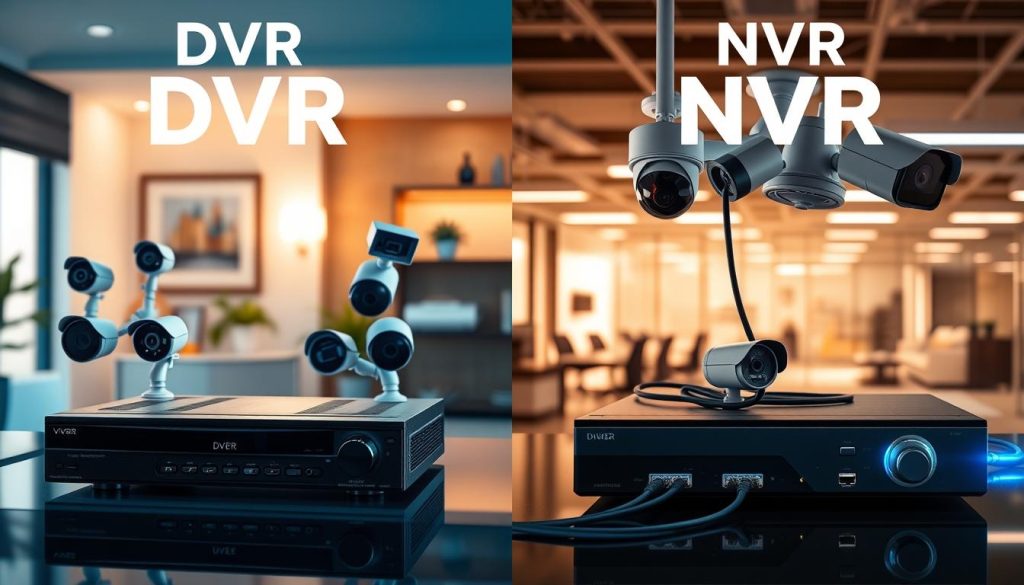
Modern security relies on video surveillance. For homes and businesses in Singapore, these cameras are a first line of defense.
They deter crime and protect people, data, and property. Choosing the right security system is a critical decision for effective protection.
This guide breaks down the key distinctions between the two main recording technologies. You will learn about Digital Video Recorders (DVR) and Network Video Recorders (NVR).
Each system uses different methods to process and transmit video footage. Understanding this difference is vital for a smart investment in your security infrastructure.
We provide a clear, comprehensive comparison. Our analysis covers core components, pros and cons, and specific considerations for Singaporean properties.
Key Takeaways
- Video surveillance is a foundational element for both commercial and residential security in Singapore.
- Selecting the correct recording system is crucial for effective property and asset protection.
- DVR and NVR are the two primary types of video recording systems, each with distinct underlying technology.
- The core difference lies in how each system processes and transmits data from the cameras.
- Making an informed choice requires understanding the pros, cons, and ideal applications of each system.
- This guide will compare components, setup requirements, and performance to help you decide.
- Both systems record video but are not interchangeable; the right choice depends on your specific needs.
Introduction to Video Surveillance: DVR vs NVR
For Singaporean homes and businesses, selecting the right recorder impacts security outcomes directly. Two primary technologies dominate the market.
These are the Digital Video Recorder and the Network Video Recorder. Each represents a distinct approach to capturing and managing visual information.
- DVR stands for Digital Video Recorder. This system processes raw video signals at the recorder unit itself.
- NVR stands for Network Video Recorder. This setup processes video data directly at the camera before transmission.
This core distinction in processing location is everything. It defines which cameras you can use and what cables are required for installation.
Surveillance has evolved from classic analog CCTV to modern Internet Protocol (IP) based setups. Older analog systems feed raw footage to a central box.
Newer network video technology allows cameras to act as independent computers. They send compressed, digital streams over a data network.
Your choice between these nvr systems and dvr systems affects complexity and future growth. A dvr system can be simpler if coaxial wiring already exists in a building.
In Singapore’s humid climate, the robustness of cabling like Ethernet for nvr dvr setups matters. Planning for scalability with a modern network video recorder often provides better long-term value.
Think of the digital video recorder as a proven legacy solution. The network video recorder embodies current, flexible technology.
A clear grasp of these basics is essential before examining component details and specific comparisons. It ensures your security investment is sound.
Understanding DVR Systems: Components and Operation
To grasp how a DVR system functions, one must examine its three core parts: the cameras, the cables, and the recorder itself.
Each component plays a specific role in capturing and converting visual information. This setup represents a classic approach to security monitoring.
Analog Cameras: The Eyes of DVR Systems
Analog cameras, often called CCTV cameras, are the starting point. These devices are simple capture tools.
They do not process the video they record. Instead, they send a raw, unprocessed analog signal directly to the recorder.
This analog technology has limitations. It typically supports lower maximum resolutions compared to modern IP camera options.
For basic surveillance needs, these security camera units remain a cost-effective choice.
Coaxial Cables: Transmission and Limitations
The raw signal travels from the camera to the DVR via coaxial cables. This is the traditional conduit for analog systems.
These cables are thick and relatively stiff. Their bulkiness can create challenges during installation in tight spaces or walls.
A major constraint is distance. Coaxial runs are generally limited to about 90 meters (300 feet).
Beyond this length, the video signal degrades noticeably. These cables also require a separate power line for the camera.
So-called siamese cables bundle video and power together. This simplifies the physical setup but doesn’t change the core limitations.
The DVR Recorder: Processing and Storage
This unit is the brain of the entire system. The DVR recorder houses a critical component: an Analog-to-Digital (AD) encoder chipset.
Its job is to convert the incoming raw analog signal into a viewable digital video stream. All video data must complete this journey to become usable footage.
This centralized processing defines the DVR architecture. It means intelligence resides in the box, not in the cameras.
Audio support is often a secondary consideration. Native audio transmission over standard coaxial connections is rare.
Adding sound usually requires extra RCA cables or specialized audio-over-coax technology. This adds complexity to the dvr system installation.
A key advantage of these dvr systems is cost. The components are generally less expensive than their nvr dvr counterparts.
This makes them attractive for budget-conscious projects. They are also ideal for properties with existing coaxial cctv infrastructure.
The complete operational flow is straightforward. It moves from the Analog Camera through the Coaxial Cable to the DVR Recorder for processing, then to storage and viewing.
This reliable chain offers stable signal performance with minimal network bandwidth use.
Understanding NVR Systems: Components and Operation
The architecture of an NVR setup fundamentally changes where intelligence resides in a security network. Instead of a central brain, processing power is distributed to each camera.
This design creates a more flexible and capable surveillance system. It leverages modern network infrastructure for superior performance.
IP Cameras: Smart Image Capture
IP cameras are intelligent devices. They contain their own built-in processor for encoding video data.
This allows them to capture, compress, and prepare footage for transmission. The camera handles the heavy lifting before sending a clean digital stream.
These smart security cameras can run advanced video analytics. Features like facial recognition and license plate reading are processed on the device.
Advanced motion detection is also native. This intelligence at the edge makes the entire system more responsive and efficient.
Ethernet Cables and Power over Ethernet (PoE)
Connection is achieved via standard Ethernet cables, like Cat5e or Cat6. These thin, flexible cables are much easier to route through walls than coaxial ones.
A major advantage is Power over Ethernet (PoE). A single Ethernet cable delivers power, video, and audio simultaneously.
This streamlines installation dramatically. There’s no need for separate power outlets near each camera.
Ethernet runs can reach 100 meters per segment. Network switches can extend this range almost indefinitely without signal loss.
The digital signal does not degrade over distance. This offers great flexibility for covering large Singaporean properties.
The NVR Recorder: Storage and Viewing Hub
The network video recorder itself has a different role. It acts primarily as a centralized library and management console.
Since video is processed at the camera, the NVR focuses on storage, live viewing, and playback. This separation of duties makes the system highly scalable.
Cameras only need to be on the same network, not directly wired to the box. This supports both wired and wireless setups seamlessly.
The technology inherently supports high-resolution video quality, up to 4K. Synchronized audio is native on every camera equipped with a microphone.
For property owners, this means crystal-clear footage with sound from every angle. Remote viewing from any internet-connected device is a core feature of modern NVR systems.
The operational flow is clean: IP Camera (processing) -> Ethernet Cable/WiFi -> NVR Recorder (storage/viewing). This represents a scalable, future-ready approach to property security.
A side-by-side comparison reveals critical divergences in how DVR and NVR systems operate. Each technology serves the same ultimate purpose but follows a distinct path to get there.
Understanding these paths allows you to match the right system to your property’s specific demands. This detailed breakdown covers the seven most important factors for your decision.
What is the Difference Between DVR and NVR? A Detailed Comparison
The gap between these security systems is defined by their core architecture. It influences everything from the cameras you buy to the clarity of the footage you review.
We will examine the technology, hardware, and practical implications for users in Singapore.
Core Technology: Analog vs Digital Processing
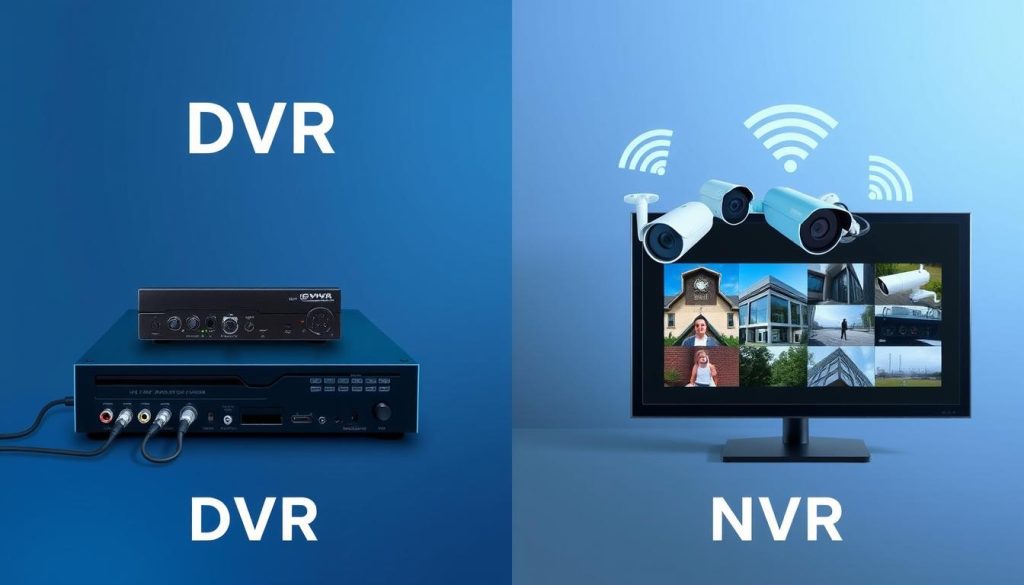
The fundamental split is where the video data is processed. A digital video recorder uses a centralized model.
Raw analog signals are sent from cameras to the main unit. An AD encoder chip inside the DVR then converts everything into a digital format.
In contrast, a network video recorder uses a distributed approach. Each IP camera encodes the video into a digital stream internally.
The NVR then receives this ready-to-store data. This core distinction dictates compatibility and performance.
Camera Compatibility: Analog vs IP Cameras
This technological divide locks you into specific camera types. DVR systems are designed to work exclusively with analog cameras.
These are often referred to as CCTV cameras. Upgrading a DVR system typically means replacing the entire setup.
NVR systems require modern IP cameras. These smart devices have built-in processors for encoding and advanced video analytics.
This compatibility gives NVR setups a clear path for future expansion and feature upgrades.
Cabling: Coaxial vs Ethernet
The physical backbone of your security setup differs greatly. Traditional DVR systems rely on coaxial cables.
These are thick, rigid, and often require a separate power cable run to each camera. Signal quality can degrade over long distances.
NVR systems use standard Ethernet cables, like Cat5e or Cat6. A major advantage is Power over Ethernet (PoE).
A single Ethernet cable delivers power, high-definition video, and audio. This simplifies installation significantly.
Video and Audio Quality
Fully digital pipelines in NVR systems support superior video quality. Resolutions of 4K or 5MP are common, providing crystal-clear detail.
Audio is transmitted natively over the same Ethernet cable. This ensures synchronized sound with your video recordings.
DVR technology has improved with Analog HD formats. However, maximum resolution is generally lower than IP alternatives.
Adding audio to a DVR system often requires extra connections and components, making it less reliable.
Installation Complexity and Flexibility
For retrofitting older Singaporean HDB flats or condos, existing coaxial wiring may favor a DVR. The installation can be less complex if the infrastructure is already in place.
However, running new coaxial cables through walls is challenging due to their bulk. The need for nearby power outlets adds another constraint.
NVR setups offer greater flexibility. Thin Ethernet cables are easier to route.
PoE eliminates the need for power outlets at each camera point. This makes NVR systems ideal for new constructions or major renovations.
System Scalability and Remote Access
Scalability is a major differentiator. A DVR is limited by the number of physical video input ports on the recorder.
Expanding beyond this limit usually means buying an entirely new unit. Remote viewing is possible but can be less seamless.
NVR systems scale freely over a network. You can add cameras as long as your network switch has available ports.
Remote viewing from smartphones or laptops is a core, robust feature of modern NVR platforms. You can check your property from anywhere.
Cost Considerations: Upfront and Long-Term
Initial investment often sways the decision. DVR systems generally have lower upfront costs for both equipment and cameras.
This makes them attractive for tight budgets or very basic monitoring needs. The total cost of ownership, however, requires a longer view.
NVR systems command a higher initial price. The investment buys you superior video quality, easier expansion, and advanced technology.
For Singaporean homeowners and businesses planning for the future, the long-term value and flexibility of an NVR system often justify the initial outlay.
Pros and Cons: Evaluating DVR and NVR Systems
Every technology choice involves trade-offs, and surveillance systems are no exception. A balanced look at the benefits and drawbacks of each platform is essential.
This evaluation moves beyond specs to practical impact. It helps you see which system aligns with your daily needs and long-term goals.
Security experts stress that there is no universal “best” option. The right fit depends entirely on your property, budget, and security expectations.
Advantages of DVR Systems
DVR systems offer compelling benefits for straightforward, budget-conscious projects. Their simplicity is a key strength.
The upfront cost is typically lower than for an NVR setup. This includes both the recorder and compatible analog cameras.
These systems use minimal network bandwidth since processing is centralized. This provides a very stable, dedicated signal path.
They are ideal for properties with existing coaxial cctv wiring. Retrofitting becomes a simple plug-and-play operation.
Brand-agnostic compatibility is another plus. Most analog cameras will work with most DVR units, simplifying sourcing.
Disadvantages of DVR Systems
The limitations of a DVR system often become apparent with modern demands. Video and audio capabilities are constrained.
Maximum video quality is generally lower, even with Analog HD formats. Fine details can be lost, which is crucial for identification.
Audio support is not native. Adding sound requires extra cables and components, making it a less reliable feature.
The physical installation presents hurdles. Coaxial cables are bulky and difficult to run through modern building walls.
Each camera needs a nearby power outlet. Scalability is limited by the number of ports on the recorder itself.
Remote viewing is possible but can be less seamless and feature-rich compared to network-based solutions.
Advantages of NVR Systems
NVR systems excel in performance, flexibility, and intelligent features. They represent the current standard for new installations.
Superior video quality is a major advantage. High-resolution 4K footage provides crystal-clear detail for reviewing events.
Installation is streamlined by Power over Ethernet (PoE). A single cable delivers power, video, and audio to each camera.
This allows for highly flexible camera placement. The system scales easily by adding cameras to the network.
Advanced video analytics, like smart motion detection, are processed on the camera. Robust remote viewing from any device is a core feature.
This technology is inherently future-proof, ready to support new features and higher resolutions.
Disadvantages of NVR Systems
The primary barrier for NVR systems is the higher initial investment. IP cameras and the recorder itself cost more than analog equivalents.
Performance depends on your property’s network infrastructure. A poor or congested network can affect video stability.
Cybersecurity becomes a direct consideration. Cameras on the network need proper configuration and security updates.
Setup can require basic IT knowledge for network configuration. There can also be brand compatibility issues between cameras and recorders.
In Singapore’s dense urban environment, these pros and cons take on specific weight. For older HDB flats with existing coax, a DVR might be the pragmatic choice.
For new condos or businesses planning for growth, the flexibility and clarity of an NVR often justify the cost.
“The best system is the one you’ll actually use effectively. For a small shop watching a cash register, a simple DVR may be perfect. For a high-value facility needing forensic-grade detail, an NVR is non-negotiable.”
Create a personal checklist: budget, existing wiring, desired image clarity, and need for remote access. Weigh the lists above against your own priorities to find your match.
Choosing the Right System for Your Needs in Singapore
Your final decision on a security system hinges on aligning technology with your unique environment and requirements. This choice is deeply personal and depends on your property’s physical layout, financial plan, and desired capabilities.
Singapore’s diverse properties, from compact HDB flats to sprawling landed homes, each present distinct challenges. A methodical assessment ensures your investment delivers reliable protection and peace of mind for years to come.
Assessing Your Property Layout and Infrastructure
Begin by examining your building’s existing wiring. Older apartments or commercial spaces may have legacy coaxial cables installed for previous CCTV setups.
If this infrastructure is intact and in good condition, integrating a DVR system can be cost-effective and simple. Retrofitting avoids the expense and disruption of running new lines through walls.
For new constructions, major renovations, or properties without old wiring, Ethernet cables offer a superior pathway. Their thin, flexible design makes installation cleaner in modern building materials.
Consider camera placement points relative to your network router. Large landed properties may need additional switches to maintain a strong connection for all cameras.
Budget Constraints and Total Cost of Ownership
Look beyond the initial price tag. A digital video recorder setup typically has lower upfront costs for both the recorder and compatible analog cameras.
This makes DVR systems appealing for strict, immediate budgets. The total cost of ownership, however, includes future upgrades and potential limitations.
A network video recorder system requires a higher initial investment. You are paying for advanced video processing, smarter cameras, and greater flexibility.
This investment often pays off by delaying the need for a full system replacement. Factor in professional installation fees, which can vary based on cabling complexity in Singapore.
Desired Features: Video Analytics, Audio, and Remote Viewing
Make a list of non-negotiable features. Is crystal-clear video quality essential for identifying faces or license plates? If so, high-resolution IP cameras paired with an NVR are superior.
Remote viewing from your smartphone is a standard expectation for modern users. Both systems offer this, but NVR systems typically provide a more seamless and reliable mobile experience.
Consider the value of intelligent video analytics. For retail shops, people-counting data is invaluable. For industrial sites, perimeter intrusion detection adds a critical layer of security.
Do you need synchronized audio from each camera? This feature is native and robust in network-based setups, while it can be cumbersome to add to analog systems.
Future-Proofing Your Security Investment
Technology evolves rapidly. Choosing a system with an upgrade path protects your investment. NVR technology is built on modern, open network standards, making it inherently more adaptable.
Future advancements in AI analytics, smart home integration, and higher-resolution sensors will easily plug into a network-based infrastructure. An analog DVR setup has a much narrower upgrade path, often requiring a complete overhaul.
Singapore’s humid climate also demands durability. Ensure outdoor cameras have proper weatherproof (IP66 or higher) ratings, regardless of your chosen system.
“We always ask clients about their five-year plan. A small business today might expand tomorrow. Installing a scalable network system from the start, even with just a few cameras, saves tremendous cost and hassle down the road.”
Create a simple decision framework. For simple, budget-limited monitoring with existing coaxial lines, a DVR is a pragmatic solution. For feature-rich, scalable protection where video clarity and smart features are priorities, an NVR is the clear long-term choice.
When in doubt, consult with experts who understand Singapore’s building codes and common installation hurdles. They can provide a site survey and tailor recommendations to your specific property.
Making an Informed Decision on Your Security Setup
Ultimately, selecting a video surveillance system is a balance between current needs and future aspirations. Both DVR and NVR setups reliably capture footage, but their core technology and data transmission methods differ.
No single system is universally best. The ideal choice hinges on your property’s unique requirements in Singapore. Prioritize budget, desired video quality, installation ease, and plans for expansion.
Review your assessment notes. Then, obtain quotes from reputable local installers for both security systems. A well-chosen video recorder is a powerful tool for safety and peace of mind.
For straightforward monitoring with existing coaxial cables, a digital video recorder system is practical. For top-tier video clarity, advanced video analytics, and scalable Ethernet infrastructure, an NVR system represents the forward-looking choice. Make your informed decision with confidence.