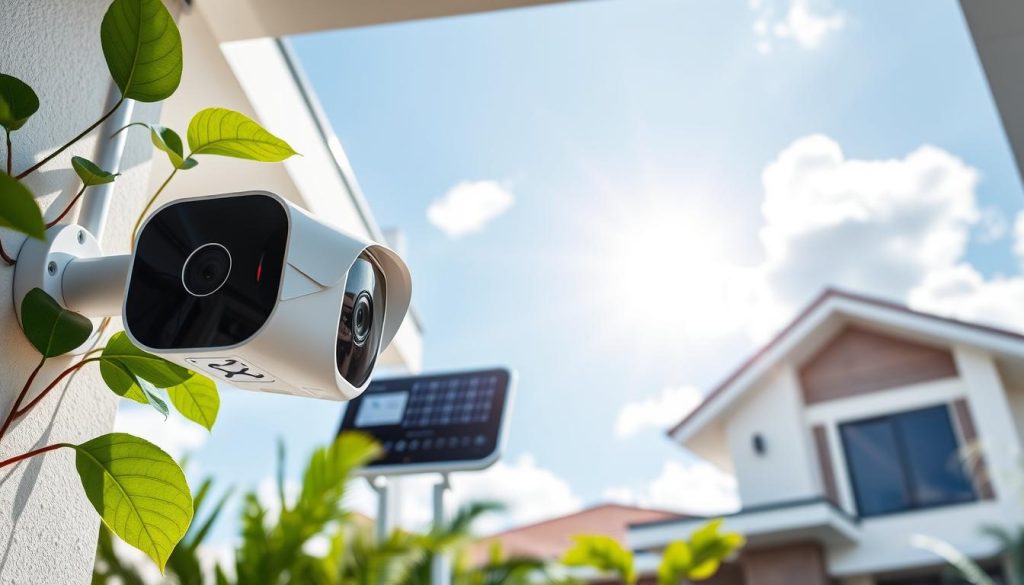
Homeowners in Singapore are increasingly turning to modern, sustainable solutions for their safety needs. These innovative devices harness the sun’s energy to provide consistent, eco-friendly monitoring.
This trend grows from a desire to be environmentally conscious. Advancements in photovoltaic technology make these systems more efficient and reliable than ever.
Singapore’s tropical climate offers ample sunshine throughout the year. This makes it an ideal location for such energy-efficient setups. The high humidity, however, requires equipment built for durability.
This guide will walk you through the major benefits and key buying considerations. We will also highlight top product picks and practical setup tips for your property.
The primary advantage is achieving reliable, uninterrupted protection. You can significantly reduce your electricity bills and your carbon footprint at the same time.
We focus on options tailored for unique Singaporean living conditions. This includes installations for high-rise HDB apartments and spacious landed properties.
Our goal is to inform you about the latest products from leading brands. This includes models from Arlo, Ring, Google Nest, and Reolink, among others.
By the end, you’ll have the knowledge to make a smart, informed purchase decision. This will lead to enhanced peace of mind and robust home defense.
Key Takeaways
- Solar-powered surveillance is a sustainable and modern approach to home safety.
- Singapore’s sunny climate is perfect for harnessing renewable energy for these devices.
- These systems offer reliable monitoring while helping to lower utility costs.
- It’s crucial to select weather-resistant models suitable for tropical humidity.
- Options are available for all types of homes, from apartments to large houses.
- Leading brands offer integrated systems with features like high-resolution video and night vision.
- Proper setup ensures maximum energy harvest and optimal performance.
Introduction: Harnessing the Sun for Home Security
In a city-state known for its bright skies, using sunlight for vigilant monitoring is a natural fit. This approach merges sustainable technology with the need for constant property safety. It represents a significant shift in how we think about residential defense.
The core mechanism is elegantly simple. A small photovoltaic cell captures rays from the sun. It then converts this light into electrical energy to continuously replenish an internal power cell.
This process ensures the unit operates non-stop, day and night. You achieve reliable surveillance without depending on your home’s electrical grid. It’s a self-sustaining cycle of power and protection.
Singapore’s tropical climate provides an exceptional environment for this technology. The nation enjoys abundant sunshine throughout the entire year. This consistent resource makes photovoltaic-powered devices highly practical and efficient here.
Recent advancements have transformed the hardware. Modern collectors are far more efficient and compact than older versions. They can be discreetly integrated with the surveillance unit, maintaining a sleek profile.
The dual advantage is compelling. You strengthen your home’s defense while actively promoting environmental sustainability. This combination offers a sense of energy independence that is both practical and responsible.
For local residents, the appeal is amplified by practical economics. Electricity costs are a consideration for many households. Adopting a system that eliminates ongoing power expenses is a financially smart move aligned with eco-friendly values.
A crucial benefit is uninterrupted operation during a grid failure. When traditional systems might go dark, these units keep watching. This provides an added layer of reliability during emergencies, offering true peace of mind.
Today’s market offers feature-rich products. Buyers can expect high-definition video, detailed color imaging after dark, and seamless connection to other smart home devices. The user experience is focused on clarity and convenience.
This introduction sets the stage for a detailed look ahead. We will explore the specific benefits for Singaporean homes, key purchase factors, and top-performing models. Understanding this foundation helps you make the best choice for your unique needs.
Why a Solar Security Camera is a Smart Choice for Singapore
For Singaporean properties, the value proposition of a renewable-powered surveillance unit is particularly strong. The benefits move beyond basic eco-friendliness to deliver real-world savings and robust defense.
These advantages are tailored to local living conditions and economic factors. Let’s explore the key reasons this technology is a wise investment.
Slash Electricity Bills and Reduce Your Carbon Footprint
One of the most compelling perks is direct cost reduction. By drawing free energy from the sun, these devices eliminate ongoing power expenses from your monthly bill.
This is significant in Singapore, where electricity tariffs are relatively high. The photovoltaic panel converts ample local sunshine into usable electricity day after day.
Your operational costs drop to nearly zero. The environmental impact is equally important.
Relying on clean, renewable power lowers your household’s carbon emissions. This action aligns perfectly with national sustainability goals like the Green Plan 2030.
You contribute to a greener future while safeguarding your present. It’s a responsible choice that makes financial sense.
Uninterrupted Protection, Even During a Power Outage
Grid failures or storm-related blackouts won’t disable your vigilance system. A built-in battery, continuously charged by the panel, keeps the unit running.
This ensures monitoring continues without a single gap. Your property remains watched when it might be most vulnerable.
This feature is crucial for comprehensive safety. Intruders sometimes cut main power to disable traditional wired equipment.
A self-sufficient setup is immune to such tactics. You gain peace of mind knowing your defense is always active, day and night.
True Wireless Freedom for Flexible Placement
The design eliminates messy, expensive wiring entirely. This allows you to position the equipment wherever coverage is best.
You are not limited by the location of outdoor power outlets. This freedom is ideal for unique Singaporean home layouts.
It works perfectly for gardens, gates, or high-rise balcony corners. The panel can even be mounted separately to capture maximum rays.
Meanwhile, the camera can be placed for optimal viewing angles. This separate mounting solves shade challenges common in dense urban areas.
Maintenance is refreshingly simple. With no moving parts, just occasional cleaning to remove dust or debris from the panel surface is needed.
Data shows that just a few hours of direct sunlight daily trickle-charges the battery sufficiently. This supports continuous operation through all hours.
These combined benefits—financial savings, environmental stewardship, unwavering reliability, and installation flexibility—make a solar-powered security camera a future-proof choice. For households seeking robust and sustainable home protection, it’s an intelligent solution that leverages Singapore’s greatest natural resource.
Key Considerations Before Buying in Singapore
Before you invest, it’s essential to match the system’s specifications with the unique challenges of Singapore’s environment. Your long-term satisfaction hinges on four technical pillars: sunlight harvest, weatherproofing, network connection, and data handling.
Sunlight Exposure: Dealing with Shade and High-Rise Living
Singapore’s urban landscape is dense. Tall buildings can cast long shadows, limiting direct sun on your property.
You must assess the specific spots where you plan to install the equipment. Observe these areas at different times of the day.
Look for at least a few hours of good illumination. This assessment is crucial for high-rise apartments with balcony installations.
Once you know your light conditions, evaluate the panel’s efficiency and the unit’s battery capacity. A high-efficiency photovoltaic cell can generate more power from partial sunlight.
A larger battery bank stores more energy. This combo ensures the device charges effectively and operates through the night and overcast days.
Weather Resistance: IP Ratings for Humidity and Heavy Rain
Tropical conditions demand robust build quality. The Ingress Protection (IP) rating tells you how well the unit resists solids and liquids.
For reliable home protection here, look for a rating of at least IP66. The first ‘6’ means it’s totally dust-tight.
The second ‘6’ signifies it can withstand powerful water jets from any direction. This is vital for our frequent heavy rains and persistent high humidity.
Choosing models with this level of weatherproofing ensures longevity. Your investment will withstand the elements year after year.
Connectivity: Ensuring Strong Wi-Fi or 4G LTE Signal
A vigilant unit is only useful if it can send alerts and video. In many local homes, thick concrete walls can weaken Wi-Fi signals.
If your intended installation point is far from the router, consider using a Wi-Fi extender. This boosts the signal strength for a stable connection.
For areas with no reliable Wi-Fi, or as a robust backup, 4G LTE connectivity is a game-changer. Devices like the Reolink Go series use a cellular data SIM card.
They provide internet access independently of your home network. This is ideal for remote corners of a landed property or as a fail-safe during network issues.
Data Storage: Local vs. Cloud Options for Your Footage
You need a plan for where your recorded video goes. The two main paths are local storage and cloud storage.
Local storage uses a microSD card inside the unit or a Network Video Recorder (NVR). It’s a one-time cost with no monthly fees.
Brands like Lorex often offer free local recording. The limitation is physical capacity; cards fill up and must be managed or overwritten.
Cloud storage uploads footage to a remote server. It allows easy remote access from anywhere and typically includes advanced features.
Services from Ring and Google Nest primarily use this method, often with optional subscription plans. You trade ongoing costs for convenience and scalability.
Your choice here also interacts with video resolution. Higher clarity, like 4K, creates larger files that consume storage space and bandwidth faster.
For details on advanced imaging capabilities like solar-powered night vision, explore this resource. Balancing clarity with your storage solution is key.
Evaluating these factors—sun, weather, connection, and data—will guide you to a surveillance system perfectly suited for Singapore. You’ll gain reliable monitoring tailored to your specific property and peace of mind.
Best Solar Security Cameras for Integrated Home Systems
For a seamless blend of vigilant monitoring and smart home automation, integrated systems offer a compelling solution. These packages combine surveillance with other intelligent devices for a unified defense network.
You manage everything through a single app. This creates a more responsive and convenient experience for your household.
Two leading options cater to different preferences. One provides professional oversight, while the other champions simple, self-managed control.
ADT with Google Nest: Professional Monitoring and Smart Features
ADT is a top choice for those who want expert oversight. It integrates Google Nest equipment into a professionally monitored setup.
The Google Nest Cams used in this system can be paired with third-party accessories for continuous power. A popular option is the Wasserstein panel available via the Google Store.
This combination ensures the unit stays charged using natural light. It’s a hands-off approach to energy management.
Key strengths include 24/7 professional monitoring with video verification. If an alert is triggered, ADT’s team can verify the event and dispatch help if needed.
The system also offers advanced facial recognition alerts. It can notify you if it detects a familiar face or an unknown person.
Deep compatibility with the Google Assistant ecosystem allows for voice control and automation. You can create routines that adjust lights or thermostats based on detection events.
A potential drawback is the typical requirement for a long-term service contract. Monthly fees are also higher than many DIY alternatives.
However, ADT often includes free Nest Cams in its package deals. This can offset the initial equipment cost for comprehensive home protection.
SimpliSafe: Easy Setup with Reliable Solar Charging
SimpliSafe represents the user-friendly, do-it-yourself path. It’s designed for quick installation without professional help.
Its outdoor surveillance unit can be powered by a dedicated photovoltaic accessory. This panel is sold separately for $79.99.
Just a few hours of direct sunlight each day provides reliable charging. This keeps the internal battery topped up for day-and-night operation.
The main advantages are incredibly simple installation and flexible, month-to-month plans. There are no long-term contracts locking you in.
Smart motion detection helps reduce false alerts from passing cars or pets. The equipment is also known for being affordable upfront.
On the downside, the range of compatible equipment is more limited compared to larger ecosystems. The video resolution maxes out at 1080p, with no 4K option available.
For many users, the intuitive mobile app and straightforward operation outweigh these limitations. It’s a system that gets the job done without complexity.
The core choice is between comprehensive, managed service and affordable, self-reliant simplicity.
Testing reveals distinct experiences. ADT’s platform allows for sophisticated automation, like turning on lights when a specific person arrives.
SimpliSafe’s app is praised for its intuitive, straightforward layout. Both systems offer reliable performance when their photovoltaic panels are placed correctly.
Consider your preference for professional monitoring versus a DIY approach. Also, think about how each system’s power compatibility fits your property’s layout and sun exposure.
An integrated system should simplify your life, not complicate it. Choose the one that aligns with your desired level of involvement and technical comfort.
Top Picks for High-Resolution and Advanced Features
When seeking the sharpest visual detail and smartest detection capabilities, two brands consistently rise to the top. Lorex and Arlo deliver exceptional image quality paired with sustainable power options.
Their products cater to users who want nothing less than crystal-clear footage. Advanced analytics further enhance the overall monitoring experience.
Lorex: 4K Clarity and Robust Solar-Powered Options
Lorex is renowned for high-quality surveillance equipment. Its lineup includes robust, wireless units designed for sustained operation.
The brand’s photovoltaic accessory provides sustainable energy for specific models. It is compatible with series like the LWB4850, U222AA, and U424AA.
A key strength is stunning video resolution up to 4K. This delivers incredibly crisp images, allowing you to see fine details clearly. Long-range color night vision ensures detailed footage even in low light.
Another major advantage is free local recording. You can store footage on a microSD card or a network video recorder without monthly fees.
One potential drawback is the extensive product range, which some find overwhelming. There is also no option for professional monitoring service.
However, the rugged construction justifies the investment. These devices are built to last in challenging environments.
Arlo: DIY-Friendly 4K Cameras with Solar Panel Compatibility
Arlo is a popular choice for tech-savvy users who prefer a do-it-yourself approach. Its products are celebrated for user-friendly setup and sleek design.
The brand offers a dedicated photovoltaic accessory for seamless charging. This panel works with Pro, Pro 2, and Go 1 models, offering easy installation.
Its adjustable mount helps you capture maximum rays from the sun. Just a few hours of direct sunlight each day keeps the internal battery full.
Notable benefits include up to 4K resolution and AI-driven detection. The system can distinguish between people, vehicles, and other objects. This smart filtering reduces false alerts significantly.
The mobile app provides a smooth and intuitive user experience. Managing your equipment and reviewing clips is straightforward.
A primary con is that full access to advanced features requires a subscription plan. Important analytics and extended cloud storage are part of these paid tiers.
Choosing between them depends on your priorities. Lorex caters to those who want top-tier resolution and free local storage above all.
Arlo appeals to users seeking smart features and DIY ease in a unified ecosystem. The pricing reflects this: Lorex’s panel costs $79.99, while Arlo’s is $59.99.
For enhanced home protection in Singapore, consider your need for absolute clarity versus integrated intelligence. Both offer reliable, high-definition monitoring powered by the sun.
Leading Choices for Smart Home and Ecosystem Integration
Integrating your home’s defense with a broader ecosystem of smart devices unlocks a new level of convenience and control. The best products work seamlessly with your voice assistants, lights, and other automated systems.
This creates a responsive environment that enhances both safety and daily living. For Singaporean households, two brands stand out for their strong ecosystem ties and sustainable power solutions.
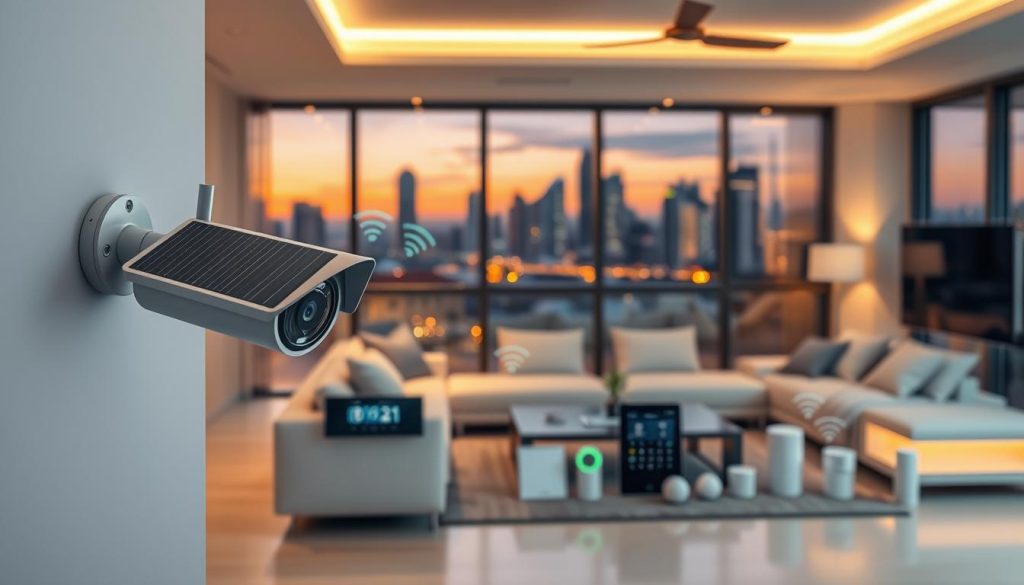
Ring: Versatile Equipment with Efficient Solar Panels
Ring is a versatile brand offering a wide range of equipment. Its products are ideal for local homes seeking reliable, wire-free monitoring.
The brand provides efficient photovoltaic accessories for models like the Spotlight Cam and Stick Up Cams. You have two main choices for keeping them charged.
The standard panel costs $49.99 and requires about three to four hours of full sun daily. The Super Solar Panel is priced at $99.99 and is a game-changer for shady spots.
This more powerful option needs only one to two hours of partial sunlight. Both are weather-resistant and feature adjustable mounts for optimal positioning.
Key strengths include remarkably easy do-it-yourself installation. You can choose from video resolutions ranging from clear 1080p to sharp 4K. Many models include bright, motion-activated lights to deter unwanted activity.
Deep integration with Amazon Alexa allows for full voice control and smart routines. A potential drawback has been past privacy concerns, though these are now mitigated by robust end-to-end encryption.
Also, Ring does not currently offer a 4K model for indoor use. Overall, the performance is reliable and the user experience is highly rated.
Google Nest (Standalone): AI-Powered Detection and Solar Charging
Google Nest (standalone) is a smart choice for those wanting advanced artificial intelligence features. It delivers this without requiring a full professional monitoring system.
Battery-powered Nest cameras and doorbells work with third-party accessories for continuous power. A popular option is the Wasserstein panel, available for $59.99.
This accessory provides a steady trickle-charge to the internal battery. It ensures the unit remains operational through day and night cycles.
The primary advantages are its sophisticated, AI-powered detection capabilities. These include familiar face alerts and customizable activity zones. The design is also exceptionally sleek and modern.
A notable con is the lack of a 4K model in the current lineup. The pricing is also at a premium compared to some competitors.
You pay for the intelligent software and seamless integration within the Google ecosystem. For homes invested in Google Assistant, the experience is wonderfully unified.
Choosing between these leaders depends on your priorities. Ring offers broader equipment variety and generally more affordable upfront costs.
Google Nest focuses on delivering highly intelligent alerts and a polished ecosystem experience. Your existing smart home setup is a major deciding factor.
For optimal performance, ensure the photovoltaic accessories face direct sunlight. Use their adjustable mounts to angle them correctly for Singapore’s latitude.
This simple step maximizes energy harvest. Your choice should align with your preferred voice assistant and the specific feature set you value most.
Excellent Options for Complete Wireless and 4G Freedom
In Singapore’s diverse landscapes, from lush gardens to high-rise balconies, Reolink delivers adaptable and self-sufficient monitoring. This brand specializes in equipment that offers true independence from electrical outlets and fixed networks.
Their lineup provides two distinct paths to wire-free operation. You can choose cellular data connectivity or rely on your home Wi-Fi. Both are designed to work seamlessly with efficient photovoltaic accessories.
This approach eliminates the need for complex wiring installations. It also ensures continuous operation, even during local power disruptions. For homeowners, this means reliable vigilance without ongoing electricity costs.
Reolink Go Series: True Off-Grid Security with LTE
The Go series is engineered for locations where Wi-Fi is weak or nonexistent. It uses 4G LTE cellular networks to transmit data. This makes it perfect for remote sections of a landed property, gardens, or even temporary sites like construction areas.
Models such as the Reolink Go PT Ultra offer impressive capabilities. They feature 4K resolution for crystal-clear video. Advanced person and vehicle detection helps filter out unnecessary alerts.
A key benefit is color night vision. This technology provides detailed, full-color imagery after dark, not just grainy black-and-white. The integrated power cell is continuously charged by a compatible panel.
Just a few hours of direct sunlight each day keeps the unit running through the night. This setup guarantees day-and-night monitoring without manual intervention. It’s the ultimate solution for complete off-grid home protection.
Reolink Argus Series: Affordable Wi-Fi Solar Cameras
For households with strong Wi-Fi coverage, the Argus series presents a cost-effective choice. These products are known for their budget-friendly pricing without sacrificing core features.
Popular models include the Argus 4 Pro and the Argus PT Ultra. They deliver high-resolution video and support dual-band Wi-Fi for a stable connection. Compatibility with efficient panels ensures they stay powered using natural light.
These devices are designed for easy do-it-yourself installation. You can place them anywhere on your property that receives good sunlight. Their wireless design offers flexibility that wired systems simply cannot match.
The value proposition is clear: robust monitoring with minimal upfront investment. You get reliable performance tailored for everyday residential use. This series proves that capable vigilance doesn’t have to be expensive.
Choosing between cellular independence and Wi-Fi affordability depends on your property’s specific connectivity landscape.
Both series share important advantages. They provide true wireless freedom, eliminating the need for outdoor power outlets. This directly leads to lower monthly electric bills.
More importantly, they continue operating during a blackout. Since they are not plugged into the grid, your property remains watched during emergencies. This is a critical layer of reliability for comprehensive safety.
There are key considerations for each type. The Go series requires a SIM card and a cellular data plan from a local provider. This is an ongoing cost but provides unparalleled placement freedom.
The Argus series depends on the strength and reach of your home Wi-Fi network. In both cases, the equipment is built to withstand Singapore’s climate. They feature weatherproof ratings that resist heavy rain and persistent humidity.
For concrete options, visit Reolink’s official website. The Reolink Go PT Ultra is a premium cellular model with pan-and-tilt functionality. The Argus 4 Pro is a top-tier Wi-Fi choice offering excellent video clarity.
Your decision should balance connectivity needs with your budget. If your area has poor Wi-Fi, the Go series is worth the extra investment. For most urban homes with good network coverage, the Argus series offers outstanding value.
Reolink’s versatile solutions demonstrate that sustainable, wire-free home defense is fully achievable in Singapore. By leveraging the sun’s abundant energy, you gain peace of mind and operational independence.
How to Set Up Your Solar Security Camera for Maximum Efficiency
Maximizing efficiency starts with a thoughtful plan that considers both sunlight and safety. A proper installation ensures your equipment delivers reliable, round-the-clock vigilance.
This process is straightforward but requires attention to detail. Follow these steps to harness Singapore’s abundant rays for optimal home protection.
You will need a few basic tools. Most kits include mounting hardware, screws, and seals.
Allow yourself a weekend morning for the task. Good preparation leads to a system that works seamlessly for years.
Three key phases guide you from planning to full operation. Each phase builds on the previous to create a robust setup.
Step 1: Surveying Your Property for Sun and Security Coverage
Begin by walking around your home at different times. Observe how shadows from nearby buildings fall during the morning, noon, and afternoon.
Identify spots that receive at least a few hours of direct sunlight daily. These are prime locations for your photovoltaic accessory.
Simultaneously, mark viewpoints that cover key entry points. Think about doors, gates, and first-floor windows.
For high-rise apartments, balcony corners often offer good sightlines. Ensure the chosen spot isn’t obstructed by plants or structures.
Balance is crucial. The ideal position provides clear surveillance views while catching ample rays from the sun.
Use chalk or removable tape to outline potential mounting areas. This visual guide simplifies the next step.
Step 2: Mounting the Panel for Optimal Sun Exposure
Secure the photovoltaic collector on a sturdy surface. A wall or pole works well. Ensure the mounting point faces generally south for maximum light capture.
Angle the unit between 30 and 45 degrees. This tilt helps it gather energy more effectively throughout the day.
Use the provided brackets and seals. Tighten all screws firmly to withstand Singapore’s heavy rain and persistent humidity.
Weatherproofing is non-negotiable. Check that seals are intact to prevent moisture from damaging the internal components.
If the panel and the main unit are separate, connect them with the supplied cable. Route the cable neatly to avoid trip hazards.
Once mounted, the collector should have a clear view of the sky. Even partial shade can significantly reduce its charging capability.
Step 3: Configuring Your Camera and Network Settings
Power on the main device using its internal power cell. Follow the manufacturer’s app to connect it to your home Wi-Fi network.
If your chosen spot has weak signal strength, consider a Wi-Fi extender. A strong connection is vital for live video and instant alerts.
For truly remote areas, set up 4G LTE connectivity. Insert a local data SIM card as per the instructions.
Next, adjust motion sensitivity zones. This reduces false alarms from moving foliage or passing vehicles.
Configure your storage options. Choose between local microSD card recording or a cloud service subscription.
Enable important features like motion alerts and night vision. Test the color night vision after dark to ensure clear video.
Update the device firmware to the latest version. This improves performance and patches any security vulnerabilities.
Finally, create a strong, unique password for remote access. This secures your footage from unauthorized viewing.
A thorough test over 48 hours confirms everything works. Check charging during the day and recording quality at night.
Proper setup ensures your investment operates at peak efficiency. You gain reliable home protection while making the most of Singapore’s sunny climate.
Your system will provide peace of mind with minimal maintenance. Just wipe the panel surface occasionally to remove dust or debris.
Now you’re ready to enjoy sustainable, vigilant monitoring. The sun powers your safety, day and night.
Understanding the Costs: Upfront Investment vs. Long-Term Savings
The decision to adopt sun-powered home defense involves a clear calculation of purchase price against future operational savings. This financial perspective is crucial for Singaporean households.
You need to look beyond the initial sticker price. The true value emerges over years of reliable, cost-effective operation.
Let’s break down the numbers. We’ll explore what you pay upfront and what you save in the long run.
Breaking Down the Price of Cameras and Solar Panels
The photovoltaic accessory is a separate purchase for most brands. These panels are surprisingly affordable, typically costing under $100.
Specific prices from leading manufacturers give you a clear idea. The Ring panel is $49.99, while Google and Arlo offer theirs for $59.99.
Lorex and SimpliSafe panels are priced at $79.99 each. This upfront cost is a one-time investment for sustainable energy.
The main surveillance unit itself has a wider price range. Basic models start lower, but high-end options with 4K clarity and smart detection cost more.
Package deals from brands like ADT can offer significant savings. They sometimes include the monitoring equipment for free with a service plan.
Always compare the total bundle cost. A higher initial outlay often brings better features and durability.
The Value of Eliminating Wiring and Reducing Battery Changes
Traditional wired setups require professional installation. This adds hundreds of dollars to your total project cost.
A wire-free, photovoltaic-powered system bypasses this entirely. You save on electrician fees and avoid messy construction work.
The ongoing energy savings are just as important. By harnessing the sun, you eliminate the electricity draw from your monthly utility bill.
In Singapore, where power tariffs are notable, this reduction adds up over time. Your operational expense drops to nearly zero.
The continuous trickle-charge from the panel dramatically extends battery life. Instead of swapping cells every few months, they last for years.
This means fewer maintenance hassles and lower long-term replacement costs. It’s a major advantage for busy homeowners.
Navigating Subscription Plans for Cloud Storage and Features
Many modern systems offer enhanced services through monthly plans. Ring Protect, Nest Aware, and Arlo Smart are common examples.
These subscriptions provide benefits like extended video history and intelligent alerts. They often enable advanced person or vehicle detection.
The fees typically range from a few dollars to over $10 per month. You must decide if these features are worth the recurring cost.
Some brands, like Lorex, champion free local recording on microSD cards. This is a great way to avoid ongoing fees entirely.
Evaluate your need for remote access and expanded storage. Cloud services offer convenience but come with a perpetual price tag.
For units using 4G LTE connectivity, remember the cellular data plan. Local telecom providers charge for SIM card data, which is an additional operational expense.
This cost is justified for locations without reliable Wi-Fi. It ensures your property stays connected no matter what.
A complete cost-benefit analysis shows the wisdom of this technology. The higher initial investment is offset by years of lower bills and minimal upkeep.
When choosing, consider the total cost of ownership. Add the price of the equipment, any panels, and potential subscription fees over three to five years.
Compare this total to a traditional plug-in system with its constant power draw and wiring needs. The sustainable option often proves more economical in the long run.
For Singaporeans, this investment pays off through dependable, eco-friendly home protection. You gain peace of mind while reducing your ongoing household expenses.
The sun provides the power, and you reap the financial rewards. It’s a smart, forward-thinking choice for modern living.
Securing Your Home with Singapore’s Sun
By leveraging our abundant natural resource, you can achieve peace of mind without compromise. A solar-powered system offers reliable, sustainable home protection. It provides significant cost savings, uninterrupted operation, and true wireless flexibility.
Assess your specific needs for integrated ecosystems, high resolution, smart alerts, or off-grid capability. Leading brands like ADT, Lorex, Ring, Google Nest, Arlo, SimpliSafe, and Reolink provide excellent options for every requirement. Your choice should balance sunlight exposure, weather resistance, connectivity, and storage preferences.
Proper setup ensures maximum efficiency and longevity for your investment. Explore the recommended products to harness the sun’s power. You will enhance your property’s defense while contributing to a greener future for Singapore.