
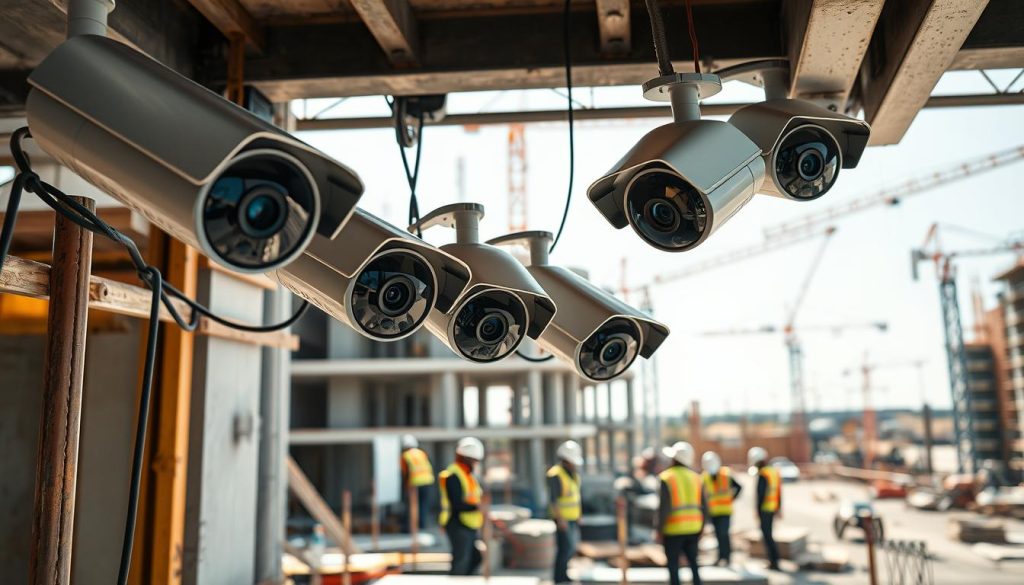
Managing a project involves protecting valuable assets and ensuring worker safety. Theft, vandalism, and unauthorized access are constant threats that can cause major delays and financial loss.
Specialized surveillance technology is designed for this tough job. These devices do more than just record video. They act as a powerful deterrent and a vital management tool for watching over your project around the clock.
This guide cuts through the noise. We will help you understand the essential features, from durability and night vision to remote monitoring. You will learn how to choose a solution that meets the specific demands of projects in Singapore’s unique environment.
Our goal is to provide clear, actionable information. This will help you make a confident investment in a system that safeguards your progress and enhances operational oversight.
Key Takeaways
- Construction zones are high-risk areas where strong surveillance is non-negotiable for asset and personnel safety.
- Modern security cameras serve as both a proactive crime deterrent and a tool for daily project management.
- Key features to look for include weather-resistant builds, high-definition video, and night vision capabilities.
- Remote monitoring access allows managers to view live feeds and review footage from anywhere, at any time.
- Selecting the right system requires considering local environmental challenges and specific site requirements.
- A well-chosen surveillance setup helps prevent theft, vandalism, and safety incidents, protecting your timeline and budget.
- This guide provides the foundational knowledge needed to evaluate and purchase an effective monitoring solution.
Why Construction Site Security Cameras Are a Non-Negotiable Investment
The financial health of any building project hinges on controlling a volatile mix of valuable assets and access points. Without a dedicated watch, these areas are exposed to significant, costly threats. A professional security camera system transforms this vulnerability into managed oversight.
This technology is a core operational pillar, not an optional extra. It directly protects your bottom line and project continuity.
Mitigating Unique Site Risks: Theft, Vandalism, and Safety
Project zones are attractive targets. Materials like copper wiring and expensive tools are often left in the open. Transient workers and changing perimeters make traditional locks insufficient.
A visible network of site security cameras acts as a powerful deterrent. Would-be intruders are less likely to act when they know they are being recorded. This psychological barrier is your first and most cost-effective layer of defense.
The protection extends beyond preventing theft. Real-time monitoring allows supervisors to watch over safety protocols. They can verify workers are using proper safety gear.
Managers can also spot potential hazard zones as they develop. This proactive view helps prevent accidents before they happen, safeguarding your team.
Beyond Security: Project Documentation and Remote Management
The value of a modern camera system goes far beyond catching criminals. Continuous recording creates an immutable, time-stamped log of all activity. This becomes an authoritative record of work progress.
Such documentation is invaluable for client updates and resolving disputes about deliverables or timelines. It provides clear, unbiased evidence.
For management teams in Singapore, remote access is a game-changer. Supervisors can view live feeds or review footage from a desktop or smartphone. This capability eliminates unnecessary travel to multiple locations.
It saves considerable time and operational expense. When an alarm triggers after hours, a quick remote check can determine if a response is needed.
In the event of an incident, recorded video is critical evidence. It helps investigators understand the sequence of events accurately. This protects your company from false claims and clarifies liability.
Integrating surveillance with other tools, like construction site CCTV and access control, creates a unified operational command center. This integrated approach can streamline workflows and may even help reduce insurance premiums.
Ultimately, a professional security camera system is a strategic investment. It safeguards profitability, protects your reputation, and strengthens your legal standing. The upfront cost is outweighed by the significant, ongoing protection it provides.
Top Benefits of Implementing a Security Camera System on Site
From safeguarding expensive machinery to ensuring protocol adherence, a well-planned monitoring system is a multi-tool for modern project management. The advantages extend far beyond basic theft prevention.
These solutions deliver tangible returns by protecting capital, streamlining operations, and mitigating legal risks. Each benefit directly supports a project’s financial health and timely completion.
Deterrence and Protection of High-Value Assets
The visible presence of a professional security camera system is a powerful psychological barrier. Studies show that monitored areas can see attempted theft and vandalism drop significantly.
Criminals are far less likely to target a location where their actions are being recorded. This deterrence effect is your first and most cost-effective layer of site security.
High-value assets like excavators, cranes, and bulk materials require constant watch. A network of site security cameras provides 24/7 oversight of storage yards and equipment parking areas.
Remote monitoring allows managers to check on these assets from anywhere, at any time. This constant vigilance helps prevent losses before they occur, protecting your investment.
Enhancing Safety Compliance and Worker Accountability
Security cameras construction projects are not just about watching for outsiders. They are vital for overseeing internal safety protocols and worker conduct.
Supervisors can remotely verify adherence to critical rules. This includes fall protection measures and proper site entry procedures.
They do not need to be physically present on every part of the construction site. This capability is especially valuable for large or multi-phase projects.
Knowing that activities are recorded encourages responsible behavior among personnel. It promotes diligent work practices and enhances overall accountability.
This recorded video also serves as an unbiased record for training and improving safety culture.
Streamlining Incident Investigation and Reducing Liability
When an event occurs, high-definition footage provides an unambiguous record. It captures the exact sequence of events without relying on conflicting witness statements.
This speeds up internal investigations dramatically. It allows for accurate assignment of responsibility.
Such clear evidence is crucial for reducing legal liability. It protects your firm from false claims and clarifies the facts for insurers and authorities.
The benefit of remote monitoring is also key for emergency response. Managers can assess a situation via live feed outside of normal working hours.
They can make informed decisions about dispatching personnel. This leads to a faster, more appropriate response.
Detailed video documentation aids in daily progress tracking. It can even be used to create time-lapse videos for client updates or marketing.
This visual record provides clarity in any contractual disagreements about work completed.
Furthermore, a demonstrable security infrastructure can lead to indirect financial benefits. Many insurers offer lower premiums for projects with proven risk mitigation measures.
Each of these benefits contributes to a strong return on investment. They justify the initial cost of the camera system by delivering continuous operational and financial protection.
Key Factors to Consider When Choosing Your System
A successful security deployment begins long before any camera is mounted. It requires a clear plan that addresses your unique vulnerabilities and operational goals.
This checklist highlights the critical factors you must evaluate. It ensures your investment delivers robust construction site security and meets specific project demands.
Assessing Your Site’s Specific Security Objectives and Risk Areas
Start with a thorough risk assessment. Walk the perimeter and identify high-value asset storage, entry points, and areas with safety concerns.
Define clear objectives. Is the primary goal to prevent material theft, monitor gate access, or ensure worker safety protocols are followed?
Your objectives directly inform your equipment requirements. Use this list to guide your evaluation of any security camera system:
- Durability & Weather Resistance: The hardware must survive rain, dust, and extreme temperatures.
- High-Definition Resolution: Clear images are needed to identify details like faces or license plates.
- Night Vision Capabilities: Essential for 24/7 surveillance in areas with minimal lighting.
- Wide-Angle Coverage: Reduces the total number of cameras needed for broad area monitoring.
- Motion Detection & Alerts: Enables real-time response to unauthorized activity.
- Remote Monitoring Access: Allows managers to view live video from anywhere.
- Integration Potential: Can the camera system work with access control gates or alarm sensors?
- Storage Options: Consider cloud storage for off-site backup of footage.
- Tamper-Resistant Design: Protects the equipment from intentional damage.
- Power Source Availability: Plan for electrical, solar, or battery solutions based on site logistics.
- Scalability: The setup should easily expand as the project progresses through phases.
This proactive approach turns generic site security into a tailored defense strategy.
Durability and Environmental Ratings: Withstanding Singapore’s Climate
Singapore’s tropical environment presents distinct challenges. Heavy monsoon rains, constant high humidity, and airborne dust from work areas can destroy unprotected electronics.
Your first technical filter should be the Ingress Protection (IP) rating. This international standard defines a device’s resistance to solids and liquids.
For reliable operation here, look for a minimum rating of IP66 or IP67.
- IP66: Offers complete protection against dust and powerful water jets.
- IP67: Provides dust-tight protection and can withstand temporary immersion in water.
A camera with these ratings will continue functioning during intense downpours. It is also shielded from the fine particulate matter common on construction sites.
This durability is non-negotiable for maintaining consistent video coverage. It prevents costly failures and replacements mid-project.
Beyond the IP code, consider the build quality and materials. A rugged, tamper-resistant housing adds another layer of physical defense.
Choosing a security camera built for these conditions is a cornerstone of effective long-term site security. It ensures your monitoring remains active through every weather shift.
Balancing upfront cost with these performance features and local vendor support is key. The right choice pays off in uninterrupted protection and peace of mind.
Essential Camera Features for Round-the-Clock Surveillance
Not all visual monitoring devices are created equal. Specific engineering features determine their suitability for harsh, dynamic environments.
To achieve reliable oversight, you need hardware built with a core set of technical capabilities. These attributes ensure the system performs through day, night, and all weather conditions.
Investing in units with these features transforms a simple video feed into a powerful security asset. It provides the clarity and responsiveness needed for true protection.
High-Definition Resolution and Wide-Angle Coverage
Image clarity is non-negotiable. High-definition resolution, typically 4K or at least 1080p, captures critical details from a distance.
This level of detail is essential for identifying facial features or reading equipment serial numbers. Blurry footage is useless for investigation or evidence.
Wide-angle coverage, measured in degrees, determines how much area a single unit can watch. A lens with a broader field of view reduces the total number of devices needed.
This directly impacts your system cost and installation complexity. Strategic placement of wide-angle models provides comprehensive visibility over large storage yards or entry points.
Together, high resolution and wide coverage form the foundation of effective visual documentation. They ensure nothing important is missed or unclear.
Advanced Night Vision and Low-Light Performance
Threats don’t stop when the sun goes down. Your security camera system must see clearly in total darkness.
Standard infrared (IR) LEDs provide basic night vision. However, they can over-expose close objects, creating white-out spots in the video.
Advanced “Smart IR” technology automatically adjusts illumination based on an object’s proximity. This ensures a clear, evenly lit image throughout the entire field of view.
For zones with partial lighting, low-light performance is critical. Check the image sensor’s sensitivity, measured in lux.
A lower lux rating means the sensor performs better in extremely dim conditions. This capability complements infrared for superior 24/7 surveillance.
“True round-the-clock monitoring isn’t just about adding infrared lights; it’s about integrating smart illumination with highly sensitive sensors to eliminate blind spots in the dark.”
Motion Detection, Intelligent Alerts, and Tamper Resistance
Basic motion detection triggers on any pixel change, like moving foliage. This leads to countless false alarms.
Modern systems use artificial intelligence to filter out irrelevant movement. They can be programmed to focus only on humans or vehicles.
When genuine activity is detected, instant alerts are sent via SMS, email, or mobile app push notifications. This enables a real-time response from managers, even when they are off-site.
Tamper resistance is equally vital. Physical design features like rugged metal housings and anti-vandal domes made from hard polycarbonate deter physical attacks.
Software-based tamper alarms add another layer. They trigger an alert if a unit is covered, sprayed, or forcibly moved from its position.
Consider how these features work together. A wide-angle unit with AI motion detection can watch a large storage area.
It will only alert your phone when a person enters after hours. The high-definition night vision then provides a usable identification clip.
This integrated approach is what makes a professional setup effective. It automates vigilance and provides actionable intelligence.
Choosing devices with these essential features ensures your investment delivers a clear return through prevented losses. It’s the smart way to secure your site with a professional surveillance.
Exploring Power Source Solutions for Flexible Deployment
Before a single camera can capture a frame, a fundamental logistical puzzle must be solved: how to deliver uninterrupted electricity across a dynamic, often chaotic worksite. A surveillance network is only as reliable as its energy supply. Choosing the wrong power source can leave critical zones blind, defeating the entire purpose of your investment.
This section breaks down the most common and effective methods to energize your security camera system. We will compare stability, cost, and installation effort for each option. The goal is to match the solution to your project’s specific layout and duration.
Hardwired Electrical and Temporary Generator Connections
For locations with established temporary power, a hardwired connection is the gold standard. These setups draw from the site’s main temporary distribution panel, which also powers offices and lighting.
This method provides the most stable and consistent voltage. It eliminates concerns about batteries draining or solar panels underperforming during cloudy periods.
Mobile generators are a staple on many projects. They offer a portable power hub for equipment and security devices in areas without grid access. Connecting your camera system to a generator requires proper planning.
- Stability: Hardwired power is extremely reliable for continuous monitoring.
- Generator Fueling: Ensure a refueling schedule to avoid unexpected shutdowns.
- Surge Protection: Use quality surge protectors to guard sensitive electronics from power spikes.
- Safety: All cabling must be properly insulated and routed away from high-traffic areas to prevent damage.
This approach is ideal for the main compound or storage yards where temporary power infrastructure already exists.
Solar-Powered and Battery-Powered Options for Remote Areas
Greenfield projects or remote corners of a large site present a unique challenge. Running cables may be impractical or too expensive. Here, autonomous power solutions come to the forefront.
Solar-powered units combine a photovoltaic panel with a rechargeable battery bank. During the day, the panel charges the batteries, which power the camera through the night.
“In Singapore’s climate, sizing your solar panel correctly is crucial. Account for the high frequency of cloudy days and ensure the battery capacity can support several days of low sun exposure to maintain uninterrupted surveillance.”
Battery-powered cameras offer ultimate flexibility for short-term needs. Modern units can operate for months on a single charge. They are perfect for rapidly deploying monitoring on a specific high-value asset or for a defined project phase.
Consider these points for Singapore:
- Select solar panels with a higher wattage rating to compensate for humidity and cloud cover.
- Opt for lithium batteries designed for high-temperature environments.
- Choose enclosures that protect both the camera and its power source from heavy rain.
Power over Ethernet (PoE) for Simplified Installation
Power over Ethernet technology streamlines setup dramatically. A single standard Ethernet cable carries both data and electrical power from a PoE switch to the device.
This eliminates the need to run separate power cables. It reduces material costs and installation complexity. PoE is a game-changer for networked camera systems.
The central PoE switch allows for easy management and power cycling of individual devices remotely. It also provides a cleaner, more organized infrastructure.
Key advantages include:
- Reduced Cabling: One cable per device simplifies the network layout.
- Centralized Control: Power can be managed from the network switch.
- Safety: Low-voltage power delivery is generally safer on a worksite.
- Scalability: Adding more cameras is as simple as connecting another cable to the switch.
For a robust setup, many projects use a hybrid strategy. A camera might use solar primary power with a battery backup. This ensures operation during prolonged bad weather. The choice depends on your site’s layout, project duration, and available infrastructure.
By understanding these power solutions, you ensure your site security camera network remains operational. This protects your progress and investment around the clock. For a professional assessment, consider consulting a specialist in construction site CCTV to design a resilient system.
Navigating the Different Types of Construction Site Cameras
A robust security strategy uses a combination of camera technologies to address distinct challenges across a worksite. No single model can do everything perfectly. By understanding the specific role of each form factor, you can build a layered, comprehensive monitoring network.
This approach ensures constant coverage, active response, and intelligent filtering. It turns a collection of devices into a unified defense system.
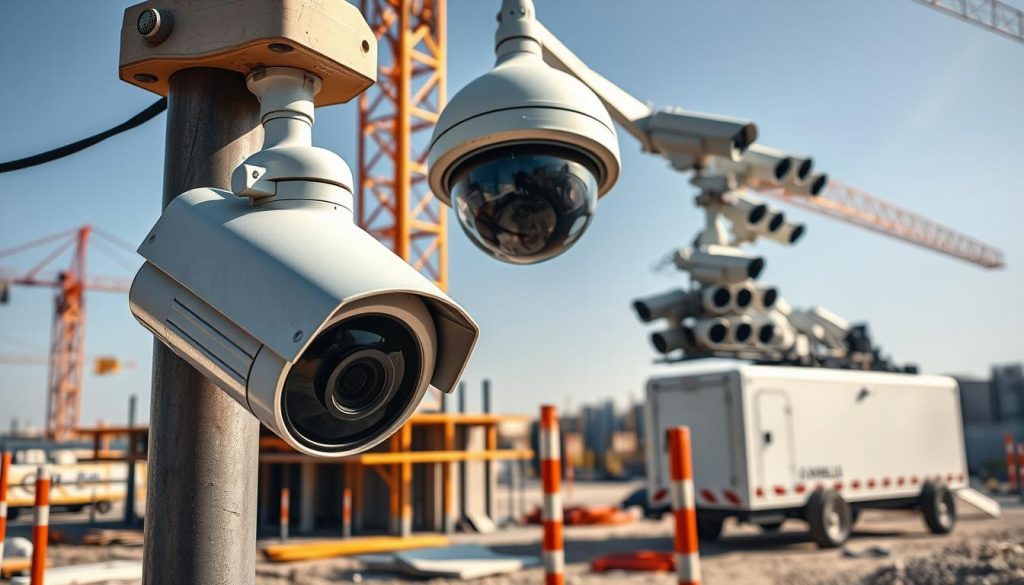
Fixed Bullet and Dome Cameras for Constant Area Coverage
Fixed models are the steadfast sentinels of any site security plan. They provide unwavering watch over designated zones. Their simplicity and reliability make them foundational.
Bullet cameras are the workhorses for perimeter defense. Their elongated, prominent shape offers a strong visual deterrent to potential intruders. They are typically designed for long-range viewing, making them ideal for monitoring fence lines or remote storage yards.
In contrast, dome cameras offer a more discreet profile. Their compact, hemispherical housing blends into ceilings or overhangs. This design is inherently more vandal-resistant, as the dome makes it difficult to tell which way the lens is pointing.
This makes them a perfect choice for indoor areas like site offices or high-traffic entry points where tampering is a concern. Both types deliver the constant video feed needed for basic surveillance and recording.
Auto-Tracking PTZ Cameras for Active Monitoring and Detail
Pan-Tilt-Zoom (PTZ) units are the force multipliers in a security camera system. Unlike fixed devices, they can move, patrol, and focus. This dynamic capability dramatically expands the coverage of a single unit.
Advanced models feature auto-tracking. Upon detecting motion, the camera can automatically zoom in and follow the subject. This provides incredible detail, such as identifying a person’s face or a vehicle’s license plate from hundreds of feet away.
“A single PTZ device can effectively patrol an area that would require six or seven fixed cameras, offering project managers a powerful tool for active, detailed surveillance without a massive hardware investment.”
Furthermore, managers can take manual control remotely via a mobile app. This allows for real-time inspection of work quality, material stocks, or any specific zone of interest. It brings a level of interactive management that static devices cannot match.
Specialized AI and License Plate Recognition (LPR) Cameras
The cutting edge of security technology lies in intelligent processing. Specialized AI cameras have onboard processors that analyze the video stream in real-time.
They can distinguish between humans, vehicles, and irrelevant motion like moving foliage with over 99% accuracy. This drastically reduces false alarms. The real benefit is intelligent alerting.
You can define virtual restricted zones. The system will send a push notification only when a person or vehicle enters that zone after working hours. This enables a targeted, immediate response.
For gate security, License Plate Recognition (LPR) camera systems are essential. They automatically capture and log the identity of every vehicle that enters or exits. This creates a digital audit trail for access control and simplifies investigations into unauthorized entries.
The most effective setup is a hybrid one. Use fixed cameras for broad, constant coverage of the entire perimeter. Deploy PTZ units to actively monitor high-risk zones like material storage. Then, integrate AI and LPR devices at main gates and sensitive areas for intelligent, automated defense.
This combination creates a layered security blanket. It ensures no single point of failure and provides multiple types of visual evidence for any incident.
Selecting the Best Construction Site Cameras: A Feature Breakdown
Evaluating potential systems means looking past marketing claims to the tangible features that deliver reliable oversight. The final choice hinges on understanding the core technology inside the housing and the software that brings it to life.
This section dissects the critical specifications that separate basic recorders from intelligent security partners. We focus on the components that define image quality, analytical power, and user accessibility.
Image Sensor Quality and Video Analytics Capabilities
The heart of any security camera is its image sensor. This chip converts light into an electronic signal. Its size, measured in inches (e.g., 1/2.8″ CMOS), directly impacts performance.
A larger sensor captures more light, especially in low-light conditions. This results in clearer, less grainy video after sunset. It is more important than megapixels alone for a usable night image.
“A high-megapixel count on a tiny sensor is like using a large bucket in the dark. A larger sensor is a more sensitive bucket, gathering every available photon for a brighter, clearer picture.”
Beyond capturing light, modern camera systems analyze the scene. This is where video analytics add a layer of intelligence. They turn passive recording into an active security tool.
Key analytics for project monitoring include:
- Intrusion Detection: Creates virtual zones that trigger alerts when entered.
- Line Crossing: Sends notifications if a person or vehicle crosses a defined boundary.
- Object Counting: Tally’s people or vehicles for traffic flow or headcounts.
Advanced analytics use artificial intelligence to filter out false alarms. They distinguish between a human, a vehicle, and blowing debris. This ensures managers only get alerts for genuine threats.
Remote Viewing Software and Mobile App Accessibility
The most powerful camera is hindered by clunky software. The remote viewing interface is your primary tool for daily management. It must be robust and intuitive.
Look for desktop and web software that offers:
- Simultaneous viewing of multiple live feeds on one screen.
- A map-based interface for quickly selecting units across large sites.
- Detailed user permission management for different staff levels.
Mobile app accessibility is non-negotiable. Supervisors need instant access from their smartphones. A high-quality app should provide smooth live streaming without constant buffering.
It must deliver instant push notifications with snapshot previews when an alert triggers. The ability to search and playback recorded footage from a specific time and camera is essential for investigations.
Compatibility across all major platforms is critical. Ensure the system offers dedicated apps for iOS and Android. The desktop software should be compatible with both Windows and Mac operating systems.
This guarantees all stakeholders, from the on-site foreman to the head office manager, can access the feeds they need. Before purchasing, always test the software demo provided by the vendor. Assess its ease of use and speed.
As a forward-looking consideration, inquire about integration capabilities. Some professional security camera systems can interface with other project management software or Building Information Modeling (BIM) platforms.
By demanding excellence in both hardware specs and software design, you select a solution that provides clear intelligence and effortless control. This is the hallmark of a professional site security investment.
Planning and Designing Your Camera System Layout
A powerful monitoring network begins with a detailed blueprint, not just a list of equipment. The physical placement of each unit and the supporting infrastructure are what transform individual devices into a unified defense. This phase determines whether your investment provides comprehensive oversight or leaves dangerous gaps.
Effective protection is about smart design. A well-planned layout ensures every critical zone is watched, eliminates blind spots, and supports future growth.
Conducting a Site Survey: Identifying Critical Zones and Blind Spots
The first step is a thorough walk-through. You must map the entire perimeter and interior before any installation. This survey identifies where assets are stored and how people move.
Key zones always need tailored coverage. These include material laydown yards, tool cribs, and fuel storage areas. Site offices and primary gates are also high-priority.
Do not forget areas with specific safety hazards. The goal is to create a visual map of all vulnerabilities. This map guides the entire camera system design.
Look for natural blind spots created by structures, machinery, or terrain. Identifying these early allows you to plan around them. Proper placement neutralizes these weaknesses from the start.
Strategic Camera Placement for Maximum Visibility and Deterrence
Once critical zones are mapped, strategic positioning begins. Mounting height is crucial for an optimal field of view. It balances a wide coverage area with the need for identifying details.
A core principle is overlapping fields of view. This means positioning units so their coverage areas slightly intersect. It eliminates blind spots and allows continuous tracking of movement across the zone.
“Overlap is your safety net. If one unit is blocked or fails, the adjacent one still captures the activity, ensuring there is no break in your surveillance record.”
Consider both deterrence and protection. Visible units act as a strong psychological barrier against theft and vandalism. Yet, they should be mounted high enough or in enclosures to prevent easy tampering.
Angling is another key detail. Position lenses to avoid direct backlight from the sun during key times of day. This prevents washed-out, unusable video footage.
Ensuring Robust Network and Data Storage Infrastructure
The reliability of your security network depends on its backbone. For construction sites, a wired Ethernet system is strongly recommended over wireless. It offers superior stability and is less susceptible to interference from other equipment.
Power over Ethernet (PoE) simplifies this immensely. A single cable runs to each device, delivering both data and electrical power. This reduces installation complexity and material costs.
All cables connect to a central PoE switch. This setup allows for easier management and power cycling of individual units.
Data storage planning is equally critical. You must decide between an on-site Network Video Recorder (NVR) and cloud storage.
- On-Site NVR: Keeps footage locally. It requires physical security for the recorder but avoids monthly fees.
- Cloud Storage: Backs up footage off-site automatically. It provides safety if on-site equipment is stolen or damaged.
Standard retention periods range from 30 to 90 days. This depends on project requirements and compliance needs. Ensure your site’s internet connection has sufficient bandwidth.
It must handle remote streaming of multiple high-definition feeds without lag for managers.
Conclude this phase by documenting everything in a camera placement map. This blueprint is essential for efficient installation. It also serves as a reference for future system expansion as the project evolves.
Integration, Setup, and Ongoing System Management
The true value of a surveillance solution is realized not at purchase, but through its seamless integration and diligent management. This phase turns your strategic plan into an active, functioning shield. It covers everything from connecting hardware to training your team for daily use.
Proper execution here ensures your investment delivers continuous protection. It also allows the network to grow and adapt as your project evolves.
Combining Cameras with Access Control and Alarm Sensors
Layering different technologies creates a smarter, more responsive defense. Integrating your visual monitoring with other systems automates vigilance and reduces reaction time.
Connect the security camera system to electronic gate access. When a card is swiped or the intercom used, the relevant feed can pop up on a monitor automatically.
This provides instant visual verification of every entry and exit. It turns a simple gate into an intelligent checkpoint.
Auxiliary alarm sensors add another dimension. Outdoor PIR motion detectors or door contacts on site offices can trigger specific actions.
For example, a perimeter beam break can force nearby units to record at their highest quality. It can also send an immediate push notification to a manager’s phone.
“Integration is force multiplication. A single sensor event can orchestrate multiple security devices—turning on lights, focusing a PTZ unit, and alerting personnel—creating a coordinated response to any incident.”
This networked approach means your team is proactively informed. They are not just reviewing recordings after the fact.
Step-by-Step Guide to Installation and Configuration
A methodical approach to setup prevents errors and ensures reliability. Follow these key phases to bring your network online correctly.
1. Physical Mounting: Secure each unit on poles, fences, or temporary structures. Ensure they are level and oriented to cover the intended zones. Use this checklist:
- Verify mounting hardware is suitable for the surface material.
- Protect cables in conduits where they could be damaged.
- Angle lenses to avoid direct sunlight during key periods.
- Ensure housings are sealed against dust and rain.
2. Network and NVR Configuration: Connect all devices to your network switch. Assign static IP addresses for reliable identification.
Configure the Network Video Recorder (NVR) to recognize each unit. Set up secure remote access, which may involve port forwarding on your router.
3. Software and User Setup: This is where you define how the system behaves. Create user accounts with different permission levels for staff.
Set up motion detection zones, recording schedules, and alert rules. Train authorized personnel on using the mobile app and desktop software.
They should know how to playback video, export clips, and acknowledge alerts. This training is crucial for daily management.
Protocols for Routine Maintenance and System Scalability
Your security infrastructure requires regular care to remain effective. Establish simple, scheduled checks to catch issues early.
Perform a monthly maintenance routine. Clean lenses, especially after dusty conditions or storms. Verify that all units are recording continuously.
Test alert functionalities and review storage capacity. Check for firmware updates from the manufacturer to patch vulnerabilities.
Scalability should be planned from the start. As the worksite expands or changes phase, you will likely need to add more units.
Ensure your core hardware can support growth. Your NVR should have unused channels. The network switch needs spare ports.
Using a modular design from the beginning makes expansion seamless. You can add new devices without overhauling the entire setup.
Good system management is an ongoing process. It ensures your security investment adapts and remains a powerful tool throughout the project’s entire lifecycle.
Your Next Step Toward a Secure and Efficient Construction Site
Securing your project’s future starts with a decisive move towards integrated surveillance. This guide has outlined why a professional security camera system is a non-negotiable investment. It mitigates theft, enhances safety, and provides vital project documentation.
Refer back to the sections on key factors, essential features, and power solutions when planning your setup. Begin by conducting a thorough site survey and defining clear security objectives.
For projects in Singapore, choose a scalable system that withstands local environmental challenges. Partner with reputable integrators who understand these unique requirements.
The peace of mind and operational efficiencies gained far outweigh the initial effort. Modern surveillance is an integral component of data-driven project management.
Use this guide as a living document as your needs evolve. It empowers you to make an informed choice that safeguards your people, assets, and success.