
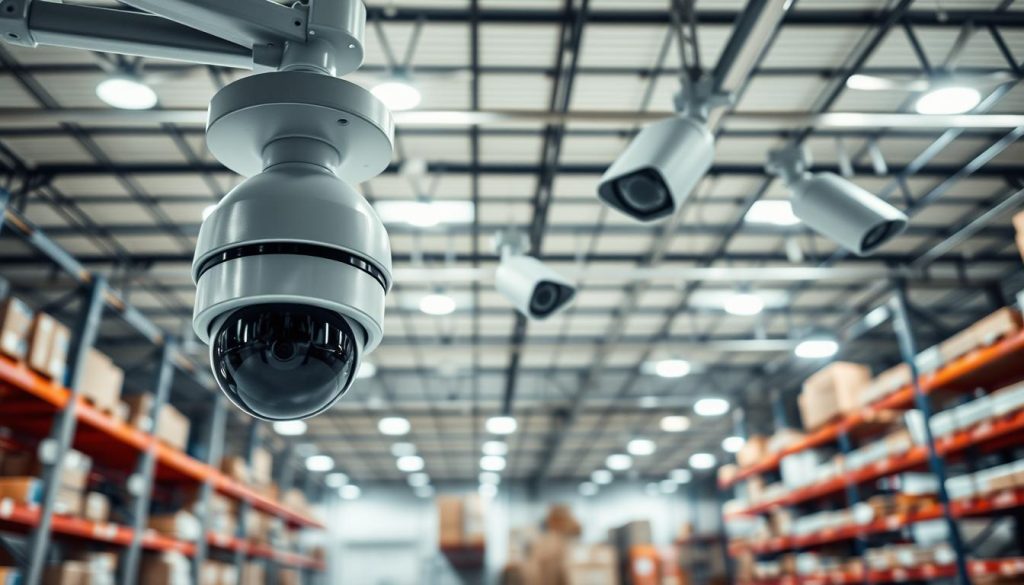
Protecting your commercial storage and distribution space is more critical than ever. Recent data shows a troubling rise in incidents, with theft increasing by 40% and physical attacks on businesses up by 28%.
These large facilities, averaging over 15,000 square feet in the U.S., present unique challenges. Standard monitoring equipment often falls short in such vast, complex environments.
This buyer’s guide is designed to help managers and teams navigate these challenges. We provide factual, data-driven insights to empower informed decisions for your operational safety.
The value of inventory and the need for operational efficiency are key drivers for investing in advanced surveillance. A comprehensive solution does more than deter crime.
It enhances safety compliance and provides crucial oversight for daily activities. Modern technology, including AI analytics and cloud-based management, is transforming how we monitor these areas.
In the following sections, we will cover everything from equipment types and technical features to integration strategies. Our goal is to give you a holistic understanding for 2023.
Key Takeaways
- Theft and safety-related incidents at commercial facilities have seen a significant rise recently.
- Large, complex spaces require specialized surveillance solutions beyond basic equipment.
- This guide aims to help you select a tailored system that fits your specific operational needs.
- Modern technology, like AI and cloud software, is revolutionizing monitoring and management.
- A robust system protects valuable inventory and can improve overall operational efficiency.
- Effective implementation involves careful planning and integration with existing operations.
- Investing in the right solution provides both crime deterrence and enhanced safety oversight.
Why Warehouse Security Demands a Specialized Approach
A standard retail monitoring setup fails completely when applied to the vast, dynamic spaces of a logistics hub. These facilities are high-value targets, packed with goods that attract both external and internal threats.
The scale of loss is staggering. Cargo thefts alone cost U.S. businesses between $15 and $30 billion every year. In the last quarter of 2023, nearly one-third of all reported thefts happened within storage and distribution centers.
This financial hemorrhage underscores the urgent need for proactive, robust measures. Beyond theft, the work environment itself presents unique health and safety risks.
Employees navigate spaces with heavy machinery, falling objects, and chemical hazards. An accident here can have severe human and financial consequences.
The physical layout adds another layer of complexity. Expansive floors, high ceilings, and long aisles create blind spots. Multiple loading docks and entry points further complicate traditional monitoring.
Relying on manual observation across such a large area is simply impractical. It creates gaps in oversight that can be exploited.
This is why technological solutions are non-negotiable. Modern surveillance systems provide the continuous, wide-area visibility that human guards cannot.
Effective protection must also integrate seamlessly with daily operations. It cannot hinder logistics, inventory control, or employee safety protocols. A specialized approach weaves these threads together.
Furthermore, the equipment itself must be tough. These systems are built to withstand dust, vibration, and temperature swings common in industrial environments.
A tailored strategy allows for precise coverage of critical zones. This includes monitoring loading bays, storage racks, perimeter fences, and workstations.
The conclusion is clear. A generic, one-size-fits-all solution is insufficient for these complex operations. Success requires a customized plan with specific camera placements and advanced features designed for the challenge.
How Warehouse Security Camera Systems Operate
The operation of a modern surveillance ecosystem hinges on a clear data pathway from capture to review. Grasping this flow is essential for selecting equipment that meets your facility’s specific demands.
It transforms raw visual information into actionable insights for protection and oversight.
The Core Components: From Lens to Monitor
Every robust monitoring setup functions through a coordinated network. The fundamental workflow begins with image capture.
Surveillance devices record live scenes across your property. This visual data is then transmitted to a central processing unit.
The key parts of any arrangement include:
- Image Capture Units: These are the various types of devices installed on-site. They range from fixed units to those with pan-tilt-zoom capabilities.
- Video Recorders: Known as NVRs (Network Video Recorders) or DVRs (Digital Video Recorders). They process and store the incoming streams.
- Monitoring Devices: On-site screens in a control room or remote access via mobile apps and cloud portals.
- Management Software (VMS): This platform organizes stored footage. It allows for search, playback, and analysis of recorded events.
Recording can happen in two primary modes. Continuous recording captures everything, ensuring a complete historical log.
Event-triggered recording activates based on specific cues. These include detected motion or sound, which saves storage space.
Analog vs. Digital: Understanding the Data Pipeline
The method of data transmission defines a system’s capabilities. The two main types are analog and digital (IP) setups.
Analog systems use coaxial cables to send video signals. They are known for stable performance with less network interference.
However, they typically offer lower image resolution. Upgrading an existing analog installation can be cost-effective.
Digital (IP) systems transmit data over Ethernet cables. They integrate easily with existing computer networks and other smart devices.
These setups deliver superior image clarity, often in 4K. Yet, they require robust cybersecurity measures to prevent unauthorized access.
The data pipeline is the journey a video signal takes. It travels from the capture unit via cable or network infrastructure to central storage.
Recorders play a vital role here. They convert raw signals into viewable formats and manage storage durations based on your settings.
Modern monitoring solutions offer flexible oversight. On-site security rooms provide immediate, localized viewing.
Remote cloud-based access enables real-time checks from anywhere. This is crucial for managers overseeing multiple locations.
Many contemporary installations blend both technologies. Encoders allow older analog units to connect to new digital networks.
This hybrid approach protects previous investments while adding modern features.
Understanding how your protection system operates is not just technical. It directly informs planning for future expansion and maintenance.
It also ensures seamless integration with other operational layers, like access control and inventory software.
Confronting Unique Warehouse Security Threats
Effective protection for industrial storage spaces must address two distinct categories of risk: malicious and incidental. A robust monitoring strategy is not just about stopping thieves.
It also safeguards people and ensures smooth daily functions. The right solution creates a shield against both deliberate crime and accidental harm.
Combating External and Internal Theft
External dangers are a constant concern for any logistics hub. These include unauthorized perimeter breaches and cargo theft from loading docks.
Vehicle-related crimes in parking lots are also a major issue. Data shows a troubling pattern: about one-third of all reported thefts occur within these facilities.
Internal threats, however, can be equally damaging. Employee theft, collusion with outsiders, and deliberate sabotage compromise integrity.
Procedural violations often create openings for loss. A notable case involved a distribution center where insiders pilfered over $100,000 in merchandise.
Visual monitoring systems serve a powerful dual role here. Their visible presence acts as a strong deterrent to would-be offenders.
Recorded video provides undeniable evidence for law enforcement. It is also crucial for internal reviews and disciplinary actions.
Mitigating Health, Safety, and Operational Risks
The work environment itself presents significant hazards. Forklift accidents, improper handling of materials, and slip-and-fall incidents are common.
Non-compliance with safety protocols can lead to severe injuries. This is where surveillance proves its value beyond crime prevention.
Recordings are invaluable during official investigations, such as those by OSHA. They document safety measures and incident responses accurately.
Modern analytics software can proactively identify unsafe actions. Managers gain visibility into areas needing improved training or protocol changes.
This proactive approach to risk management protects your greatest asset: your people. It also shields the business from costly fines and operational downtime.
A comprehensive warehouse CCTV system addresses all these challenges. It creates a unified defense against threats, both intentional and accidental.
The ultimate goal is to protect assets, ensure personnel safety, and guarantee business continuity.
Exploring the Key Types of Warehouse Security Cameras
Effective oversight in industrial settings is achieved by deploying a combination of camera types, each engineered for specific tasks. The right mix creates a seamless net of visibility across your entire facility.
Understanding the strengths of each form factor is the first step. This knowledge lets you match the right tool to each zone of your operation.
From long perimeters to packed aisles, different designs solve different problems. We will explore the five primary categories used in modern monitoring.
Bullet Cameras for Long-Range Perimeter Surveillance
Recognizable by their cylindrical, rifle-like shape, these units are built for endurance. They are a top choice for monitoring external boundaries.
Their design features a long focal length lens. This provides a narrow, focused field of view ideal for identifying details at a distance.
Install them along fences, at entry gates, and overlooking parking lots. Their very presence is a powerful deterrent to unauthorized activity.
Studies suggest visible units can prevent over 60% of criminal attempts. Their rugged housing protects against weather, making them reliable for outdoor use.
Dome Cameras for Wide-Angle Indoor Coverage
Encased in a compact, hemispherical housing, these devices offer discreet monitoring. The dome obscures the lens’s direction, adding an element of uncertainty.
This design is naturally more vandal-resistant. It is perfect for indoor spaces like workstations, storage rooms, and packing stations.
They provide a wide viewing angle to cover broad areas like aisles. However, they typically offer limited optical zoom capability.
A key maintenance note: the dome enclosure can attract dust and require periodic cleaning. This ensures the cameras capture clear video at all times.
PTZ and Turret Cameras for Flexible Monitoring
When your layout is dynamic, you need adaptable equipment. Pan-Tilt-Zoom (PTZ) and turret models provide this essential flexibility.
PTZ cameras are motorized. Operators can control them remotely to pan across a scene, tilt up or down, and zoom in on details.
This allows one unit to cover a large, open floor or actively follow movement. They are ideal for central monitoring of loading docks or vast storage areas.
Turret models offer a middle ground. They have a ball-and-socket design for manual repositioning during installation or occasional adjustments.
This is useful when storage rack layouts change. Both types require more complex installation and occasional maintenance of moving parts.
Fisheye (360°) Cameras for Panoramic Views
For complete, uninterrupted visibility in an open space, consider a fisheye unit. A single device can provide a full 360-degree panoramic view.
This drastically reduces the total number of devices needed in atrium-like areas. It eliminates blind spots between multiple fixed units.
The raw footage appears distorted. Special dewarping software is used to create normal, rectified views for review.
They are best suited for monitoring wide-open spaces with less intricate activity. Image clarity for fine details can be lower in very busy zones.
Choosing the right type depends on your specific needs. Here is a quick comparison to guide your selection:
- Installation: Bullet and dome are simplest. PTZ and fisheye are more complex.
- Maintenance: Domes need cleaning. PTZs need mechanical checks. Bullets are generally low-maintenance.
- Image Clarity: Bullets excel at long-range detail. PTZs offer powerful zoom. Fisheyes trade detail for coverage.
- Best Zone Fit: Bullets for perimeters. Domes for indoor aisles. PTZs for large open floors. Fisheyes for central atriums.
The most robust solution combines these types. For example, use bullet cameras on exterior walls to watch the fence line.
Install dome units over high-value inventory racks inside. Position a PTZ camera to oversee the bustling loading dock.
This strategic mix ensures comprehensive coverage. It protects assets, enhances safety oversight, and supports efficient operations.
Essential Technical Features for Your Warehouse Camera
Choosing a surveillance unit is more than selecting a brand. It’s about matching core engineering features to your facility’s unique demands.
Technical specifications directly determine how well you can identify people, objects, and actions. The right combination turns raw video into powerful, actionable evidence.
Resolution and Image Clarity: From 1080p to 4K
Resolution is the cornerstone of useful footage. It defines the level of detail your system can capture.
Full HD (1080p) is a solid baseline for general monitoring. It provides clear enough video to see activities and recognize individuals.
For critical identification, 4K Ultra HD is superior. This higher resolution is essential for reading small text on product labels or capturing a license plate from a distance.
It makes the difference between seeing “someone” and knowing exactly who they are. Investing in higher resolution upfront future-proofs your surveillance capability.
Frame Rate: Ensuring Smooth Footage in Busy Aisles
Frame rate, measured in frames per second (fps), controls how smooth motion appears. A low frame rate creates choppy, blurred video of fast movement.
This is a major problem in active industrial environments. Forklifts, conveyor belts, and people move quickly through aisles.
A rate around 10 fps strikes an excellent balance for these settings. It delivers smooth-enough video to follow action clearly without consuming excessive digital storage space.
For high-speed zones like loading docks, consider a slightly higher frame rate. This ensures every critical moment is captured without motion blur.
Low-Light and Night Vision Capabilities
Protection doesn’t stop when the lights dim. Many incidents occur during overnight shifts or in poorly lit storage areas.
Infrared (IR) night vision is the most common solution. These units use built-in IR LEDs to illuminate scenes, creating a clear monochrome image in total darkness.
Thermal imaging is another advanced option. It detects heat signatures rather than reflecting light, seeing through smoke, fog, and light foliage.
Some models also feature built-in spotlights. These provide color video in low-light conditions and can act as a powerful deterrent when triggered by motion.
Durability: IP Ratings for Indoor/Outdoor Use
Industrial locations are tough on equipment. Dust, moisture, temperature swings, and physical impacts are daily realities.
Ingress Protection (IP) ratings certify a device’s resilience. The rating consists of two numbers.
The first indicates protection against solids like dust. The second denotes resistance to liquids.
An IP66 rating means the unit is totally dust-tight and can withstand powerful water jets. IP67 guarantees protection during temporary immersion.
These ratings are non-negotiable for any exterior installation or use in dusty indoor areas. Vandal-resistant housing adds another layer of physical defense against tampering.
Other valuable features include Wide Dynamic Range (WDR). This technology balances extreme lighting contrasts, like a bright doorway against a dark interior.
It ensures details are visible in both the shadows and the highlights. Here is a practical checklist for evaluating units:
- Detail Requirement: Do you need to read labels or identify faces? Prioritize 4K resolution.
- Activity Level: Is the area a high-traffic zone? Ensure a frame rate of at least 10 fps.
- Lighting Conditions: Are there unlit yards or dim aisles? Specify IR range or thermal capability.
- Environmental Risks: Is the location exposed to weather or dust? Mandate an IP66 or higher rating.
- Special Challenges: Does the scene have glare or deep shadows? Look for WDR technology.
Balancing cost and benefit is key. Higher-end features like thermal imaging command a premium but offer unmatched capability in specific, high-risk scenarios.
For general coverage, robust 4K units with IR and high IP ratings provide excellent value. Always look for equipment certified to commercial or industrial standards.
This indicates rigorous testing for reliability in demanding, continuous-use environments. Your technical choices form the foundation of a trustworthy surveillance solution.
The Power of Smart Integrations and Video Analytics
Today’s most effective protection strategies transform passive video feeds into a dynamic, intelligent network. The real advancement lies in connecting visual monitoring with other digital tools.
This creates a unified ecosystem that anticipates problems. It moves far beyond simple recording after an event occurs.
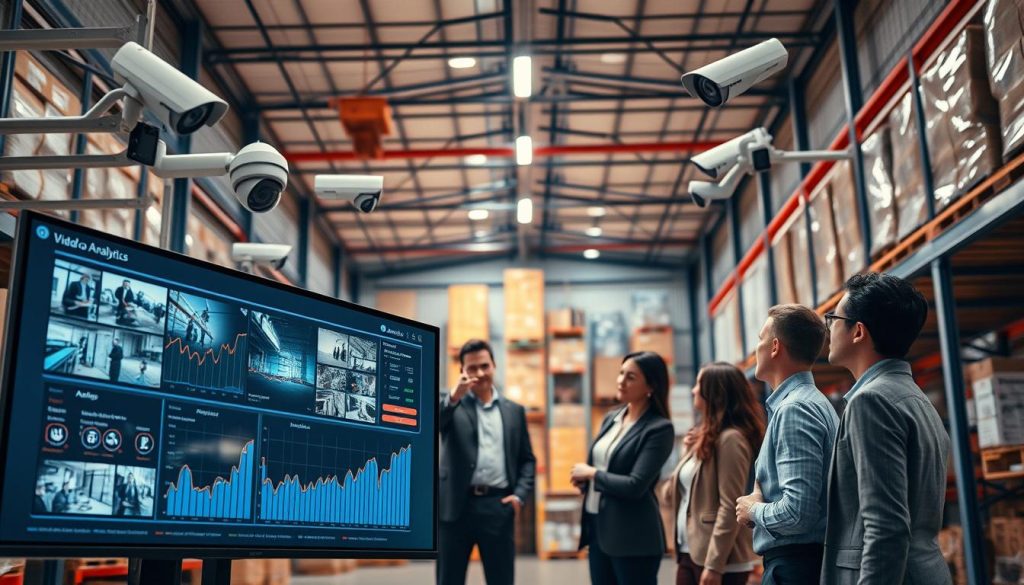
Intelligent software analyzes live streams to spot unusual activity. It can then trigger automated responses across your facility.
This proactive approach is a game-changer for modern business operations.
AI-Powered Analytics for Proactive Threat Detection
Modern video analytics use machine learning to understand normal patterns. They watch for specific, predefined behaviors that signal potential risks.
For example, algorithms can detect a person loitering near a fence after hours. They can identify someone entering a restricted zone without authorization.
These systems are trained to recognize safety incidents, like a slip and fall. They can even spot potential OSHA violations, such as improper forklift operation.
When an anomaly is detected, the software sends a real-time alert to managers. This allows for immediate intervention before a minor issue escalates.
This technology turns every camera into a smart sensor. It continuously scans for threats, providing constant visibility without human fatigue.
Unifying Video Surveillance with Access Control
Combining visual monitoring with entry point management creates a powerful audit trail. Modern systems can integrate directly with card readers and biometric scanners.
Some advanced units even have built-in facial recognition. They can act as a credential reader, granting access only to authorized personnel.
This integration provides visual proof of who entered a secure area and when. If a badge is used fraudulently, the associated video footage provides instant evidence.
It automates the process of monitoring entry points. This strengthens overall site integrity and streamlines management.
Utilizing License Plate Recognition (LPR) for Yard Security
Vehicle movement in storage yards is a critical point of control. License Plate Recognition technology automates this process with high accuracy.
Specialized cameras capture an image of a vehicle’s plate as it approaches a gate. The system instantly reads the number and checks it against a database.
Authorized vehicles on a whitelist can be granted automatic entry. Unauthorized or blacklisted plates trigger an alert, and barriers can remain closed.
This technology also helps detect loitering in parking areas. It logs every vehicle’s arrival and departure time, creating a complete log.
Cloud-based platforms are the backbone for managing these smart integrations. They allow for remote viewing of live video and recorded footage from any device.
Managers can receive alerts and review incidents from their phone or laptop. This enables 24/7 oversight of multiple locations.
These platforms also tie together different IoT devices. A motion sensor can trigger a specific camera to start recording and follow the motion.
A door contact sensor can tell the surveillance system to capture video whenever it is opened after hours.
Consider this automated response: an AI unit detects a person in a high-value inventory zone after closing. It can immediately lock interior doors and send an alert to a guard’s phone.
An LPR camera recognizing an unauthorized truck can keep the main gate closed. It simultaneously notifies the onsite team.
Implementing these technologies requires careful attention to data privacy. All communications between devices must use secure, encrypted channels.
Access to sensitive video analytics data should be strictly controlled. Proper policies must be in place to govern its use.
Ultimately, smart integrations turn a collection of devices into a proactive command center. They dramatically improve response time and provide deep operational intelligence.
This intelligent layer is what transforms a basic monitoring solution into a comprehensive defense for your warehouse activities.
Best Practices for Planning Your Camera Placement
The blueprint for a robust oversight system begins long before installation, with meticulous planning of each unit’s location. Intelligent positioning is what transforms a collection of devices into a cohesive network.
This process ensures every critical square foot receives appropriate visibility. It also maximizes the deterrent effect of your investment.
Conducting a Thorough Site Risk Assessment
Start with a comprehensive walkthrough of your entire facility. This survey identifies all critical assets, high-traffic employee zones, and potential blind spots.
Review historical data on past incidents, whether theft, safety issues, or procedural violations. This history reveals your property’s unique vulnerability patterns.
The assessment must evaluate a range of potential risks. Consider external threats like vandalism or unauthorized entry.
Also, review internal activity and operational hazards. Compliance requirements for your industry add another layer to this evaluation.
This groundwork creates a prioritized list of zones needing monitoring. It turns a generic plan into a tailored solution.
Strategic Placement for Maximum Coverage and Deterrence
With risks identified, map your facility to plan exact locations. The goal is overlapping fields of view to eliminate blind spots.
Minimize obstructions from storage racks, machinery, or signage. Each device should have a clear line of sight to its target areas.
Strategic placement serves a powerful psychological purpose. Highly visible units at main entrances, exits, and high-value inventory zones act as a strong deterrent.
Technical considerations are equally important. Mounting height and angle affect the field of view and detail capture.
Always account for lighting conditions and proximity to power or data sources. These factors influence both performance and installation cost.
A strategic mix of device types is recommended. Use fixed units for constant monitoring points like cash handling stations.
Employ Pan-Tilt-Zoom (PTZ) models for areas requiring occasional focused attention. This combination provides both blanket coverage and flexible detail.
Remember to protect the monitoring equipment itself. Ensure housings are tamper-resistant and rated for their specific environmental conditions.
Successful planning is a collaborative effort. Involve your security personnel, operations managers, and a professional installer in the phase.
Their combined insights on daily workflow and threat management are invaluable. They help balance optimal visibility with practical installation and budget realities.
Finally, always test the coverage before finalizing the entire setup. Simulate scenarios to ensure the planned placements capture the necessary video evidence.
Effective placement is not about using the most devices. It’s about using each one wisely to create an intelligent, layered defense for your business locations.
Wired vs. Wireless: Choosing the Right Installation
Installation type—whether cables or wireless signals carry the data—directly influences system stability, maintenance needs, and future expansion. This choice is a core technical decision for any monitoring network.
Each method offers distinct trade-offs between reliability and flexibility. Understanding these differences is key to a successful long-term solution.
Wired Systems: The Backbone of Reliability
Wired configurations use physical cables to transmit power and video data. The two main types are traditional coaxial and modern Power over Ethernet (PoE).
PoE is a popular choice for new installations. It delivers both electricity and data over a single Ethernet cable, simplifying the cabling process.
These systems are renowned for their unwavering performance. They provide consistent power and a stable data stream, free from signal interference.
This makes them ideal for critical, fixed monitoring points. The physical connection also offers a layer of security, as it’s harder to intercept.
The main drawback is installation complexity. Running cables through an industrial space often requires professional help and can be costly upfront.
Wireless Systems: Flexibility with Considerations
Wireless options, like Wi-Fi or cellular networks, offer a different set of advantages. Their primary benefit is easier and faster setup.
You can place units in locations where running a cable is impractical. This provides great flexibility for covering hard-to-reach areas.
For smaller facilities or temporary needs, this can be a perfect fit. However, the industrial environment presents unique challenges for wireless signals.
Metal storage racks and thick concrete walls can severely hinder Wi-Fi range. Bandwidth congestion on a shared network can also degrade video quality.
Battery-powered wireless cameras add another maintenance task. You must regularly check and replace batteries to ensure continuous operations.
Scalability and Environmental Factors
When planning for growth, wired systems are typically more robust. They form a permanent, scalable backbone for large facilities.
Wireless setups can be excellent for supplemental coverage. They are useful for temporary zones or where cabling is prohibitively expensive.
The physical construction of your property is a major deciding factor. Dense metal and concrete structures are notorious for blocking wireless signals.
Assessing your site’s layout before choosing a technology is crucial. This prevents coverage gaps that compromise overall visibility.
Cybersecurity and Data Integrity
Protecting your data stream is non-negotiable. Wired networks have a natural advantage as the physical cable is harder to tap into remotely.
Wireless networks broadcast data through the air, which requires strong protection. Implementing the latest encryption standards, like WPA3, is essential to prevent unauthorized access.
This protects your footage and your broader business network from intrusion. A breach here can expose sensitive operational data.
Making the Right Choice for Your Facility
Your decision should be based on a clear assessment of your specific needs. Consider these key criteria:
- Property Size and Layout: Large, complex spaces often benefit from the reliability of wired solutions.
- Construction Materials: Metal and concrete heavily favor cabled installations for consistent performance.
- Installation Budget: Wired systems have higher upfront costs but lower long-term maintenance.
- Need for Mobility: If monitoring points change frequently, wireless offers necessary flexibility.
- Existing IT Infrastructure: A strong, dedicated network can support a robust wireless setup.
The Pragmatic Hybrid Approach
Many modern facilities find success with a blended strategy. This approach uses the best technology for each specific zone.
Use reliable, wired PoE systems for your most critical fixed points. These include main entrances, high-value inventory storage, and cash handling areas.
Then, deploy wireless units for supplemental coverage. They can monitor temporary storage zones or provide additional angles without major construction.
This hybrid model balances rock-solid reliability with adaptable management. It ensures comprehensive oversight while being mindful of budget and practical activities.
Choosing the right installation method is not just about today’s setup. It’s an investment in the long-term integrity and effectiveness of your entire monitoring solution.
Future-Proofing Your Warehouse Security Investment
Smart facility managers view their monitoring equipment as a dynamic asset, planning for both expansion and routine care. Your initial setup is just the starting point.
A truly robust solution must evolve with your business needs and technological advances. This forward-thinking approach protects the long-term value of your capital outlay.
It ensures your oversight capabilities don’t become obsolete. Proactive planning covers two critical areas: scalable architecture and disciplined maintenance.
Planning for Scalability and System Upgrades
Choosing technology with an open architecture is your first defense against obsolescence. Prioritize equipment that adheres to universal standards like ONVIF.
This ensures new devices from different brands can integrate later. It prevents you from being locked into a single vendor’s ecosystem.
When selecting core hardware, always build in headroom. Your network video recorder should have extra channels beyond your current count.
Network switches need spare ports for adding units in new areas. This planning avoids costly infrastructure overhauls during simple expansions.
Software is the brain of your system, and its updates are non-negotiable. Regular patches fix security vulnerabilities and often add new features.
Enhanced analytics or improved user interfaces can arrive via update. This extends the functional life of your existing hardware investment.
Understand the technology lifecycle. Plan for periodic hardware refreshes every 5-7 years to leverage better resolution and efficiency.
Consider cloud storage as a flexible alternative to on-site servers. It offers scalable data retention and remote management from any location.
“The most cost-effective upgrade is the one you planned for during the initial installation.”
Establishing a Routine Maintenance Schedule
Proactive upkeep is what turns a good system into a reliable one. A disciplined schedule prevents minor issues from causing major failures.
Create a monthly checklist for visual inspections. Verify each unit is securely mounted and free from physical obstructions.
Clean lenses and dome enclosures quarterly to maintain clear video quality. Dust and grime can severely degrade footage clarity over time.
For wireless units, establish a strict battery replacement cycle. Document each change to predict future needs accurately.
Specialized devices require extra attention. PTZ models with moving parts need periodic lubrication of their mechanisms.
Infrared illuminators in night-vision cameras can degrade and may need replacement. Always update the firmware for these advanced units.
Test your entire setup’s functionality regularly. Verify recording is active, playback works, and backup power systems engage correctly.
Meticulous documentation is your troubleshooting lifeline. Maintain logs of all maintenance, IP addresses, and system layout diagrams.
This is invaluable for onboarding new staff or diagnosing problems quickly. It turns reactive fixes into predictable, managed activities.
Ultimately, future-proofing is about sustained visibility and control. It ensures your protection infrastructure grows in tandem with your operations.
This strategy safeguards your assets, personnel, and operational continuity for years to come.
Building a Comprehensive and Compliant Security Ecosystem
The insights from this guide converge on a single principle: protection is not a cost center, but a foundational element of business resilience. Building a robust ecosystem means integrating your visual monitoring with access control, sensors, and operational software.
This unified approach, as used by firms like Coram AI for major logistics clients, turns data into actionable intelligence. It drives tangible outcomes: reduced loss, lower insurance costs, and enhanced safety records.
Partnering with a specialist who understands industrial logistics is key for seamless implementation and support. They ensure your solution complies with regulations and scales with your growth.
Now is the moment to apply these principles. Assess your current posture and plan your strategic upgrade to safeguard your operations and profitability for the year ahead.