
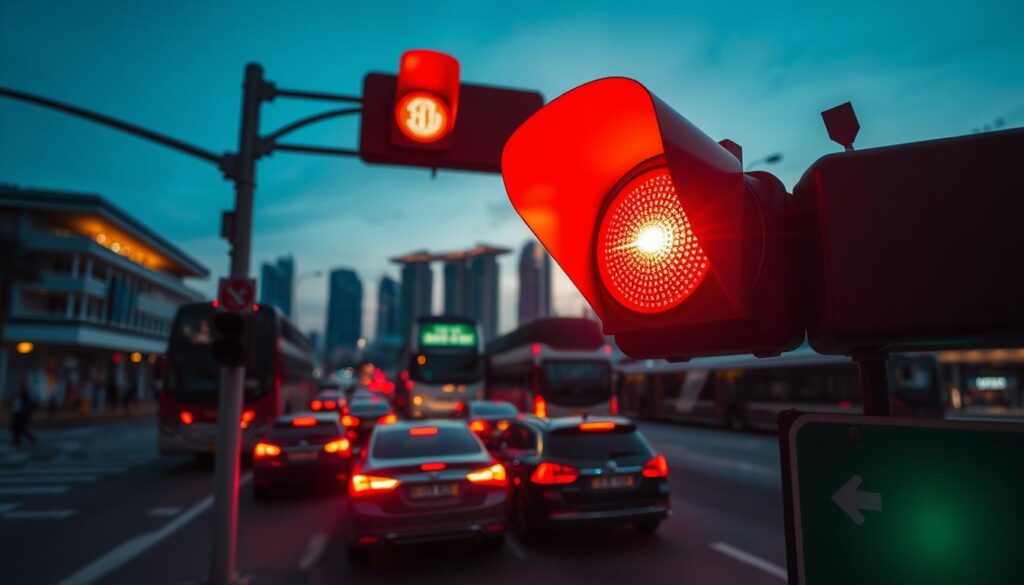
For drivers navigating Singapore’s roads, understanding the significance of a flashing red light is crucial for safety. This signal acts like a stop sign, demanding that all vehicles come to a complete halt before proceeding. The Land Transport Authority enforces this rule strictly under the Road Traffic Act. Ignoring it can lead to serious consequences, including fines and accidents.
Flashing red lights typically appear at intersections with lower traffic volumes, enhancing safety without the need for constant monitoring. By treating this signal with the same seriousness as a stop sign, drivers can help prevent accidents and maintain smooth traffic flow. Statistics show that Singapore has seen a 22% drop in intersection accidents from 2020 to 2023, highlighting the importance of compliance.
This how-to guide will explore every aspect of responding to flashing red lights, from legal obligations to practical driving techniques. Understanding these signals not only keeps drivers safe but also protects pedestrians and cyclists sharing the road. Let’s dive into the essential information that every responsible driver in Singapore should know.
Key Takeaways
- A flashing red light requires drivers to stop completely, similar to a stop sign.
- Compliance with this signal enhances road safety and reduces accidents.
- Local traffic laws enforce strict adherence to stopping at flashing red lights.
- These signals are often used at low-traffic intersections for safety.
- Understanding this signal is essential for all road users, including pedestrians and cyclists.
Understanding What a Flashing Red Light Means in Singapore
Understanding the implications of a flashing red light is essential for safe driving in Singapore. Under the Road Traffic Act, the Land Transport Authority (LTA) classifies these signals as mandatory stop indicators. Drivers must treat them with the same seriousness as a stop sign. This means halting completely before proceeding when it is safe to do so.
Legal Definition and Purpose under Singapore Traffic Laws
In Singapore, a flashing red light serves a critical role in traffic control. It requires all drivers to come to a complete stop behind the stop line. This rule applies regardless of whether other vehicles or pedestrians are present. The primary purpose of these signals is to prevent collisions at intersections where permanent signals are not necessary, such as quieter junctions near schools during off-peak hours.
Difference Between Flashing Red Lights and Solid Red Lights
It is important to differentiate between flashing red lights and solid red lights. A solid red light requires drivers to wait until the signal turns green. In contrast, a flashing red light allows movement after a full stop, provided the way is clear. This distinction optimizes traffic flow while ensuring safety. It enables drivers to navigate low-traffic intersections efficiently without compromising road safety standards.
Comparison with International Traffic Standards
When comparing Singapore’s approach to international traffic standards, there are notable differences. Countries like the U.S. and U.K. share similar rules regarding flashing signals. However, Singapore enforces stricter penalties for violations. This ensures more consistent monitoring of compliance. Malaysia also aligns with similar principles but has less consistent enforcement. Thus, Singapore maintains higher expectations for all drivers.
Technical specifications in LTA manuals highlight the use of standardized LED modules. These ensure consistent visibility of flashing red lights across the island. Real-world examples, such as intersections near East Coast Park, illustrate how these signals effectively manage sporadic vehicle and cyclist traffic without needing full signal cycles.
In conclusion, understanding the legal definition and purpose of flashing red lights is foundational knowledge for every driver. It is crucial for navigating Singapore’s roads safely and lawfully.
How to Properly Respond to a Flashing Red Light
Navigating intersections safely requires understanding how to respond to a flashing red light. When you encounter this signal, there are three critical steps every driver must follow to ensure safety and compliance with traffic laws.
Step 1: Come to a Complete Stop
First and foremost, drivers must bring their vehicle to a complete stop behind the white stop line. This means that your wheels should cease all motion for a minimum of three full seconds before proceeding. Remember, rolling stops—where the vehicle slows to 5-10 km/h instead of reaching 0 km/h—are illegal. In fact, these account for 40% of all violations at high-traffic junctions like Orchard Road.
Heavy vehicles, such as trucks and buses, require additional braking distance. Therefore, they must begin deceleration earlier to achieve a proper full stop at the stop line.
Step 2: Check for Pedestrians and Cross Traffic
Next, conduct a thorough 180-degree visual sweep. Check left for oncoming traffic and pedestrians, then right for bicycles and motorcycles. Additionally, examine frontal crossing patterns and review your rearview mirror for any approaching emergency vehicles. This step is crucial, especially during monsoon season when heavy rains can reduce visibility. Always double-check blind spots to confirm the way is completely clear.
Step 3: Proceed Only When Safe
Finally, you may proceed only when the intersection is confirmed safe. Always yield to pedestrians, who have the right of way—even if they are crossing against signals. Distracted scanning is a major concern, causing 23% of accidents at flashing red intersections. Therefore, focused attention during all three steps is absolutely critical for safety.
Remember, these three steps—complete stop, thorough check, and safe proceeding—form the non-negotiable protocol that every driver must follow when encountering a flashing red light. Failing to execute any of these steps properly can result in fines, demerit points, and an increased risk of collisions with other vehicles or pedestrians.
Right-of-Way Rules at Flashing Red Light Intersections
Understanding who has the right of way at flashing red light intersections can prevent accidents. Singapore follows a specific priority sequence to ensure smooth traffic flow and safety. This hierarchy is crucial for all road users, including drivers, pedestrians, and cyclists.
Priority for Pedestrians and Emergency Vehicles
At flashing red light intersections, emergency vehicles with active sirens and lights always receive absolute priority. Drivers must yield to these vehicles unconditionally, allowing them to pass without delay. Following emergency vehicles, pedestrians in marked crosswalks hold the second position in the hierarchy. Drivers must stop and yield to pedestrians at all times, regardless of other traffic conditions.
Protocols for Multiple Vehicles Arriving Simultaneously
When two vehicles arrive at a flashing red light simultaneously, LTA Rule 78B dictates that the driver on the right proceeds first after both have come to a complete stop. In four-way stop situations, the first vehicle to arrive and stop moves first. If arrival times are tied, right-hand priority prevails. This clear protocol helps prevent confusion and ensures safety at intersections.
According to recent dashcam analyses, approximately 70% of conflicts occur from misjudging arrival order. Therefore, patience and clear communication are essential. Additionally, the 2024 LTA updates now rank cyclists above regular vehicles but below pedestrians in the right-of-way hierarchy. This change reflects Singapore’s evolving traffic management approach.
Violating right-of-way rules can lead to significant penalties, including 6 demerit points and a $200 fine. To avoid such consequences, drivers should use indicators and make eye contact with other motorists to communicate intentions clearly. Understanding and respecting these rules is fundamental to safe driving at flashing red light intersections.
Safety Measures and Best Driving Practices at Flashing Red Lights
Safety on the roads is paramount, especially when approaching flashing red lights. These signals demand attention and careful driving practices to ensure the safety of all road users. Here are essential measures every driver should follow.
Maintaining Full Stops and Avoiding Rolling Stops
First and foremost, drivers must come to a complete stop at the stop line. This is crucial to prevent accidents. Rolling stops remain the most common violation at flashing red lights across Singapore. NTU’s 2023 study indicates that many drivers underestimate stopping distances by 1.2 meters in wet conditions. This can lead to vehicles dangerously encroaching into pedestrian crosswalks.
When stopping, ensure to maintain at least 1.5 meters of clearance from crosswalk markings. This distance allows pedestrians to cross safely. Remember, a full stop means no movement at all, and every driver should adhere to this rule.
Situational Awareness in Adverse Weather and Low Visibility
Situational awareness is critical, especially during adverse weather conditions. Heavy rains can reduce visibility significantly. Drivers should double-check all directions before proceeding. Critical blind spot checks include scanning beneath vehicle hoods for small children and checking mirror angles for approaching seniors. Monitoring crosswalk countdown timers is also essential.
Additionally, the Active Mobility Act grants pedestrians absolute right-of-way once they enter marked crossings. This legal obligation emphasizes the need for driver vigilance around crosswalks.
Effective Communication with Other Road Users
Clear communication with other road users is vital. Use hand signals or headlight flashes to indicate your intentions at intersections. This helps to avoid misunderstandings and enhances overall safety. Being patient and alert is essential, especially when watching for cyclists and pedestrians who may cross unexpectedly.
Drivers should anticipate unpredictable movements from other road users, particularly in school zones and areas with high foot traffic near flashing red lights. By combining proper stopping techniques, heightened situational awareness, and clear communication, drivers can create a safer environment for everyone on the road.
Handling Signal Malfunctions and Power Outages
Drivers must be prepared to handle situations where traffic signals malfunction or go dark. Recognizing the signs of a malfunctioning signal is crucial for maintaining safety at intersections. When you encounter a traffic signal that is not functioning correctly, it is essential to identify the issue before proceeding.
Identifying Blacked-Out or Malfunctioning Traffic Signals
Look for complete signal darkness, flickering lights, or inconsistent blinking patterns. These indicators suggest that the traffic signal is not operating as intended. For example, during the 2022 Woodlands outage, 80% of collisions occurred due to misidentification of signal failures. Understanding the difference between intentional flashing red lights and defective signals can prevent accidents.
Temporary Four-Way Stop Procedures
When traffic signals are blacked out, treat the intersection as an all-way stop. This means you should come to a complete stop behind the stop line. Yield to vehicles that arrived first, and if multiple vehicles arrive simultaneously, apply right-hand priority rules. This procedure helps ensure that traffic flows smoothly and safely.
Reporting Defective Signals to Authorities
It is important to report any defective signals to the authorities. You can contact the LTA Hotline at 1800-CALL-LTA, which has an average response time of 38 minutes. Alternatively, use the MyTransport.SG app for real-time reporting. If navigating a malfunctioning intersection at night, flash your hazard lights to alert other drivers of unusual traffic conditions ahead.
Remember, insurance claims following accidents at malfunctioning signals may require proof that you reported the defect. Therefore, documenting the scene with timestamps can be crucial. Hesitation during signal outages can cause 60% of congestion, so proceed confidently but cautiously after following all safety protocols.
In conclusion, knowing how to handle signal malfunctions is a critical skill that every Singapore driver must develop to maintain safety during unexpected traffic situations.
Legal Obligations and Potential Penalties for Violations
Understanding the legal obligations associated with traffic signals is essential for every driver in Singapore. Ignoring flashing red lights can lead to severe consequences, both financially and legally. Compliance with these signals is not just a matter of safety; it is also a legal requirement.
First-time offenders face a S$150 fine and 4 demerit points under Singapore’s Driver Improvement Points System. This tiered penalty structure emphasizes the importance of obeying traffic signals. For repeat violations within 12 months, fines escalate to S$300 and 8 demerit points. This approach showcases the legal system’s zero-tolerance stance on traffic violations.
Commercial drivers face additional risks. Accumulating 13 demerit points can lead to vocational license suspension, which directly impacts their employment. Furthermore, demerit points remain on a driver’s record for 12 months. If a driver accumulates 24 points within 24 months, they face mandatory license suspension and driving retests.
Liability in accidents involving flashing red lights is another critical aspect. The Tan vs Lim 2021 court case established strict liability when pedestrians are involved in collisions at these intersections. This means that drivers are held accountable for accidents, regardless of circumstances.
In multi-vehicle crashes, comparative fault applies. Dashboard camera evidence plays a decisive role in determining each driver’s share of responsibility. A 2023 precedent case confirmed that rolling stops constitute complete violations, eliminating ambiguity about partial stops at flashing red lights.
Foreign license holders should be cautious as well. Outstanding violations may prevent the conversion of their license to a Singaporean one. After license suspensions, the Comprehensive Driving Evaluation program becomes mandatory for point recovery, adding time and cost burdens for violators.
In conclusion, the legal framework surrounding flashing red light violations is robust and strictly enforced. Compliance is the only sensible choice for all drivers, ensuring safety and adherence to the law.
Impact of Flashing Red Light Violations on Insurance and Driving Records
Understanding the effects of flashing red light violations is crucial for drivers looking to maintain a clean record and reasonable insurance rates. When a driver is caught violating these signals, the repercussions can extend well beyond immediate fines.
Insurance premiums often see an average increase of 65% following a flashing red light violation. Major insurers, such as NTUC Income, apply a three-tier calculation model. This includes a base rate adjustment of 30-50%, a risk surcharge for accumulated demerit points, and a claims history multiplier. For instance, at-fault violations can increase motor insurance premiums by up to 50%.
Insurers evaluate three key factors during underwriting after a violation:
- The frequency of traffic violations.
- The rate of demerit point accumulation.
- Any involvement in prior accidents.
Policyholders with multiple traffic violations may face coverage limitations. Some insurers even require defensive driving courses for policy renewal. This requirement underscores the seriousness of maintaining safe driving practices.
Disputes can arise from violations, and drivers have the option to file challenges through the Singapore Traffic Police’s online portal within 14 days of receiving a violation notice. Dashboard camera footage often serves as decisive evidence in these adjudication processes. Therefore, maintaining a functioning dashcam in your vehicle is essential.
Furthermore, at-fault determinations in flashing red light accidents directly impact insurance claims. Violators typically bear primary liability for any resulting damages and injuries. Even a single violation can affect insurance premiums for multiple years, as the incident remains on the driver’s record and influences risk assessments during renewal periods.
To mitigate these impacts, drivers should consider investing in defensive driving courses proactively. This not only helps demonstrate a commitment to safe driving practices but may also assist in lowering insurance costs.
In conclusion, the insurance ramifications of flashing red light violations extend far beyond the initial fine. They can affect a driver’s financial standing for years to come.
The Role of Flashing Red Lights in Traffic Control and Road Safety
Flashing red lights play a pivotal role in ensuring road safety and efficient traffic management across Singapore. These signals are strategically placed at low-traffic intersections and school zones, where full signal cycles may cause unnecessary delays. Their primary function is to maintain safety while optimizing traffic flow.
In low-traffic areas, flashing red lights help drivers make quick decisions without compromising safety. They reduce wait times by an impressive 18% during off-peak hours, as shown in smart junction trials. This efficiency is vital for keeping traffic moving smoothly while ensuring that drivers remain vigilant.
Use in Low-Traffic Intersections and School Zones
Flashing red lights are particularly important in school zones. Here, enhanced protections, such as flashing beacon systems, activate during student dismissal times. These systems are complemented by volunteer crossing guards and high-visibility road markings, creating a safer environment for children crossing the street.
Fines for violations near educational institutions start at S$300, reflecting the heightened safety priorities in areas with vulnerable young pedestrians. The SG Road Safety Council’s “Stop for Students” initiative further reinforces these measures, emphasizing the need for drivers to be alert and cautious.
Contribution to Accident Prevention and Smooth Traffic Flow
Flashing red lights contribute significantly to accident prevention. They compel drivers to slow down and thoroughly assess intersections before proceeding. This careful approach is essential for reducing the risk of collisions.
Moreover, these signals facilitate smooth traffic flow by allowing vehicles to move after stopping when conditions are clear. Instead of waiting for timed signal cycles, drivers can proceed safely, enhancing overall traffic management.
Statistics show a 22% reduction in intersection accidents across Singapore from 2020 to 2023, underscoring the effectiveness of flashing red lights in traffic control. The strategic placement of these signals balances traffic efficiency with road safety, particularly in areas with irregular or seasonal traffic patterns.
In conclusion, flashing red lights serve as an essential tool in Singapore’s comprehensive traffic management system. They protect vulnerable road users while maintaining efficient vehicle movement, contributing to a safer driving environment for everyone.
Distinguishing Flashing Red Lights from Other Traffic Signals
Recognizing the differences between various traffic signals is essential for safe driving. Each signal serves a specific purpose, and understanding these distinctions can help drivers respond appropriately. Here, we will explore how flashing red lights compare to other signals, such as flashing yellow lights and solid red arrows.
Contrast with Flashing Yellow Lights
Flashing yellow lights signal caution rather than requiring a full stop. They are often seen on roads like Clementi Ave 6 during off-peak hours. When drivers encounter a flashing yellow light, they should slow down and proceed carefully. This signal alerts them to potential hazards without demanding a complete halt.
Differences Compared to Solid Red Arrows and Steady Signals
In contrast, flashing red lights mandate a complete stop before proceeding. Solid red arrows, on the other hand, completely forbid turns in the indicated direction until the light changes to green. Multi-phase intersections often combine flashing red lights with solid red arrows to manage complex traffic patterns effectively.
LED technology enables these signals to switch between modes automatically. For instance, the East Coast Parkway uses this feature extensively during nighttime operation patterns. This innovation enhances visibility and safety for drivers.
Signal standardization across Singapore ensures that drivers encounter consistent rules, whether facing flashing lights or solid arrows. This reduces confusion at complex intersections, which is vital for maintaining safety.
While flashing red lights allow movement after a complete stop, solid red arrows permit no movement whatsoever in the restricted direction until the signal changes. Confusing these signal types can lead to dangerous situations, as proceeding through a solid red arrow carries severe penalties and high accident risks.
Smart traffic systems now adjust these signals based on real-time conditions. This optimization helps maintain consistent safety standards across the road network while improving traffic flow.
In conclusion, the ability to quickly distinguish between different traffic signals is an essential skill that every driver must develop for safe navigation of Singapore’s roads.
Special Considerations for Flashing Red Lights at Railroad Crossings
Flashing red lights at railroad crossings demand special attention from drivers to ensure safety. These signals are not just a caution; they indicate a mandatory stop for all vehicles. When the lights activate, every driver must adhere to strict protocols to avoid accidents.
All vehicles must come to a complete stop at least 5 meters before the crossing when flashing red lights activate, regardless of whether a train is visible. This distance is crucial for ensuring that drivers have ample time to react. Advanced sensor technology detects approaching trains up to 1 kilometer away, providing essential warning time.
Mandatory Stop Requirements Before Crossing
When the warning signals are activated, drivers should remain vigilant. The initial bell rings 30 seconds before a train’s arrival, followed by flashing lights that begin at the 15-second mark. Finally, the gates lower completely just 5 seconds before the train crosses. This precise synchronization is designed to keep all road users safe.
Synchronization of Warning Signals and Gates
Rail crossings operate on fail-safe principles. If any system malfunction occurs, all warning devices automatically activate. This ensures that drivers receive maximum warning at railroad crossings. Regular maintenance by SMRT’s teams occurs weekly, aligning with off-peak traffic periods to minimize disruptions.
Historical data shows a remarkable 72% reduction in crossing accidents since 2000, highlighting the effectiveness of Singapore’s multi-layered safety approach. Additional safety measures include high-intensity LED warning lights, concrete barriers along rail corridors, and 24/7 CCTV surveillance at all crossings.
Drivers must never attempt to drive around lowered crossing gates. This dangerous behavior undermines the synchronized warning system and risks catastrophic collisions with trains. Jurong Port’s railway network demonstrates these protocols daily, activating crossing systems 45 seconds before train arrival to provide generous warning time.
In conclusion, railroad crossings with flashing red lights demand the highest level of driver caution and compliance. The consequences of violations can be fatal, making awareness and adherence to these protocols essential for all road users.
Emergency Vehicle Protocols at Flashing Red Light Intersections
When emergency vehicles approach flashing red light intersections, drivers must follow specific protocols to ensure safety. These actions are vital for allowing first responders to navigate congested areas efficiently.
Yielding Practices and Clearance Distances
The Singapore Civil Defence Force (SCDF) requires motorists to create a 30-meter clearance when emergency vehicles with active sirens approach. This yielding distance allows safe passage even at busy junctions. For instance, data from Ang Mo Kio Fire Station shows that this buffer prevents 78% of potential delays, enabling first responders to reach emergencies faster.
Smart Traffic Systems and Priority for First Responders
Modern smart traffic systems enhance emergency response by providing preemptive right-of-way at 92% of Singapore’s signaled crossings. These systems automatically trigger early green lights for approaching emergency vehicles. This technology has significantly reduced ambulance response times by 17% since 2021.
Drivers must recognize key signals, such as alternating siren patterns and rooftop emergency beacons visible from up to 200 meters. Additionally, it’s essential to watch for multiple responding vehicles traveling in convoy.
Proper intersection clearance procedures include:
- Stopping parallel to the curb if unable to cross.
- Never stopping on pedestrian crossings.
- Waiting until all emergency vehicles have passed before proceeding.
Blocking an intersection during an emergency response can lead to a S$200 fine under the Road Traffic Act. This emphasizes the legal obligation to clear the way for first responders.
Public education campaigns, including VR simulations at community centers, teach proper yielding practices, particularly in high-risk areas near hospitals and fire stations. Drivers should remain alert for emergency vehicles even after one passes, as multiple responders often travel in convoy to the same incident scene.
In conclusion, yielding properly to emergency vehicles at flashing red light intersections is both a legal requirement and a civic duty. It directly supports Singapore’s emergency response capabilities and ensures the safety of all road users.
How Weather Conditions Affect Flashing Red Light Visibility and Response
Weather conditions significantly impact how drivers perceive and respond to flashing red lights. In Singapore, the monsoon season and nighttime conditions can create unique challenges for visibility and safety at intersections.
During the monsoon season, heavy downpours can reduce the visibility of flashing red lights by up to 40%. This significant decrease makes it essential for drivers to be extra cautious when approaching intersections. The National Environment Agency integrates real-time weather alerts with traffic management systems, helping drivers anticipate hazardous conditions.
Monsoon Season Impacts and Driving Adjustments
To navigate safely during monsoon rains, drivers should follow several critical adjustments:
- Activate low beam headlights to improve the reflection of traffic signals.
- Increase following distance to allow for extra reaction time.
- Replace wiper blades every six months for optimal clarity.
Additionally, retroreflective materials meeting AS/NZS 1906 standards ensure that traffic signals remain visible even during torrential rain conditions.
Nighttime Visibility Enhancements and Precautions
Nighttime driving presents its own set of challenges. Upgraded LED signals provide brighter illumination, enhancing visibility for drivers. Anti-fogging treatments on lens covers also improve clarity in low-light conditions. Moreover, smart windshield projection systems are currently in trial phases, which may further enhance driver awareness of flashing red lights during nighttime driving.
For pedestrian safety, reflective vests are now mandatory for school crossing guards during evening hours near flashing red light intersections. Drivers should also regularly clean their windshields and adjust headlight angles according to vehicle load, as these simple steps dramatically improve signal recognition.
Finally, drivers must reduce speed and increase caution during adverse weather. Stopping distances increase while visibility decreases, making it essential to adapt driving behavior to maintain safety at flashing red light intersections throughout Singapore’s varied climate conditions.
Advanced Technology Behind Flashing Red Traffic Signals
The infrastructure supporting traffic signals is essential for maintaining safety and efficiency on Singapore’s roads. This section explores the technological advancements that power the flashing red lights, focusing on LED systems, sensor networks, and AI enforcement technologies.
LED and Sensor-Based Signal Systems
Singapore’s GLIDE (Green Link Determining) system processes real-time data from over 2,000 intersections. Sensors detect vehicle volume and adjust signal phases accordingly. This ensures that traffic flows smoothly while enhancing safety at intersections.
Standardized signal timing follows precise LTA regulations. Flashing red intervals last exactly 0.5 seconds, followed by 1.5-second pauses verified by roadside sensors. This meticulous timing helps drivers respond effectively to traffic signals.
Adaptive Signal Control and AI Enforcement Technologies
AI-powered cameras at high-traffic junctions, such as Rochor and Newton Circus, instantly detect rolling stops. These cameras process approximately 12,000 incidents daily with an impressive accuracy of 99.3%. This technology plays a crucial role in enforcing traffic laws and ensuring compliance.
Mobile enforcement squads patrol high-risk intersections during peak hours. They utilize advanced license plate recognition technology to identify violators. This proactive approach significantly deters violations of flashing red light rules.
Moreover, over 87% of Singapore roads now feature 24/7 CCTV surveillance at signalized junctions. This comprehensive enforcement network enhances safety and accountability for all road users.
Pedestrian countdown timers synchronize with vehicle signals at 92% of crossings. This feature improves safety for pedestrians, ensuring they can cross streets confidently.
Upcoming technological upgrades include glare-resistant signals designed specifically for monsoon conditions. These are scheduled for deployment across Singapore by 2025, further enhancing road safety.
Adaptive signal control systems reduce wait times while maintaining safety standards. This demonstrates Singapore’s commitment to balancing traffic efficiency with road safety.
Heat maps generated by enforcement systems reveal violation hotspots, such as Tampines Ave 7. Here, 43% of incidents involve right-turning vehicles ignoring flashing red signals.
In conclusion, Singapore’s investment in advanced traffic signal technology showcases its dedication to leveraging innovation for enhanced road safety and efficient traffic management.
Elevating Road Safety Through Flashing Red Light Awareness and Compliance
Awareness of traffic signals is vital for every driver in Singapore, especially regarding flashing red lights. Understanding these signals and complying with their requirements is fundamental to road safety. The documented 22% reduction in intersection accidents from 2020 to 2023 demonstrates that adherence to these signals directly prevents collisions and saves lives.
Key takeaways include coming to a complete stop, conducting thorough visual scans, yielding appropriately, and proceeding only when the way is clear. The LTA’s ongoing public education campaigns enhance traffic awareness, with schools and workplaces increasingly incorporating signal education into their training programs.
Drivers are encouraged to enroll in defensive driving courses to sharpen their skills for navigating flashing red intersections. Upcoming technological advancements, including adaptive signals and glare-resistant lights debuting by 2025, will further support safe driving in all conditions.
Road safety is a collective responsibility, requiring cooperation from all road users—drivers, pedestrians, cyclists, and emergency responders. Ignoring flashing red lights can lead to severe consequences, affecting innocent road users and their families. By respecting these signals, every driver contributes to Singapore’s reputation for having one of the safest and most efficient road networks in the world.