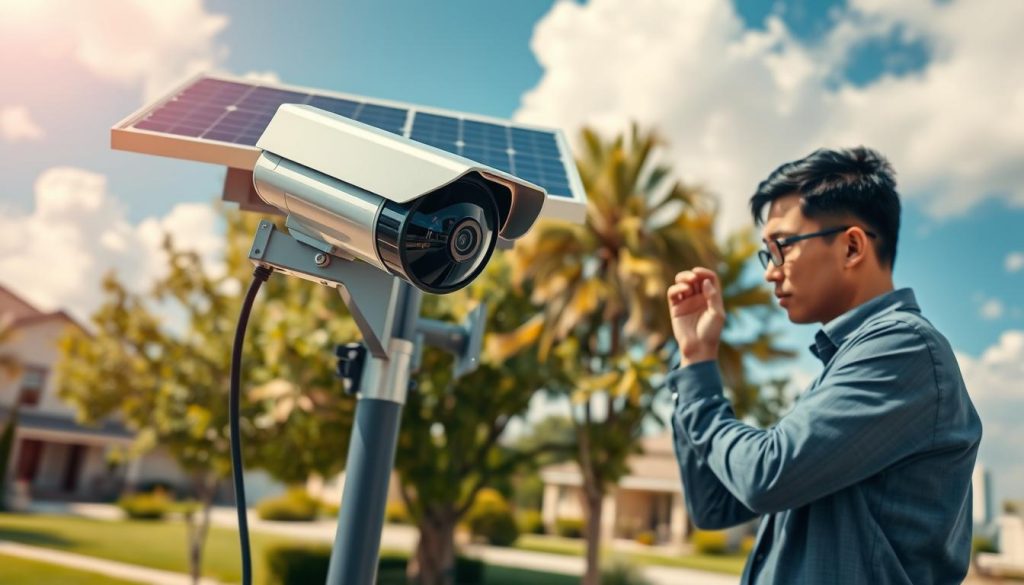
Modern surveillance needs smart solutions. This comprehensive guide explores advanced security systems that offer true independence. We focus on devices combining renewable energy with flexible monitoring.
These units merge three vital technologies. Sunlight powers them for complete energy freedom. Cellular connectivity ensures reliable remote access from anywhere. Pan-tilt-zoom mechanics provide comprehensive area coverage.
For Singapore residents, this technology aligns perfectly with national sustainability goals. The tropical climate offers ample sunlight for consistent performance. This guide will help you choose the right system for your specific needs.
You’ll learn about significant cost savings over traditional wired setups. We’ll examine installation flexibility for challenging locations. The guide also covers maintaining uninterrupted protection in off-grid areas.
We detail core specifications like video resolution and night vision. Battery management for rainy seasons gets special attention. Durability ratings suitable for humid conditions are explained thoroughly.
Our analysis compares top brands available locally, including Dahua and Hikvision. Practical advice covers setup, maintenance, and navigating IMDA regulations. We frame this technology as a future-proof investment for homes and businesses.
Key Takeaways
- These surveillance systems combine solar power, 4G connectivity, and PTZ functionality for complete independence.
- They offer significant long-term cost savings by eliminating wiring and reducing electricity bills.
- Installation is highly flexible, perfect for remote locations, construction sites, or large properties.
- Singapore’s tropical climate provides ideal conditions for solar-powered security performance.
- Key features to evaluate include video resolution, battery capacity, weather resistance, and smart detection.
- Local regulations like IMDA approval for cellular devices and PDPA compliance are important considerations.
- Top brands like Reolink offer models specifically designed for Southeast Asian market conditions.
What is a PTZ Solar Camera 4G and Why It’s a Game-Changer
This technology integrates three critical elements into one cohesive unit. The result is a self-sufficient protection system with remarkable flexibility. It functions independently from local power grids and WiFi networks, making it ideal for various challenging environments.
The Triad of Technologies: Solar, 4G, and PTZ Explained
The first element harnesses renewable energy. High-efficiency photovoltaic panels capture sunlight and convert it into usable electricity. These panels often use monocrystalline cells with efficiency rates reaching 22%.
This generated power charges a high-capacity, modular battery unit. The battery stores energy for continuous operation, even during cloudy periods or at night. This ensures the system remains active through multiple days without direct sun exposure.
The second element provides robust connectivity. Instead of relying on WiFi, the device uses cellular networks for data transmission. In Singapore, this means compatibility with providers like Singtel, M1, or StarHub.
This cellular connection enables reliable live streaming and instant alert notifications. It transmits video data directly to your smartphone or monitoring station. This feature is crucial for locations where traditional internet infrastructure is unavailable or unreliable.
The third element delivers comprehensive visual coverage. Pan-Tilt-Zoom mechanics allow the unit to move horizontally and vertically. It can also zoom in optically to capture fine details from a distance.
This mechanical capability lets one device monitor a vast area. It can track moving subjects automatically with intelligent analytics. The combination creates a dynamic viewing experience far beyond fixed-position units.
Key Components of an All-in-One System
A typical unit combines several physical parts into a streamlined package. The solar panel is the primary power generator, constantly feeding the battery. The battery itself is usually a lithium-ion or AGM type, chosen for durability and capacity.
The main body houses the lens, image sensor, and processing electronics. It’s enclosed in weatherproof housing to withstand outdoor conditions. A sturdy mounting bracket provides secure installation on various surfaces.
Internal components handle connectivity and storage. A SIM card slot accepts a cellular data plan for network access. An SD card slot or built-in storage provides local recording of events and footage.
Smart power management circuitry optimizes energy use throughout the day. It balances charging, operation, and standby modes efficiently. This extends the system’s operational time between charges.
Leading manufacturers like Hikvision design these as consolidated packages. This integration eliminates the need to purchase separate elements. It also reduces installation complexity and potential failure points.
The unified design represents a game-changing approach to property protection. It enables deployment in literally any location with sunlight access. Users gain persistent monitoring without ongoing electricity costs or infrastructure limitations.
Remote controllability from anywhere completes this powerful package. You maintain complete oversight regardless of your physical location. This triad of technologies delivers unprecedented security independence.
The Growing Demand for Solar Security in Singapore
The demand for autonomous, eco-friendly protection systems is surging in Singapore, driven by clear market and regulatory forces. Industry reports highlight a consistent 40% annual growth in adoption. This trend is not just a fad.
It answers a critical need for sustainable, resilient surveillance. The National Environment Agency noted a 70% spike in commercial installations last year. This shift reflects a deeper change in how businesses and homeowners view property safety.
Aligning with Singapore’s Green Plan 2030
This growth aligns perfectly with national ambitions. Singapore’s Green Plan 2030 mandates a push for sustainable infrastructure across all sectors. Eco-friendly security solutions directly support goals to reduce the national carbon footprint.
Government incentives make the choice financially smart. Initiatives like the BCA Green Mark certification reward buildings that integrate green technologies. For many projects, choosing a solar-powered security system can contribute to certification and potential rebates.
It transforms a practical purchase into a strategic one. Homeowners and businesses gain robust protection while supporting Singapore’s environmental vision. This policy framework ensures the trend has long-term staying power.
Overcoming Infrastructure Challenges in Remote and Urban Areas
Beyond policy, sheer practicality fuels demand. Traditional wired setups face major hurdles here. Running power cables and internet lines is often prohibitively expensive or physically impossible.
Remote locations like offshore sites, large farmlands, or nature reserves highlight this challenge. Standalone units that need no wiring provide the only viable solution. They deliver reliable oversight where it was once logistically out of reach.
Urban settings present different but equally tough problems. Installing traditional CCTV in heritage buildings or dense commercial districts poses aesthetic and logistical headaches. Drilling for conduit in these structures can be restricted or costly.
Independent systems eliminate this friction entirely. Installation time and labor costs can be up to 70% lower compared to trenching and configuring network infrastructure. You simply mount the unit in an optimal spot.
Operational reliability is another key advantage. Modern systems are engineered for endurance. High-efficiency batteries allow them to function for up to seven days without direct sunlight.
This ensures continuous operation during Singapore’s occasional monsoon seasons or extended cloudy periods. The technology offers peace of mind that isn’t dependent on perfect weather.
Ultimately, this approach is a pragmatic answer to Singapore’s unique landscape. It solves real-world problems of access, cost, and resilience. Choosing this path is not merely an eco-friendly statement—it’s a decision for superior, uninterrupted security.
Unpacking the Unique Advantages of a PTZ Solar Camera 4G
These systems redefine property security by eliminating the three biggest hurdles: power, connectivity, and installation constraints. The combined benefits create a surveillance solution that works where others cannot. Let’s explore how each advantage translates to practical value for Singapore users.
From complete energy freedom to flexible deployment, the advantages are interconnected. They work together to deliver reliable protection without compromise. This makes the technology suitable for diverse applications across the island.
Complete Energy Independence and Off-Grid Operation
Once installed, a solar-powered security unit generates its own electricity. This eliminates monthly power bills and vulnerability to grid outages. You gain true energy autonomy.
High-efficiency photovoltaic panels capture ample sunlight in Singapore’s tropical climate. They feed large-capacity batteries that store energy for continuous operation. Modern units can sustain surveillance for multiple days without direct sun.
This off-grid capability is crucial during monsoon seasons or extended cloudy periods. Your protection remains active when traditional systems might fail. The technology ensures uninterrupted monitoring regardless of weather conditions.
Battery life management is intelligent. Systems prioritize essential functions to extend operational time. This smart power use maximizes reliability between charging cycles.
Unmatched Installation Flexibility and Cost Savings
Contrast this with traditional CCTV setup. There’s no need for electricians to run conduit and power lines. IT staff aren’t required to configure network switches and WiFi extenders.
The installation process becomes remarkably simple. You save significantly on upfront labor costs. There are zero ongoing energy expenses, leading to a faster return on investment.
“Our all-in-one design gives unparalleled convenience in deployment and maintenance, reducing costs and boosting efficiency.”
Deployment flexibility is another major benefit. These cameras can be mounted on poles, fences, rooftops, or temporary structures. They can be easily relocated as your security needs change.
This is perfect for construction sites, seasonal events, or evolving property layouts. The wireless design adapts to your requirements without expensive re-wiring. It future-proofs your security investment.
Reliable Surveillance Where WiFi Can’t Reach
WiFi networks often struggle outdoors. They have limited range and are susceptible to interference. Signal strength drops with distance and obstacles.
4G LTE connectivity solves these problems. Cellular networks provide consistent data transmission in areas with poor or no WiFi coverage. This ensures real-time alerts and remote viewing are always available.
This reliability is essential for challenging locations. Rural construction sites, coastal properties, and large parks benefit greatly. Even in urban areas with complex layouts, 4G delivers stable connections.
Your monitoring isn’t limited by internet infrastructure. You maintain constant access to live feeds and recorded footage. This consistent connectivity is what makes remote security management truly effective.
Together, these advantages remove traditional barriers to comprehensive protection. They make professional-grade surveillance accessible for virtually any location in Singapore. The technology delivers peace of mind through practical, sustainable solutions.
Core Features to Evaluate in Your Purchase
Smart buyers focus on specific features that determine real-world reliability in Singapore’s climate. Technical specifications translate directly to on-the-ground protection capabilities. This section breaks down the critical components you must assess.
Understanding these metrics ensures your investment delivers consistent performance. We’ll examine imaging quality, energy systems, mechanical range, and physical durability. Each element contributes to overall system effectiveness.
Video Resolution and Low-Light Imaging Capabilities
Image clarity is fundamental for identification. A minimum of 1080p (2MP) resolution is essential for recognizing faces. For capturing finer details like license plates, 4MP or 4K resolution becomes ideal.
Superior sensors make a significant difference. Look for technologies like Sony’s Starvis or Starlight sensors. These provide exceptional low-light performance without excessive noise.
Night vision depends on infrared illuminators and sensor sensitivity. Quality units offer true color night vision in near-dark conditions. Infrared range, often up to 150 meters, determines how far you can see after sunset.
This capability is vital for round-the-clock security. It ensures events are recorded clearly regardless of lighting conditions. Don’t compromise on imaging technology for your protection needs.
Solar Panel Efficiency and Battery Management Systems
The energy system is the heart of autonomous operation. Panel wattage (e.g., 20W vs. 60W) determines charging speed. Monocrystalline cells, with efficiency around 22%, harvest more sunlight in limited space.
Smart controllers optimize this harvest. Maximum Power Point Tracking (MPPT) technology can achieve 92% efficiency. It adjusts electrical characteristics to extract maximum power throughout the day.
Battery capacity, measured in Ah or mAh, dictates operational duration. Chemistry choices matter: Lithium-ion offers light weight, while AGM types provide longer lifespan. Smart management prevents damaging over-discharge.
This intelligent management extends overall battery life significantly. It ensures your unit remains operational through multiple cloudy days. Proper energy design guarantees uninterrupted surveillance.
PTZ Range, Speed, and Auto-Tracking Intelligence
Mechanical movement defines coverage area. Optical zoom power, such as 32x, allows detailed observation from a distance. Digital zoom supplements this but can reduce image quality.
Pan and tilt ranges determine how much physical area one device can monitor. Common specifications include 355° horizontal rotation and 90° vertical movement. Speed settings affect how quickly the unit can follow action.
The most advanced feature is AI-powered auto-tracking. This intelligent function detects and follows moving objects automatically. It transforms a passive recorder into an active monitoring tool.
This combination provides comprehensive visual oversight. A single unit can effectively cover spaces that would require multiple fixed devices. The intelligence adds a proactive layer to your security strategy.
Durability: Understanding IP and IK Ratings for Tropical Climates
Singapore’s environment demands robust construction. IP (Ingress Protection) ratings indicate resistance to dust and water. IP66 means dust-tight and resistant to powerful water jets.
Higher ratings like IP67 or IP68 offer temporary immersion protection. This is crucial for surviving heavy monsoon rains and high humidity. The housing must withstand constant moisture exposure.
IK (Impact Protection) ratings measure vandal resistance. IK10 represents protection against 20 joules of impact energy. This is important for units installed in accessible locations.
Materials must also resist corrosion from salt spray near coasts. UV-resistant components prevent degradation from intense sun exposure. These ratings directly relate to long-term reliability in tropical conditions.
Prioritize features based on your specific scenario. A construction site may need higher impact resistance. A large farm might benefit more from long-range zoom capabilities.
Understanding these core features empowers your purchasing decision. You can match technical specifications to your actual security requirements. This ensures you select the optimal system for your Singapore property.
Ensuring Optimal Performance: Installation and Positioning
Correct installation transforms advanced technology into practical, day-to-day protection. Where and how you place your equipment directly impacts its effectiveness. This section provides actionable guidelines for maximizing your system’s capabilities.
Following these recommendations ensures reliable operation in Singapore’s environment. You’ll achieve the best possible security coverage and energy harvest. Proper setup is an investment that pays dividends in consistent performance.
Solar Panel Placement for Maximum Sun Exposure
Your panel’s position determines how much energy it generates. For maximum efficiency, it needs an unobstructed view of the sky. Even partial shading can significantly reduce power output.
In Singapore, face the photovoltaic unit toward true north. This orientation captures the most sunlight throughout the year. An optimal tilt angle of approximately 23° balances seasonal sun variation.
This angle also helps with self-cleaning during rain showers. Avoid placing the unit under trees or near tall buildings. Shade can reduce energy harvest by 30% or more during monsoon seasons.
Use tools like the SolarSurveyor app to analyze sun paths at your location. This helps identify potential obstacles at different times of day. Proper planning prevents energy shortages later.
Ensure mounting poles or brackets can withstand loads up to 50kg during storms. Secure installation prevents damage from strong winds. Your energy source must remain stable in all weather conditions.
Strategic Camera Mounting for Comprehensive Coverage
Mounting height is critical for both security and field of view. Install your surveillance unit at least 3 meters high. This prevents tampering while providing a broader perspective.
However, avoid placing it so high that facial recognition becomes difficult. Find a balance between safety and identification capability. The right height maximizes your equipment’s usefulness.
Position your ptz camera to cover primary entry points first. Then address valuable assets and known blind spots. Utilize its full pan and tilt range to maximize area coverage.
One well-placed unit can often monitor spaces needing multiple fixed devices. Strategic positioning reduces equipment costs while improving oversight. Think about coverage patterns before finalizing locations.
Use galvanized or stainless steel brackets and poles for durability. These materials resist corrosion in humid conditions. Proper grounding to Singapore’s SS 555 standards provides lightning protection.
Conduct a thorough site survey before beginning installation. Plan cable runs between the panel and main unit if they’re separate. Assess sun exposure at different times to identify potential obstacles.
Check for growing vegetation that might block views or shade panels later. Consider seasonal changes in your environment. Forward-thinking placement prevents future problems.
Remember that proper setup isn’t a one-time task. Schedule periodic checks to ensure panels remain clean and unobstructed. Verify that the camera’s view hasn’t been blocked by new growth or structures.
This maintenance routine preserves optimal performance over time. Your initial installation effort continues paying off through reliable operation. Good positioning is the foundation of lasting security.
Long-Term Reliability: Maintenance and Upkeep
Your security system’s long-term effectiveness depends on consistent, simple upkeep practices. While these units are designed for minimal intervention, a basic maintenance routine prevents performance degradation. This ensures your investment continues to deliver reliable protection year after year.
Neglecting these tasks is the most common reason for premature system failure. A small amount of regular attention preserves image clarity and energy independence. Let’s explore the essential schedule that keeps everything running smoothly.
Routine Cleaning and System Health Checks
Dust and debris are the main enemies of efficiency. Clean your photovoltaic surface every month or two. Use a soft microfiber cloth with water to remove dust, pollen, and bird droppings.
A dirty panel can lose over 30% of its energy harvesting capability. This directly impacts how long your unit operates between charges. Keep it clear for maximum power generation.
The lens and infrared illuminator window also need attention. After rainy or dusty periods, gently wipe them with a soft cloth. A small amount of isopropyl alcohol can remove stubborn grime without damaging coatings.
Clear optics are vital for sharp daytime video and effective night vision. Cloudy lenses make identification difficult. Regular cleaning maintains optimal image quality.
Schedule a thorough physical inspection every three months. Check all cable connections for corrosion or looseness. Ensure mounting brackets remain tight and secure.
Inspect the housing for any cracks or seal degradation. Test alarm triggers and motion detection zones. These quick checks catch small issues before they become big problems.
Battery Lifespan and Replacement Cycles
The energy storage component has a finite operational life. Lithium-ion batteries in these security systems typically last three to five years. AGM (Absorbent Glass Mat) batteries offer seven to ten years but are heavier.
Monitor your battery’s health through the device’s management software. Most apps display current capacity and estimated runtime. Replace the unit when capacity drops below 50% of its original rating.
Watch for warning signs of failure. Reduced standby time is a clear indicator. If your system struggles to operate through the night, the battery likely needs attention.
Software notifications about low power or charging issues are direct alerts. Don’t ignore these warnings. They help you plan replacement before complete failure occurs.
Proactively replace lithium batteries every three to four years. Doing this before the monsoon season avoids unexpected downtime. Keep a spare on hand for quick swaps.
Software maintenance is equally important. Update your device’s firmware twice a year. Manufacturers release patches for security vulnerabilities and system stability.
Updates can also add new features and improve existing functions. This digital upkeep keeps your protection current with technological advances. It’s a simple step with significant benefits.
Following this maintenance plan maximizes your equipment’s service life. Your surveillance remains dependable through Singapore’s humid climate and seasonal changes. Consistent care is the key to uninterrupted security.
Comparing Top Models: Dahua, Hikvision, and Reolink
Dahua, Hikvision, and Reolink each bring distinct advantages to solar-powered surveillance. Understanding their differences helps you select the ideal system for your Singapore property. This comparison focuses on practical specifications and real-world performance.
We analyze representative models from each manufacturer. Key factors include optical capabilities, smart detection, and durability. Your choice should align with both budget and security requirements.
Feature Breakdown: Zoom, Resolution, and Smart Analytics
Optical zoom determines how closely you can observe distant subjects. Dahua’s SD6C3432XB model offers impressive 32x magnification. This allows detailed identification from hundreds of meters away.
Hikvision’s DS-2XS2T47G1-LDH provides even greater 47x optical capability. Such powerful zoom is ideal for monitoring large estates or commercial sites. It captures fine details without compromising image quality.
Sensor resolution affects overall clarity. The Dahua unit records at 4MP, delivering sharp 1440p video. Reolink’s Go PT Plus uses a 2MP sensor, suitable for general residential monitoring.
Premium models feature advanced AI analytics. These systems distinguish between people, vehicles, and animals. This reduces false alarms from leaves or shadows.
Basic motion detection appears in budget-friendly options. While functional, it lacks the precision of AI-powered analysis. Smart analytics transform passive recording into active threat assessment.
Low-light performance varies significantly between brands. High-end units employ specialized sensors for color night vision. Budget models typically rely on black-and-white infrared imaging.
Connectivity options also differ. Support for local 4G LTE bands ensures compatibility with Singtel, StarHub, and M1. Dual-SIM capabilities provide network redundancy for critical installations.
Integration with video management software is another consideration. Professional systems often work with third-party VMS platforms. Consumer-focused models typically use proprietary mobile apps.
Budget-Friendly vs. Premium Professional Options
Price ranges reflect different target markets. Residential units often cost between SGD $300 and $500. These systems meet basic home security needs effectively.
Commercial-grade equipment starts above SGD $1,000. This investment buys superior components and extended durability. Such models handle 24/7 operation in demanding environments.
Build quality shows clear differences. Premium housings use aluminum alloy for strength and heat dissipation. Budget versions frequently employ high-grade plastics.
Ingress protection ratings indicate weather resistance. Professional models typically achieve IP67 or higher. They withstand Singapore’s heavy monsoon rains and high humidity.
Impact protection is equally important. IK10 ratings on premium units resist vandalism and accidental damage. This is crucial for publicly accessible installations.
After-sales support varies by brand. Warranty periods offer insight into manufacturer confidence. Dahua provides three years of coverage for its products.
Hikvision extends this to five years for greater peace of mind. Reolink also offers five-year warranties specifically for Singapore customers. Local technical support availability is another key factor.
Firmware updates maintain system security and functionality. Regular updates address vulnerabilities and add features. Premium brands often provide more frequent and longer-term support.
Choose Dahua for exceptional optical zoom and professional VMS integration. Their systems suit large properties needing detailed distance observation.
Select Hikvision for all-in-one kit convenience and extended warranty protection. Their packages simplify deployment with comprehensive components.
Opt for Reolink when seeking user-friendly apps and excellent value. Their solutions work well for residential applications with straightforward needs.
Each brand serves different segments of the security market. Your decision should balance immediate costs with long-term reliability. Consider both technical specifications and support infrastructure.
Cost Analysis: Initial Investment vs. Long-Term Savings
The true value of autonomous surveillance becomes clear when examining both upfront investment and long-term operational savings. This financial perspective reveals why sustainable security solutions offer compelling economic advantages. Understanding total ownership costs helps buyers make informed decisions for their property protection needs.
Breaking Down the Total Cost of Ownership
Your initial investment includes several key components. The security unit itself represents the primary purchase. You’ll also need mounting accessories and a cellular data SIM card with an appropriate plan.
Professional installation adds to upfront costs if you choose not to DIY. Compare this directly with traditional wired surveillance setups. Those require expensive electrical wiring, conduit, and network cabling.
Labor charges for traditional installations are significantly higher too. The total cost of ownership for installation is often 70% lower with autonomous systems. This immediate saving makes the technology accessible for various budgets.
Long-term operational savings provide even greater value. There are zero electricity consumption costs from the grid. Maintenance expenses remain minimal compared to wire repair and replacement.
Scalability becomes straightforward without new infrastructure needs. Adding more units doesn’t require complex electrical work. This flexibility supports growing security requirements efficiently.
A five-year Total Cost of Ownership analysis shows clear patterns. The higher initial purchase price of sustainable systems gets offset quickly. Year-on-year savings typically create a break-even point within 14 to 18 months.
After this period, the technology delivers pure financial advantage. Ongoing operation costs remain near zero. This economic model makes sustainable protection a smart financial decision.
Government Incentives and Rebates in Singapore
Singapore offers specific financial incentives that reduce net costs further. The Building and Construction Authority’s Green Mark 2021 program provides cash rebates. Certified installations can qualify for up to SG$5,000 in support.
This initiative rewards sustainable building practices across the island. Security systems that harness renewable energy align perfectly with these goals. The rebates directly lower your effective investment amount.
“Sustainable security installations contribute directly to our national green building targets, offering both environmental and economic returns.”
Other subsidy programs add additional value. The Productivity Solutions Grant supports technology adoption for businesses. IMDA’s Tech Depot lists approved products eligible for various subsidies.
Enterprises may also qualify for carbon credit generation. This aligns corporate security investments with sustainability objectives. The credits create tangible value beyond basic protection.
Factor these incentives into your budgeting process from the start. Work with installers familiar with application procedures. They can help maximize your savings through proper documentation.
The combined effect of incentives and operational savings creates a powerful case. Sustainable security delivers protection while supporting Singapore’s green environment. This dual benefit represents true value for money.
Ideal Applications and Use Cases
The versatility of self-powered surveillance systems shines brightest when applied to real-world scenarios across Singapore. These independent monitoring solutions address diverse protection challenges that traditional wired setups cannot solve.
From landed homes to remote construction sites, each application highlights unique advantages. Understanding where these units deliver maximum value helps property owners make informed security decisions.
Residential Property Protection for Landed Homes
Landed houses and bungalows with extensive grounds benefit greatly from wire-free surveillance. Running cables across large properties is often disruptive and expensive.
Self-powered units provide perimeter security without trenching through gardens or driveways. They monitor pool areas, garden sheds, and boundary fences effectively.
Condominiums with large common areas also find these systems valuable. Management can secure recreational facilities and parking lots without complex electrical work.
The pan-tilt-zoom functionality allows one device to cover substantial outdoor space. This reduces the number of units needed for comprehensive monitoring.
Commercial and Industrial Sites
Construction locations represent perfect use cases for temporary security needs. These sites have valuable equipment and materials but lack established power infrastructure.
Theft prevention becomes manageable without running temporary electrical setups. Supervisors can also monitor safety compliance from remote offices.
Agricultural operations like farms utilize these systems for multiple purposes. They watch for trespassers while tracking livestock movement across large plots.
Warehouses and logistics yards secure their perimeters in areas without established power. The cellular connectivity ensures reliable monitoring regardless of location.
Remote and Temporary Locations
Festivals, public parks, and pop-up markets need fast-deployment security solutions. These events require crowd control and asset protection for limited durations.
Organizers can set up monitoring quickly without permanent infrastructure. After the event, they easily remove the entire system.
Highway sections prone to vandalism or accidents benefit from remote surveillance. Authorities monitor trouble spots without expensive cabling projects.
Nature reserves use these units for anti-poaching efforts and fire detection. The technology minimizes physical disruption in environmentally sensitive areas.
Government applications include monitoring remote reservoirs and offshore installations. Coastal areas without power access gain reliable oversight capabilities.
The mechanical movement feature proves particularly valuable in these scenarios. One surveillance unit can cover an entire construction site or farmland plot.
This reduces equipment costs while maintaining comprehensive visual coverage. The intelligent tracking follows movement across wide areas automatically.
Environmental considerations make these systems ideal for Singapore’s conservation efforts. They eliminate trenching and physical disruption in protected zones.
The technology aligns with sustainable development goals while providing robust protection. This dual benefit appeals to both private and public sector users.
Ultimately, self-powered surveillance offers a universal solution for any location. It works where traditional infrastructure is unavailable or impractical.
From residential gardens to remote highways, the applications demonstrate true versatility. Property owners gain reliable monitoring without limitations.
Navigating Singapore-Specific Considerations
Operating surveillance equipment in Singapore requires careful attention to both legal frameworks and environmental realities. Local regulations and tropical conditions create specific requirements that impact system selection and deployment.
Understanding these factors ensures your protection setup remains compliant and reliable. This section details the essential compliance steps and hardware specifications for Singapore’s unique context.
Regulatory Compliance: IMDA Approval and PDPA
All telecommunications devices in Singapore must meet Infocomm Media Development Authority standards. This includes any unit using cellular connectivity for data transmission.
IMDA type approval ensures equipment doesn’t interfere with local networks. It also verifies technical compatibility with Singapore’s telecommunications infrastructure.
You can verify a product’s approval status through several methods. Look for the official IMDA label on the device or its packaging.
Consult the online IMDA database for registered equipment models. Reputable suppliers should provide certification documents upon request.
The Personal Data Protection Act governs information collection through surveillance. If your units capture public spaces or identifiable individuals, specific obligations apply.
You must notify people of monitoring through clearly visible signs. Secure all recorded information against unauthorized access or disclosure.
Best practices for PDPA compliance include several key measures. Implement encryption for stored video files and data transmissions.
Establish access logs tracking who views recorded footage. Create clear policies for data retention and scheduled deletion.
These steps protect both your security interests and individual privacy rights. Proper compliance avoids potential legal issues while maintaining effective monitoring.
Essential Climate Adaptation Features for Humidity and Rain
Singapore’s tropical environment demands robust hardware specifications. Equipment must withstand high humidity, heavy rainfall, and intense heat.
Ingress Protection ratings indicate weather resistance capabilities. A minimum IP66 rating provides protection against powerful water jets.
For optimal durability, select units with IP67 or IP68 certification. These withstand temporary immersion during monsoon downpours.
Impact Protection ratings measure physical durability. IK10 certification resists vandalism and accidental damage in accessible locations.
Material choices significantly affect long-term performance. Aluminum alloy housings offer excellent corrosion resistance.
Marine-grade stainless steel (316L) provides superior protection in coastal areas. These materials withstand salt spray and constant moisture exposure.
Thermal management becomes critical in Singapore’s heat. Units should operate reliably at temperatures exceeding 35°C regularly.
Adequate ventilation prevents internal component overheating. Look for designs with heat dissipation features in the housing.
Built-in drainage channels address humidity-related issues. These prevent water accumulation inside the unit’s casing.
Drainage systems reduce fungus growth on internal components. This common problem in humid environments can impair lens clarity and sensor performance.
Hydrophobic lens coatings offer additional protection. They repel water droplets and reduce condensation buildup.
These climate adaptation features ensure consistent operation year-round. Your investment remains protected against environmental challenges specific to Singapore.
Common Buyer Mistakes and How to Avoid Them
Even the most advanced security technology can fail if buyers make preventable errors during selection and purchase. These mistakes often lead to frustrating downtime and compromised protection. Understanding common pitfalls helps you invest wisely in reliable surveillance.
Two areas deserve special attention for Singapore buyers. Energy system specification directly impacts year-round operation. Support network selection affects long-term maintenance and reliability.
Underspecifying Battery Capacity for Monsoon Seasons
A critical error involves underestimating energy storage needs. Buyers often choose a system with insufficient battery capacity. This leads to failures during Singapore’s December monsoon season with consecutive cloudy days.
For reliable year-round operation, specify a battery with minimum 40Ah capacity. Pair it with a photovoltaic panel that can recharge fully within one to two sunny days. This combination ensures continuous performance during extended poor weather.
Battery life depends on both capacity and smart management. Quality systems include controllers that optimize charging and discharge cycles. They prevent damaging deep discharge that shortens component lifespan.
Another mistake involves purchasing non-tropicalized equipment. Units designed for milder climates lack adequate sealing or cooling. Singapore’s constant high humidity and heat demand specialized construction.
Look for housings with proper drainage channels and ventilation. These features prevent internal condensation and overheating. Your investment must withstand local environmental challenges.
Overlooking Local Warranty and Support Networks
Purchasing from unauthorized or overseas sellers creates significant risks. These products often lack IMDA approval for Singapore networks. They may use incompatible frequency bands for cellular connectivity.
Most importantly, gray-market imports have no valid local warranty. Buyers face difficulties obtaining repairs or replacement parts. Firmware updates and technical support become unavailable.
A local warranty from an authorized Singapore dealer provides essential protection. It ensures access to repairs and professional assistance. Many reputable suppliers offer 72-hour response guarantees for urgent issues.
Always verify installer credentials through established directories. Organizations like SPRING Singapore maintain qualified professional listings. This verification ensures proper installation and system configuration.
Many buyers overlook ongoing data plan expenses. Not factoring in 4G SIM card costs leads to unexpected monthly bills. Choose a plan with sufficient data for your monitoring needs and streaming preferences.
The simplest way to avoid these pitfalls involves requesting a professional site survey. Reputable vendors will assess your location’s specific conditions. They design solutions matching actual environmental and security requirements.
This proactive approach prevents specification errors before purchase. You gain confidence that your system will deliver consistent, uninterrupted protection. Smart planning today avoids costly corrections tomorrow.
The Critical Role of 4G Connectivity in Modern Surveillance
The backbone of any remote monitoring solution lies in its ability to maintain a constant, secure data connection. For property protection that operates independently from wired infrastructure, this connectivity becomes the essential link between the unit and the user.
It transforms recorded footage into actionable intelligence delivered in real time. Understanding the strengths of cellular networks versus traditional WiFi is crucial for reliable performance.
Superior Reliability Compared to WiFi in Outdoor Settings
Standard wireless internet faces significant challenges in exterior environments. Its effective range often drops below 50 meters outdoors. Physical obstacles like walls and dense foliage can completely block the signal.
Interference from other electronic devices further degrades performance. This creates unreliable links that may drop video feeds or delay critical alerts.
Cellular LTE networks provide a robust alternative. Singapore’s extensive mobile coverage ensures a strong signal almost anywhere on the island. From urban centers to remote coastal areas, consistency remains high.
This network delivers sufficient bandwidth for streaming high-definition video. Average latency measures around 68 milliseconds. That’s fast enough for real-time monitoring and responsive mechanical control.
Security is another major advantage. Cellular connections are typically encrypted end-to-end by the network itself. This creates a secure channel for video data transmission.
It offers protection superior to potentially vulnerable home or business WiFi networks. Your surveillance information remains private and protected during transit.
Choosing the Right Data Plan for Continuous Monitoring
Selecting an appropriate cellular plan ensures uninterrupted operation. Local carriers like Singtel, StarHub, and M1 offer dedicated Machine-to-Machine SIM options.
These M2M plans start from approximately $4.99 per month. They are cost-effective for continuous, low-to-medium bandwidth usage. This makes them ideal for surveillance applications.
Estimating your data consumption is the first step. A unit streaming 1080p video continuously may use 1 to 2 gigabytes daily. Event-based recording significantly reduces this usage.
For most single-device setups, a plan with 50 to 100 gigabytes monthly is suitable. This provides ample capacity for live viewing and recorded event playback. It avoids unexpected overage charges.
Technical configuration ensures a stable link. You must correctly set the Access Point Name in your device’s settings. For Singtel networks, this APN is typically “e-ideas”.
Other providers have similar specific settings. Proper configuration allows the unit to authenticate on the mobile network. This step is essential for establishing a reliable connection.
Cellular connectivity is not merely a backup option. For professional-grade, location-independent surveillance, it serves as the primary method. It delivers the reliability that modern protection demands.
When planning your comprehensive security solutions, prioritize this robust data transmission. It ensures your investment delivers consistent, real-time oversight regardless of location.
Future-Proofing Your Security Investment
Protecting your property today means planning for the surveillance needs of tomorrow. Technology evolves rapidly, and your protection setup should adapt rather than become obsolete. Future-proofing involves selecting solutions designed for growth and improvement over years of service.
This approach protects your initial financial outlay. It ensures your monitoring remains effective against emerging threats. Smart planning today prevents costly replacements tomorrow.
Modular Designs for Easy Upgrades and Expansion
Look for protection systems with a modular architecture. This means individual components can be upgraded separately. The photovoltaic unit, energy storage, imaging module, and communication parts work as independent units.
Such design offers significant long-term benefits. In three years, you could install a more efficient energy panel. You might add a higher-capacity battery without replacing the entire surveillance unit.
This modularity protects your initial investment substantially. It allows incremental improvements as technology advances. You avoid the expense and disruption of complete system overhauls.
Manufacturers now offer this flexible approach. Components use standardized connectors and mounting systems. Upgrades become straightforward plug-and-play operations rather than technical challenges.
Consider how your needs might change. A residential property might expand with new structures. A business could require additional coverage areas as operations grow.
Modular systems accommodate these changes gracefully. You add components rather than starting from scratch. This scalability makes financial and practical sense for Singapore properties.
Emerging Technologies to Keep on Your Radar
Several innovations will shape monitoring solutions in coming years. Understanding these trends helps you choose adaptable platforms today. Your selection should accommodate tomorrow’s advancements.
Edge computing represents a major shift. Future units will have more onboard processing power. They’ll run advanced analytics locally rather than in the cloud.
This includes facial recognition or anomaly detection algorithms. Local processing reduces bandwidth needs dramatically. It also improves response times for critical alerts.
Connectivity standards continue evolving. While 4G remains viable for years, 5G offers higher bandwidth and lower latency. Your system should support emerging network technologies as they become practical.
Imaging technology advances constantly. Multi-spectral sensors combine thermal imaging with visual light. They detect intrusions in complete darkness or through light foliage.
These sensors identify heat signatures regardless of lighting conditions. They provide another layer of detection capability. This technology is particularly valuable for perimeter security.
Integration capabilities deserve careful attention. Choose surveillance units that support open APIs or standard protocols like ONVIF. This ensures compatibility with future video management systems.
Your protection setup should work with smart home or office ecosystems. Open standards prevent vendor lock-in. They maintain flexibility as your overall technology environment evolves.
Renewable energy integration expands beyond photovoltaic panels. Small wind turbines or hydrogen fuel cells may complement solar harvest. These alternatives suit extremely challenging environments with limited sunlight.
Singapore’s research institutions actively develop these technologies. Your system’s architecture should accommodate such innovations. This prepares your investment for next-generation power solutions.
Think of your security as a five-to-ten-year commitment. The platform you choose must adapt to incorporate new capabilities. This forward-thinking approach maintains effectiveness throughout the system’s lifespan.
Your vigilance today ensures uninterrupted protection tomorrow. Smart planning delivers peace of mind that lasts.
Making Your Final Decision: A Step-by-Step Checklist
A methodical decision-making process ensures your security investment delivers optimal protection for years to come. Following a structured approach transforms technical specifications into reliable, real-world surveillance. This checklist guides you from initial assessment to confident purchase.
Assessing Your Site’s Specific Needs and Challenges
Begin with a comprehensive evaluation of your property. Understand the unique conditions that will impact your surveillance system’s performance.
First, conduct a thorough site survey. Map the entire area requiring coverage and identify critical zones. These include entry points, valuable assets, and known blind spots.
Assess sun exposure patterns throughout the day and across seasons. Note any physical obstructions like trees or buildings. This analysis determines optimal panel placement for maximum energy harvest.
Second, define your primary and secondary security objectives. Is the main goal theft deterrence, remote asset monitoring, or safety compliance? Clear objectives dictate which features become priorities.
Third, calculate precise power requirements. Consider the unit’s consumption rate and required hours of operation. Account for Singapore’s monsoon season with consecutive cloudy days.
Determine minimum photovoltaic panel wattage and battery capacity. This ensures uninterrupted operation during challenging weather periods. Proper energy planning prevents system failures.
Prioritizing Features Based on Your Primary Use Case
With your site assessment complete, focus shifts to selecting the right equipment. Match technical specifications to your specific application scenario.
Establish a realistic budget that includes all components. Factor in the surveillance unit, mounting hardware, and professional installation fees. Don’t forget ongoing cellular data plan expenses.
Research and shortlist two or three models from reputable brands. Use comparisons from this guide to identify suitable options. Ensure they meet both technical requirements and financial constraints.
Verify regulatory compliance and local support networks. Check for IMDA approval on all shortlisted devices. Review warranty terms from authorized Singapore distributors.
Read reviews about after-sales service experiences in Singapore. Local warranty coverage provides essential protection for your investment. It ensures access to repairs and technical assistance when needed.
Prioritize features according to your primary use case. Remote farmland monitoring demands exceptional battery life and long zoom range. Rainy urban installations require superior weather resistance.
Consult with a professional installer for final assessment. Authorized technicians can spot issues you might have missed. They ensure optimal system design and configuration.
Make your purchase from an authorized dealer to secure full warranty benefits. This step protects against gray-market imports without local support. Your decision now leads to years of reliable protection.
Following this structured approach eliminates guesswork from your selection process. Each step builds toward a surveillance solution tailored to your property. The result is sustainable security that meets both current and future needs.
Your Path to Sustainable and Uninterrupted Security
Embracing energy-independent protection marks a decisive step toward resilient property oversight. This approach merges practical security with environmental responsibility.
You gain complete surveillance freedom without power or internet constraints. The long-term savings and climate resilience make it a smart choice for Singapore.
Your investment supports national sustainability goals while delivering reliable protection. It future-proofs your property against evolving threats and infrastructure changes.
Start with a single unit to test performance in your specific environment. Then expand your coverage as you see the benefits firsthand.
Contact reputable local integrators specializing in solar-powered solutions. Begin your journey toward truly autonomous security today.